

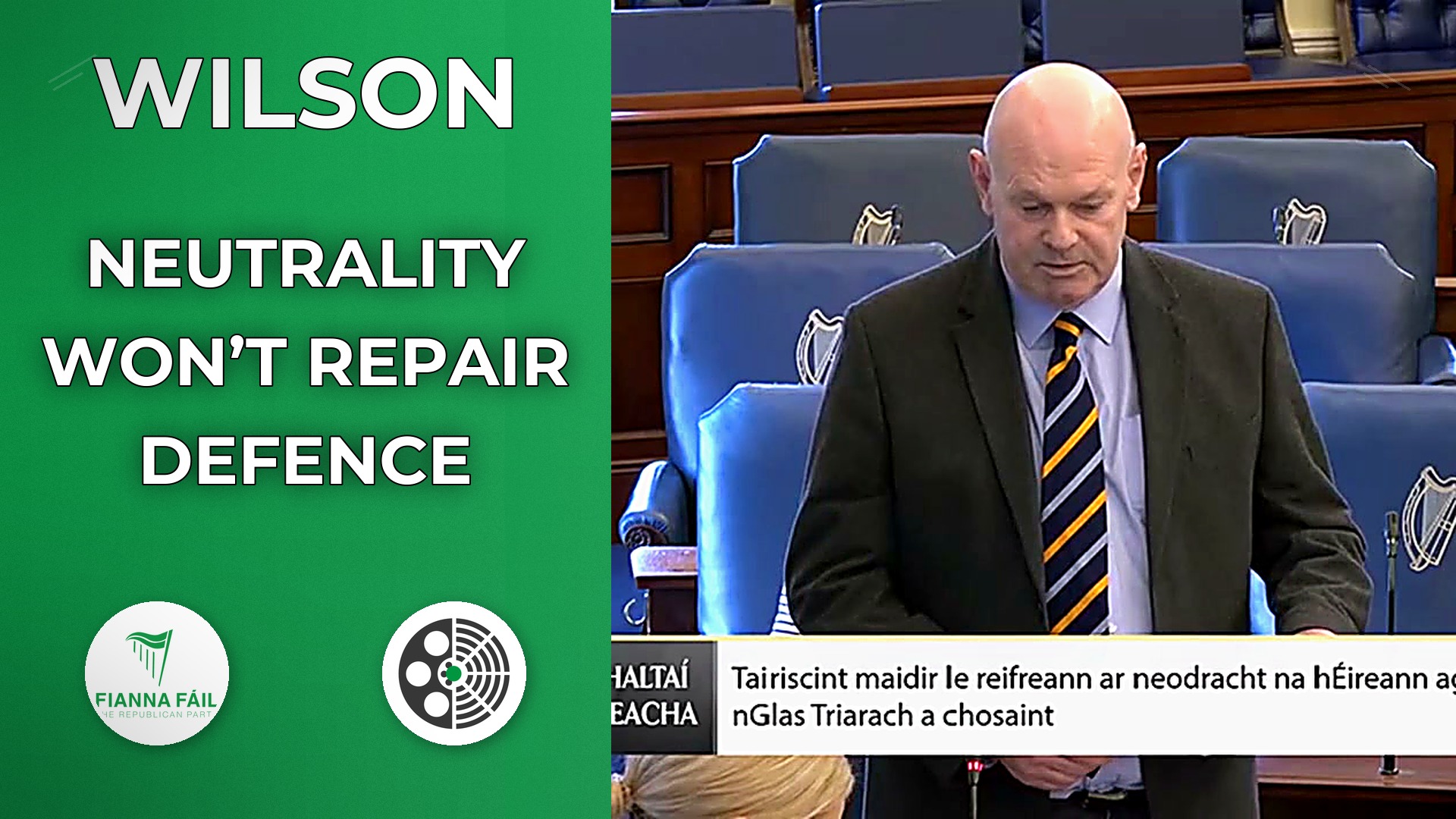


Diarmuid Wilson: Neutrality Debate Must Focus on Defence Capacity
Senator Diarmuid Wilson spoke in Seanad Éireann during a debate on Ireland’s military neutrality and the Defence Forces. He argued that a constitutional definition of neutrality would not address recruitment, equipment or security needs, and called for faster progress towards the Defence Forces’ Level of Ambition 2+ commitment.
Wilson seconded an amendment to Senator Clonan’s motion and said the target of 11,500 permanent Defence Forces personnel by 2028 would not be met. He said reaching 7,500 to 8,000 personnel by then would be a strong result, and also highlighted the planned growth of the Reserve Defence Force.
Wilson said he did not support putting a rigid definition of neutrality into the Constitution. He stated that there was no proposal to abandon Ireland’s policy of military neutrality or to join a military alliance or mutual defence arrangement. He argued that Article 29 already affirms Ireland’s commitment to peace and international cooperation, while constitutional rules should not restrict future governments’ responses to unforeseen security threats.
Wilson said a referendum would not resolve practical gaps in patrol vessels, cyber capacity, airspace monitoring, recruitment, retention or equipment. He welcomed the budget announcement of a 1.6 billion investment in 2027, including recruits, cyber and maritime security, helicopters, radar and military facilities, and called for closed barracks to be reopened, specifically naming Dooney Neal Army Barracks in Calvintown.
Wilson also raised the Triple Lock and the ability to deploy troops, contrasting the requirement for United Nations sanction for deployments of more than 12 troops with the constitutional provision for Dáil Éireann to approve a declaration of war. Watch the recording to hear the full contribution.
Defence targets and recruitment
Wilson seconded an amendment to Senator Clonan’s motion and said the target of 11,500 permanent Defence Forces personnel by 2028 would not be met. He said reaching 7,500 to 8,000 personnel by then would be a strong result, and also highlighted the planned growth of the Reserve Defence Force.
Neutrality and the Constitution
Wilson said he did not support putting a rigid definition of neutrality into the Constitution. He stated that there was no proposal to abandon Ireland’s policy of military neutrality or to join a military alliance or mutual defence arrangement. He argued that Article 29 already affirms Ireland’s commitment to peace and international cooperation, while constitutional rules should not restrict future governments’ responses to unforeseen security threats.
Investment and military facilities
Wilson said a referendum would not resolve practical gaps in patrol vessels, cyber capacity, airspace monitoring, recruitment, retention or equipment. He welcomed the budget announcement of a 1.6 billion investment in 2027, including recruits, cyber and maritime security, helicopters, radar and military facilities, and called for closed barracks to be reopened, specifically naming Dooney Neal Army Barracks in Calvintown.
The Triple Lock
Wilson also raised the Triple Lock and the ability to deploy troops, contrasting the requirement for United Nations sanction for deployments of more than 12 troops with the constitutional provision for Dáil Éireann to approve a declaration of war. Watch the recording to hear the full contribution.
We publish thousands of recordings to make Irish politics transparent and resistant to manipulation. Spotted an error? Report it — together we are building a reliable archive of Irish politics.
Other speeches
Tego samego dnia All speeches from this day →
Victor Boyhan
Victor Boyhan Seeks Inheritance Tax Review for Childless Farmers
Joe O'Reilly
Joe O'Reilly Seeks Fix to Carers Benefit Anomaly
Victor Boyhan
Victor Boyhan on Defence Forces and Irish neutrality
Barry Ward
Barry Ward Challenges ‘Betrayal’ Rhetoric in Budget Debate
Simon Harris
Simon Harris: Budget 2027 to protect households and plan ahead
Helen McEntee
Helen McEntee sets out Budget 2027 aid and defence investment
Transcript
Thank you very much, Laska. Here, look, I want to welcome you, Minister, to the House
and welcome this debate. I want to thank Senator Clonan and his colleagues for tabling this
motion and indeed, I want to say at the outset, there's quite a bit of that that I would
personally agree with. However, I stand here today to second our amendment to Senator Clonan's
motion. And I think one of the things that I do agree with Senator Clonan and his colleagues
on is that we need to have a united and focused approach across all sides of this House on
insisting that the government do more to deliver on commitment ambition number two on the commission
of the defence forces. And as I said, I share the concerns expressed by the signatures
of Senator Clonan's motion that we will not meet that target of 2028 of achieving 11,500
permanent members of our defence forces. It is not going to be achieved. In fact, if we
7,500 to 8,000 by 2028, we'll be doing very, very well. And that is also I want to mention
in that regard, the reserve defence forces, who are also included in the commission of
the defence forces, and who tend to be forgotten about when the numbers are mentioned of 11,500
by 2028. My understanding is that our ambition is to bring the reserve up to 4,000
by the early 2030. So it's important to bear that in mind as well.
Where I must depart, Senator Clonan, from you and your honourable colleagues, is whether the
best way to protect Ireland's traditional policy of neutrality while having the capacity to respond
to changing circumstances is to place a rigid and potentially
ambiguous definition of neutrality into the constitution. The government's view,
and indeed my own personal view, is that it is not. There is no personal proposal to abandon
Ireland's policy of military neutrality. There is no proposal by this government and by my party,
in particular, to abandon Ireland's policy of military neutrality.
And Ireland is not seeking membership of a military alliance.
Nor are we proposing to enter a common or mutual defence arrangement.
Our commitment to the United Nations Charter and our national interests is non-negotiable.
I strongly believe the constitution, via Article 29, already affirms Ireland's devotion
to peace and friendly cooperation among nations founded on international justice and morality.
That constitutional framework is important, but it should not be converted into a political
instrument that limits the ability of democratically elected governments to respond
to new and unforeseen security circumstances. A constitutional amendment cannot anticipate
every future threat, and I know that you're going to cover that in your response, Senator
Clonin. It cannot predict the nature of the next crisis, the next form of hybrid interference,
the next attack on undersea infrastructure, or the next challenge to our airspace, maritime
approaches, cyber networks or critical national systems. We should also be honest about what a
referendum would not achieve. It would not put a single extra patrol vessel to sea. It would not
recruit a single extra engineer, radar operator, cyber specialist or aircraft technician. It would
not protect a single subsea cable, monitor our airspace or improve the capacity of our reserve
defence forces. It would not solve the recruitment and retention problems facing the defence forces
and it would not deliver the modern equipment and infrastructure that Ireland urgently needs.
Those are the challenges we must confront, colleagues. The Commission on the Defence Forces
made clear that Ireland must move beyond the limited capacity associated with level of ambition
one. The government has accepted that report and committed to achieve a level of ambition two
plus by 2028. I think we have to be honest with each other. That is not going to be achieved. We
have to be honest with each other in this House. That is not going to be achieved and delivery on
that commitment must be stepped up and we must, every one of us in this House, has an obligation
to ensure that it is. I welcome yesterday's announcement in the budget of a £1.6 billion
investment in 2027, 850 new defence force recruits, enhanced cyber and maritime security,
new helicopters and radar and the modernisation of military facilities. I would also like to add
to that, Minister, when you are here, I want to see the reopening of some of the barracks that
were closed throughout the country, which I think had a detrimental effect on recruitment and
retention to our defence forces, and especially I want to mention Dooney Neal Army Barracks in
Calvintown, which was one of two purpose-built facilities by the defence forces in the history
of our state. It is there in Calvintown, ready to be reopened and play its part in the defence
of our nation. My time is up now, and I did not get to finish what I had to say, but
just a slight clarification, Minister, maybe Senator Clonan could comment on this in his
reply or whatever. At the moment, under the Triple Lock, my understanding is that we cannot send any
more than 12 troops without sanction of the United Nations, but it is important to realise
that under Article 28.3.1, and by a vote of Dáil Éireann, we can go to war,
but we can send our troops to peace. I think that is an indictment on all of us.