



Micheál Martin: A Balanced Budget for a Challenging Time
Micheál Martin set out the Government’s case for a balanced Budget during the Dáil Éireann Budget debate, arguing that it supports households and businesses while protecting jobs and investment. He said Ireland must respond to rising costs and economic uncertainty without weakening the foundations needed to fund public services and future growth.
Martin argued that high employment and a resilient economy are essential to funding public services and sustaining incomes. He defended restraint in public spending, noting the risks of relying on revenues that may be temporary, and pointed to the €4.1 billion payment into the Future Ireland Fund in 2027.
The Budget includes increases to social protection payments, tax changes for workers and a new cost-of-disability payment. Martin also highlighted plans to reduce childcare costs by a quarter from September, expand supports for families and increase assistance with energy costs.
Martin set out plans for almost €12 billion in State investment in housing, alongside increased rent tax credits and support for first-time buyers. He also outlined further investment in health, education and public safety, including additional Gardaí, special needs assistants and special needs teachers.
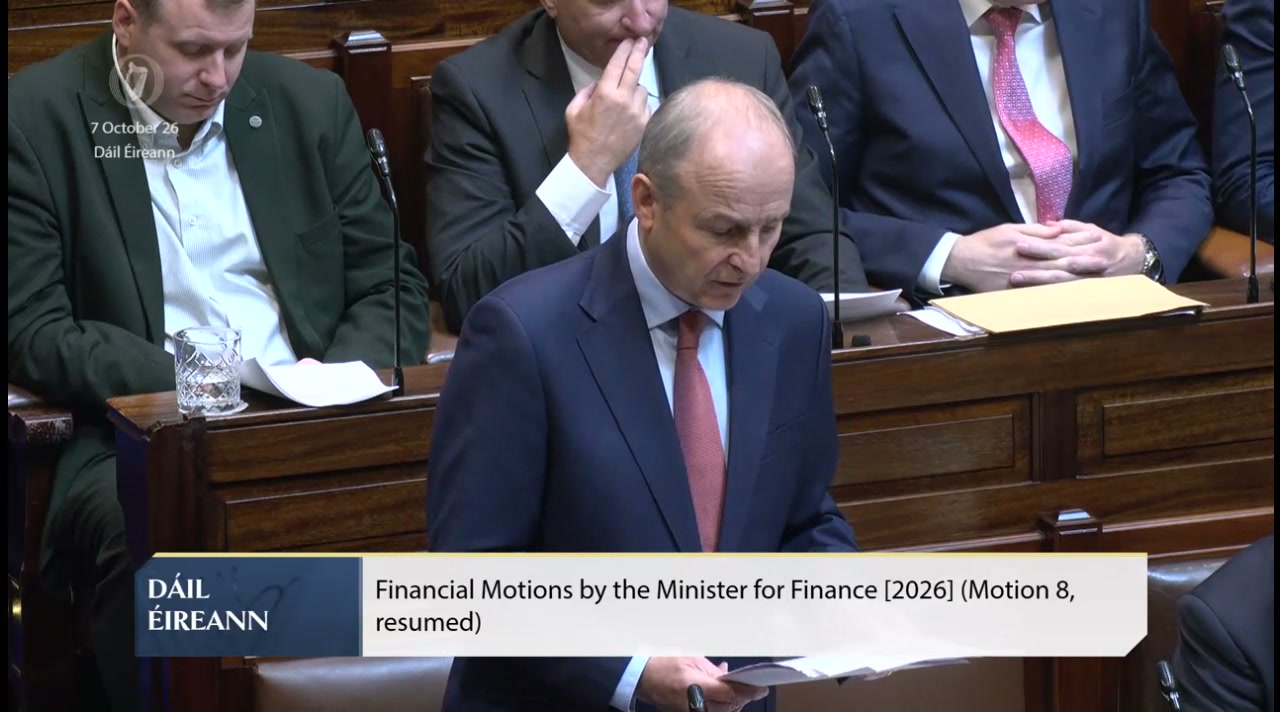
The speech addressed the impact of international conflicts, trade tensions and energy price rises on Ireland’s economy. Martin argued that investment in housing, energy, transport, skills and Irish businesses can strengthen the country’s capacity to meet future challenges, while continued engagement and cooperation remain important at home and across Europe.
Jobs, growth and fiscal responsibility
Martin argued that high employment and a resilient economy are essential to funding public services and sustaining incomes. He defended restraint in public spending, noting the risks of relying on revenues that may be temporary, and pointed to the €4.1 billion payment into the Future Ireland Fund in 2027.
Support for households and workers
The Budget includes increases to social protection payments, tax changes for workers and a new cost-of-disability payment. Martin also highlighted plans to reduce childcare costs by a quarter from September, expand supports for families and increase assistance with energy costs.
Investment in housing and public services
Martin set out plans for almost €12 billion in State investment in housing, alongside increased rent tax credits and support for first-time buyers. He also outlined further investment in health, education and public safety, including additional Gardaí, special needs assistants and special needs teachers.
Preparing for economic uncertainty
The speech addressed the impact of international conflicts, trade tensions and energy price rises on Ireland’s economy. Martin argued that investment in housing, energy, transport, skills and Irish businesses can strengthen the country’s capacity to meet future challenges, while continued engagement and cooperation remain important at home and across Europe.
We publish thousands of recordings to make Irish politics transparent and resistant to manipulation. Spotted an error? Report it — together we are building a reliable archive of Irish politics.
Other speeches
Tego samego dnia All speeches from this day →
Helen McEntee
Helen McEntee sets out Budget 2027 aid and defence investment
Victor Boyhan
Victor Boyhan Calls for Food Vision 2030 Debate
Lynn Boylan
Lynn Boylan calls for a windfall tax on fossil fuel profits
Victor Boyhan
Victor Boyhan on Defence Forces and Irish neutrality
Richard O'Donoghue
Richard O'Donoghue: Working Families Are Being Squeezed
Norma Foley
Norma Foley outlines €7.5bn Budget for children and disability
Transcript
Go raibh maith agat, Ceann Comhairle. Tá an go náisneis a dó gríomair i né,
in a chuid de chláir cwíg blíon na Ríoltaise, agus críoch le proséise ar lé ibre a lán a phaig sé bhí.
Is éireada tá gest leis an go náisneis, ná afraith an nú, agus castáil ar obair uileag an Ríoltaise,
agus féic an chuncín ar chustas an chláir ibre a Ríoltaise, a bheidh le déonibh a phaig raing blíonta eile a maith ráin.
Bhuallan buíochas a go mhaith agus athintas a thúirt, do na bhíl Ríoltaise go léir,
agus na mhílta i brí sa tarra phíos féibh blí ar ranna obair dhíon effachtach,
er an go náisneis seo, chomalais na thioncir ó agraic dhí agus sainóile a théir mod an Ríoltaise.
Go bonúsach is éireada tá gest le ríolú na desne achor ar fáil don daonra agus ráine a dhéanamh.
Céidh go geapin páirte athe an mheasúra, go phéide le gach duine an méide tá uath a dháil,
chun a bheith ma cháinte fíorinnach, tá tiorna chóirinnacha áin.
Cáig an cháineisneis seo a bheith in bhúnaithe.
Céidh go bhuil fíosamh mór díore athe ar haglaidh agus ar ghanóthí,
ceapimíod go bhuil cháineisneis seo tá cofram achá ríon le gach duine corra i bhaidh mo guinn.
Tuachta corra agus tá cíocht réidh dúill do chách.
Fáir bríotair séireabhaisí bhuibh lí agus déanta dáin deall,
go bhuil éire réidh chun dulain lecht le dúchanáin mhóra na linge seo.
Ceoingórle, this is a budget which provides substantial support for people at a challenging time.
It expands vital public programmes and it invests in Ireland's future with both urgency and ambition.
It is a balanced budget.
It is a budget which is both responsive to very real needs today and responsible in taking action
so that Ireland can navigate a period of deep economic uncertainty in Europe and the wider world.
In recent years we have seen an ongoing series of economic shocks and disruptions.
The fact is that they point to a world that is becoming much more uncertain and unpredictable.
Many traditional assumptions that we have held about international trade, energy supply, technology, climate and geopolitics are in question.
Recent developments have reinforced this reality.
These range from rising trade tensions and conflicts which have exposed vulnerabilities in energy markets
to rapid technological change and threats to international values and institutions which are central to Ireland's interests.
It is clear that these are not just temporary disruptions.
They are having lasting impacts and will continue to affect our society and our economy in different ways in the years ahead and the decades ahead.
That being said, our economy is showing ongoing resilience.
The most accurate measures of the domestic economy show that we outperformed predictions this year
and should secure decent growth next year as well.
In spite of the number of questions available to them, the number of private members' motions and the amount of opposition speaking time,
it is remarkable how rarely the opposition ever mentions economic growth.
Never.
They simply take it for granted that the economy will look after itself while they look to clean out the cupboard.
Yet it is growth delivered by a dynamic export-led economy that is the core of all new measures which can be delivered next year.
Before anything else, before any budget measure, the single biggest concern of workers is to have work.
Ensuring high levels of employment is a bedrock of this government's policies.
As the independently reviewed background to this budget shows,
our actions to increase and protect employment has ensured that Ireland has the highest level of employment in its history.
However, we cannot be complacent.
We cannot take our economic success for granted.
The core foundation for jobs, employment and funding public services is the wider economy.
Acting to ensure that it is strong and resilient in the face of new challenges requires constant attention.
We are addressing this in a range of measures which I will address.
The world is seeing major price increases, largely driven by conflicts, and we have to do what we can to sustainably help people.
The budget provides all who rely on the state for their income with increases in line or above inflation,
while also delivering significant tax changes to benefit those who work.
These combine with action to help businesses which are under pressure.
Yet in spite of the centrality of the economy and employment to everything,
the debate so far has completely ignored these points.
The opposition appear to believe that the economy and employment are irrelevant.
They have no policies beyond demanding dramatically more spending.
This is to be paid for through higher taxes as well as cutting provision for the investments we need
in order to sustain high employment, more housing, better public services and sustainable energy.
The contributions so far have accused us of being scrooges, miserly and insulting.
Above inflation income measures have been described as less than nothing.
Perhaps the most remarkable attack has been the claim that seeking to ensure that the public's money is well spent is
an Elon Musk-like attack on public servants.
These absurd and pre-scripted attacks ignore the substance of the many issues our country faces.
They are not about trying to solve pressures being faced by the people, but simply about trying to exploit them.
The facts show that this budget delivers significant increases in spending on services and supports as well as for investment.
Yet it also ensures that we continue to provide both for ongoing investment needs
as well as having resources to respond to more difficult economic conditions.
It provides aid to workers and families ahead of rising prices while investing in protecting the jobs and growth we need
to give people decent incomes and to fund the public service.
In contrast to opposition contributions, the comments of the Irish Fiscal Advisory Council are substantive and serious
and they deserve a response.
The Council is absolutely correct to say that we have to show restraint and avoid allocating all available revenues.
We have to be conscious that some of these revenues may be temporary.
And we have to acknowledge that there is a limit to the capacity of the economy and public services to absorb increased spending and tax measures.
Because we respect this opinion, expressed by others as well as the Council,
we have rejected many of the escalating demands for extra permanent spending we have heard during this debate.
It should also be acknowledged that total gross expenditure has remained very static at about 33% of modified domestic demand,
the most accurate measure of the economy's strength.
Allowing for the growth in the economy, total spending has remained very consistent over the period 2022-2030,
using forecasts from the Department of Finance which have been independently reviewed.
We have also brought in a surplus and have increased the funding put aside for future needs,
especially for economic investments to underpin employment.
Paying a €4.1 billion into the Future Ireland Fund in 2027, bringing the total allocation to €7.5 billion,
is a very significant measure and a signal of our commitment to protecting against economic risks.
However, we must reach a judgement on the balance between this restraint and being responsive to the very real impact which international events have had.
This especially concerns significant increases in the cost of living.
The ability of families and businesses to cope with rising costs is limited.
The significant extra help which we have provided is succeeding in protecting high levels of employment as well as household incomes.
The inflationary impact of the spending has been and will be limited,
with inflation in line with the Eurozone average in spite of our reliance on imported energy.
In addition, various measures are directly linked to addressing dramatic spikes in energy costs which can be reversed.
We are also pushing forward investments designed directly to increase indigenous businesses and protect sustainable long-term revenues for the state.
Major investments in energy, housing, transport and other areas are essential for expanding the productive capacity of the economy and underpinning fiscal stability.
We are conscious of risks and the need for sustainability.
Minister Chambers is pushing forward actions to improve the speed and efficiency of investments as well as maximising the impact of public spending.
These are already having an impact.
The balance which we have reached in this Budget shows significant restraint, particularly when you set it in the context of wider demands.
The combination of growth, high employment, an overall surplus and rising reserves single to the wider world and to investors that Ireland has a resilient economy and a responsible fiscal position.
Our bond yields today are significantly better than traditionally stronger economies, keeping down costs and making spending more sustainable.
Should we need to be more restrictive, we will be.
We will certainly not be adopting the opposition's demand that we rip up all restraint and spend everything now.
As I have said, this Budget provides significant improvements for workers and family incomes, expands critical public services and advances critical investments.
The incomes of the poorest in our society and older people are protected through a range of increases in key payments.
Increases in social protection are ahead of price increases and additional payments will help one parent families, low income working families and families with children and will significantly increase fuel related payments.
The first ever dedicated cost of disability payment will support almost one quarter of a million people.
It is an important start to a new approach which I promised last year.
Together with actions in the areas of education, health and transport, this Budget marks an important moment for developing supports to help people with disabilities.
These range from this new 500 euro payment through to the development of new services and the expansion of practical assistance such as vehicle adaptation and a very significant expansion in special education also.
The switch analysis of social protection changes confirms that they will reduce the numbers at risk of poverty and contribute to our wider targeting of reducing child poverty, particularly when taken with action in other areas.
The programmes for government which our parties have agreed have marked a decisive move towards helping people on low pay and low incomes, especially people on fixed incomes and relying on state support.
European Union and OECD reports have shown that our Budgets have involved highly progressive measures which have directly helped those most at need in our society.
While direct state support to ensure decent incomes for people is a consistent part of our Budgets, people in work and who pay the taxes which help to fund these supports must also be our concern.
We have had limited tax measures for them in recent years but the impact of rising costs made it important that we deliver a substantive measure of tax changes to benefit people in work.
We simply do not accept the argument of much of the opposition that we should ignore the bulk of workers or claw back everything which benefits above average workers.
These tax reductions are fair, proportionate and a recognition that all workers deserve a break at this time of high rising costs.
And of course significantly we've addressed a consistent issue with our tax system in that people are going into the higher rate at a far too low income level.
In relation to public sector workers, we have now signalled very clearly our willingness to reach a new pay agreement.
We have always rejected the ideologies of those who seek conflict or who belittle the role of public servants.
That is why we have been willing to expand the number of public service positions and implement substantial pay agreements.
What no one can expect us to do is to accept unilateral preconditions before discussions or to give up our right to table proposals.
Any dispute on this basis serves no positive purpose and simply delays negotiations which we have shown time and again that we always approach in good faith.
A dispute in my view would be totally unwarranted given our willingness to talk and the provisions we have made and the tax cuts that have been decided on.
And I hope we can see some progress soon.
I would also say to deputies that some of the comments on this matter which we've heard in this chamber exposed a near systematic refusal to respect the fact that we must be responsible stewards of the public's money.
To call for government to effectively be quiet and just meet any demand is not a serious contribution and I hope we hear less of this in the days and weeks ahead.
During our time in government, we have steadily implemented a dramatic increase in state support for an area which is one of the biggest costs faced by working families in particular.
This year over 277,000 children are benefiting from the National Childcare Scheme because of our sustained commitment to developing the sector and reducing costs for families.
Next year we will again cut the cost of childcare. It will be reduced by a quarter in September and this is a benefit of over €2,000 in a full year.
And crucially we are going further than this to support more places, to train more people to work in the sector, to expand provision specifically for children with special needs and to expand free childcare places for low income families.
We are taking another major step forward towards our goal of ensuring that there is affordable, accessible and quality childcare available in all communities.
And we also believe that there is a need for a wider range of actions to give children the best start in life, to help break cycles of disadvantage and to help those who need extra help.
Over the years I have seen how much our country has benefited from a wide range of action to increase inclusion and opportunity in education.
We succeeded in achieving one of the highest school completion rates in Europe and reducing education disadvantage through a sustained commitment and we will build on this.
In our most disadvantaged communities we will implement further measures to help children to stay in school and benefit from it.
DESH Plus will be further developed and an additional 100 homeschool liaison posts will be created.
And all research shows, since DESH was originally introduced well over a decade ago, it has had a significant role in enhancing school completion rates in the Republic.
And when the Shared Island Unit commissioned research from the ESRI, for example, in respect of different completion rates North and South, clearly the level of completion rates in the Republic was far higher than in the Northern Education System.
As a result of that, Shared Island allocated funding to Northern Ireland Executive to work on a joint programme called RAISE to try and enhance, through shared experiences and learnings, the school completion rate in Northern Ireland.
And that's an important metric for us as a society.
In addition, the direct capitation payments now to schools will rise by 24% in primary schools.
And that's on top of a very significant increase last year also.
And then by 9% in secondary schools.
As a Minister of Education, I successfully argued for the development of a new approach to special education then.
Creating the first classes in mainstream schools. These were dedicated classes for higher needs and for particularly those on the autistic spectrum.
And the creation of a new type of role with the hiring of special needs assistants in mainstream schools.
We have to keep improving special needs provision, ensuring appropriate supports and a focus on the needs of the child.
And that is why next year over 2,300 new SNA posts will be created.
Over 1,300 new special needs teachers will be hired.
And work will move forward to ensure that key blockages in the system are overcome.
And so that would bring total SNAs to 28,000.
Which is quite a significant expansion.
If you go back even over the last five years, the growth in special needs assistants has been exponential.
I think it's a lie to the assertions that somehow there are cuts to SNAs and all of that. There hasn't been.
And also of course we've brought in the therapy in school service.
Where we're now recruiting therapists for special schools.
Which is well underway and which is having impact.
And we have more to do there, but we're very committed to it.
So this education budget this year is significant in terms of the very, very huge expansion in the places for children with additional needs.
During and since the pandemic, we've implemented a national program for expanding access, quality and new services in our health system.
The benefit of this has been seen in terms of lower waiting times, improved patient outcomes and the addressing of long neglected areas.
Health will once again benefit from increased funding for critical services.
New public health measures like the shingles vaccine program will benefit thousands.
The further systematic extension of mental health services will proceed.
Because we believe in helping people to be at home as long as possible.
The expansion of home help support has been sustained through recent years and this will continue.
Home help empowers families to make their own decisions and maximise the amount of time people can spend in the comfort of their own homes.
Health will next year be by far the most funded public service area.
The needs of the population deserve this and international pressures on health costs are felt here as well.
It's important to say the government will continue to support the minister as she works to ensure that the public benefits fully from the extra funding and posts created.
And if you look back over the last 20 years, there has been a very significant enhancement in terms of lifespan in Ireland.
Quite dramatic in comparison to any other European country because of our investments in cancer, in cardiovascular health over a 25-30 year period.
It is yielding very significant results in terms of outcomes for people.
We're living longer and the quality of life as we live longer is much better now.
But we need to maintain that and technology is going to be very important and the application of AI will be very important.
And of course we will continue in terms of the scale of public funding is now very significant.
The number of modern facilities that have been developed is significant. We need to do more.
But that means then that we have to deal with the continuation of major overruns because that's unacceptable.
We cannot have habitual overruns in the public health system because that would, in my view, undermine the progress that we have made in terms of health outcomes.
In terms of public safety, we have to ensure and enforce the law, especially in those crimes which can so damage the quality of life in communities.
Measures taken in the last year are ensuring that the number of Gardaí working in the community is maximised.
Next year, a further 1,000 Gardaí will be recruited and form part of a sustained effort to target crime where it has the most impact.
In addition, through a range of community supports, including sports facilities, we further invest in community level initiatives,
helping to sustain the social capital which is such a unique and positive part of Irish life.
Part of this investment in Ireland's future will continue to be the Shared Ireland initiative,
which is by some considerable measure the largest ever investment in building understanding and connections between all parts of our island, funded entirely by the government here.
It's a sad reality that we've seen in recent days that the challenge of building understanding and a common sense of a shared future is far from complete.
It can often seem that people are more interested in speaking to their own side than finding ways of leaving division behind.
Indeed, there are many who appear to believe that there's no place for calmly engaging with others.
Many commentators can often seem mainly interested in stereotyping people and demanding loyalty to the party line.
People who are genuinely serious about changing things or achieving long desired outcomes don't see discussions as simply a minor break between press conferences and speeches.
As people talk about not returning to the past, I think we should remember that we could never have achieved anything without good faith negotiations and looking for opportunities to seek discussions rather than reckonings.
Today, more than ever, I believe that sustained, substantive and respectful engagement is the only way forward.
Next year we will spend a further $200 million through the Shared Island Fund.
We will push forward key infrastructural projects and go much further in funding projects which address critical issues.
We will build on the annual report on the economies North and South which we began this year and is the first ever systematic approach to understanding this critical area.
I will also prepare a number of specific initiatives designed to mark a significant step forward in understanding key social, economic, legal and other issues.
Housing will continue to be a defining challenge of this generation.
A rising population, rising employment and many social developments have led to a long-term crisis in supply and affordability.
This is felt not only in Ireland but through much of the developed world.
The only way of delivering the homes that people need is action across a complex range of issues including legal reform, training, infrastructure, tax and direct support.
Brick by brick we are putting in place a step change in home construction.
It is still far too difficult to find a home to rent or buy but facts show the impact of our sustained determination to get homes built.
European Union figures state that Ireland is one of the few countries in Europe which is succeeding in increasing the rate of home building and we now have the fastest rate of home building across Europe.
Within this the number of new homes going to first time buyers is up because of a range of new supports.
The budget will allow state investment of almost 12 billion to housing.
This will allow for far more social houses to be built.
Rent tax credit will be increased to 1,150 per year for a single person and 2,300 for a couple.
Rent and room relief will increase. Tax relief through help to buy scheme for first time buyers has also been increased by 5,000 euros from 30 to 35.
These are only a few of the measures that will keep the momentum in housing supply and supporting people to find a home to buy or rent.
As I said earlier we believe that action is required to ensure that Ireland's economy remains strong and prospers in the face of many deep challenges.
We cannot take success for granted and one of the most important issues we must address is the need to find ways to scale indigenous companies so they form a wider base for our internally trading companies.
Our budget is providing for a 1 billion euro investment programme led by the Ireland Strategic Fund to help Irish firms with scaling up.
Multinational firms have played a major role for over 60 years since the governments of Sean Lamas and Jacqueline Lynch introduced a poor enterprise outward looking tax policy and committed us to seeking to become a trading nation.
Multinational firms will continue to be an important and valued firm for part of our economy but we must do more to increase the number and scale of significant innovative Irish firms.
There are many elements to this and one part is addressing the active disincentives to keeping businesses here and reinvesting capital gains from significant sales.
That is why the reduction in capital gains tax is important and I am pleased to see that this has been widely welcomed by groups which are focused on building Irish businesses and enterprise.
We also have to continue to support the security and development of our world class agri-food sector.
A broad base of family farms is key to quality production as well as the lifeblood of many of our communities.
That is why we are implementing a series of substantial measures to support farming.
We will be implementing measures to aid intergenerational transfers, to keep farms and families and help a new generation to earn a good income.
The urgent problems of this moment require targeted supports and these will help farmers with the triple challenges of the costs of fuel, fodder and fertiliser.
We believe that farmers are increasingly the leaders in transitioning to lower cost sustainable energy and protecting the environment.
Time and again farmers have shown a willingness to act if given the right supports.
A combination of improvements to the TAMS and the SEI grants will provide generous supports for installing lower cost secure energy on farms, something which reflects a cross-government approach.
Cleaning up key waterways while protecting our world class and sustainable dairy sector is a priority for us and an additional €21 million will next year fund specific water quality and biodiversity schemes in partnership with farmers.
We will continue to ambitiously fund Ireland's transition to secure affordable and environmentally sustainable energy.
Ireland's progress in decoupling growth and carbon emissions is very clear and providing funding to go much further is a core part of the reserves we are providing for.
We are taking measures in relation to carbon taxes to recognise the reality of current pressures while also protecting the core principles behind this.
Anyone who thinks that you can address existential climate issues without any consumption taxes is not being serious.
That is why I am surprised that those parties in the opposition which claim to be most concerned with this issue signed a joint letter on climate with the largest opposition party.
A party which is a loud and inflexible opponent of any carbon linked index taxation.
It is important to note that we have signalled our intention to support fishing communities and a long term future for another sustainable and high quality indigenous industry.
The allocation of an additional €20 million to begin implementing our plans is a major step forward.
For every part of the Irish economy the haulage sector represents an essential partner.
It costs matter to all of us and the impact of fuel prices has been profound.
This is why we are reducing the excise and fuel for hauliers on the road transporters support scheme.
At this critical moment in shaping our economic future we are taking actions to further invest in education and training.
We are providing a further €50 million a year for the next three years, €150 million in total to the National Training Fund for AI Skills and a Resilience Package.
We are also acting on a cross government basis in relation to developing skills to understand and where appropriate adopt artificial intelligence.
The debate on the need to protect privacy and address safety issues with frontier AI models is a very serious one.
It is however a very different issue to the use of AI in relation to a wide range of practical applications.
Enterprise based applications which perform limited but important tasks are a reality.
This is where we need to ensure we have the skills required to make use of AI to improve services and protect competitiveness.
As part of our presidency of the European Council we will shortly host a major conference in AI which will explore this issue.
As we look at the economic challenges of today and the years ahead we would do well to remember the words of Sean Lemass when he addressed the post-war meeting of what became the OECD.
He said then, we cannot win for our people the high and rising standard of living we wish them to have merely by the temporary patching up of our own national economies.
For him international cooperation and strong rules bound organisations was essential.
In fact it was the only route to progress for countries like Ireland.
And that is as true today as it ever has been.
And that is why we will continue to be a Euro positive government seeking opportunities to strengthen the European Union as it faces continued attacks from the right and the left.
We strongly reject the corrosive Euroscepticism of half of the opposition in this house.
Our allocation to the Department of Foreign Affairs and Trade will ensure that we continue to build on the exceptional work being undertaken at this moment by ministers, diplomats and officials to move Europe's agenda forward.
This Presidency will mark a significant step forward in the level and depth of Ireland's work for a shared prosperity amongst the nations of Europe.
At a challenging moment in international affairs and with major needs for social and economic investment this Budget is both balanced and ambitious.
It addresses key social and economic issues through sustained action both next year and beyond while also providing significant direct assistance to families and businesses under pressure today.
It rewards work delivering increased take home pay for all workers while also using resources to help those who need support.
Increased pensions and social protection payments, a range of measures for people with disabilities, a major cut in childcare costs will each make a difference as will a programme of expanding important public services.
Home building will grow further including the largest ever programme of social home building and direct support for renters will increase.