

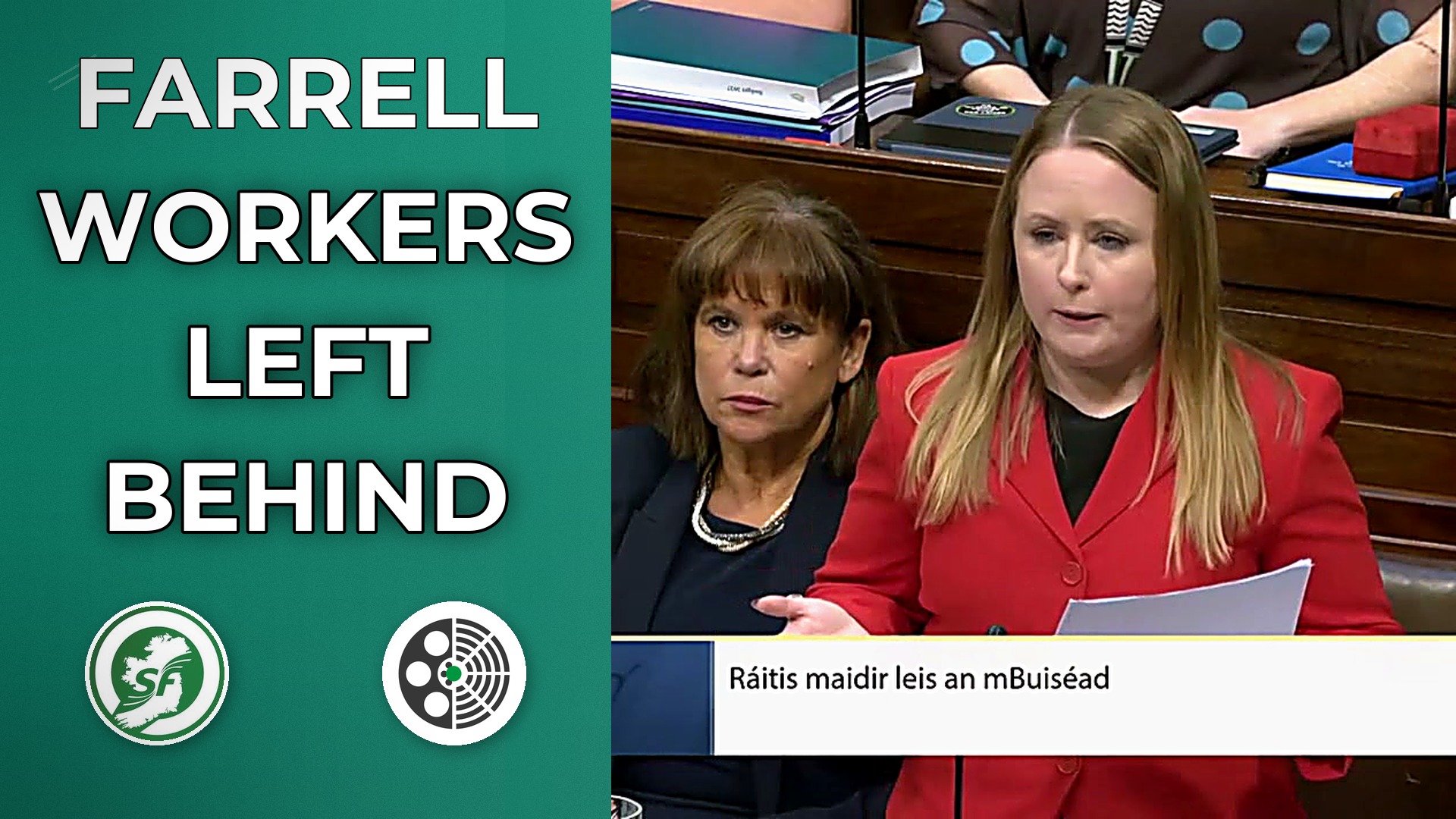


Mairéad Farrell says Budget fails workers and families
Sinn Féin TD Mairéad Farrell criticised Budget 2027 during a Dáil Éireann debate, arguing that it failed workers, families and public services. She called for action on the cost of living, housing, student fees, healthcare and public sector pay, and set out measures Sinn Féin would take instead.
Farrell said people were struggling with fuel prices, rents and grocery costs despite Ireland’s wealth. She called for a further 10-cent-per-litre reduction in petrol and diesel prices and proposed a €500 payment for one million households to help with food costs.
She accused the Government of breaking a promise on student fees, noting that fees had risen by €500 before a later €150 reduction. Farrell said Sinn Féin would halve fees immediately and abolish them by September next year. She also called for apprenticeship fees to be abolished, travel and accommodation allowances to be doubled, and capacity in the apprenticeship system to be increased.
Farrell described housing as the country’s biggest social crisis and said the budget would worsen it. She highlighted homelessness, including among children and pensioners, and spoke about the housing barriers facing women escaping domestic abuse. She also called for a permanent cost-of-disability payment, improved mental health services and investment in endometriosis care.
She criticised cuts to public service allocations and raised concerns about nurse and midwife recruitment in Galway and patient safety at Cork University Hospital. Farrell called for more medical cards and hospital beds, and condemned the lack of a public sector pay deal amid rising living costs.
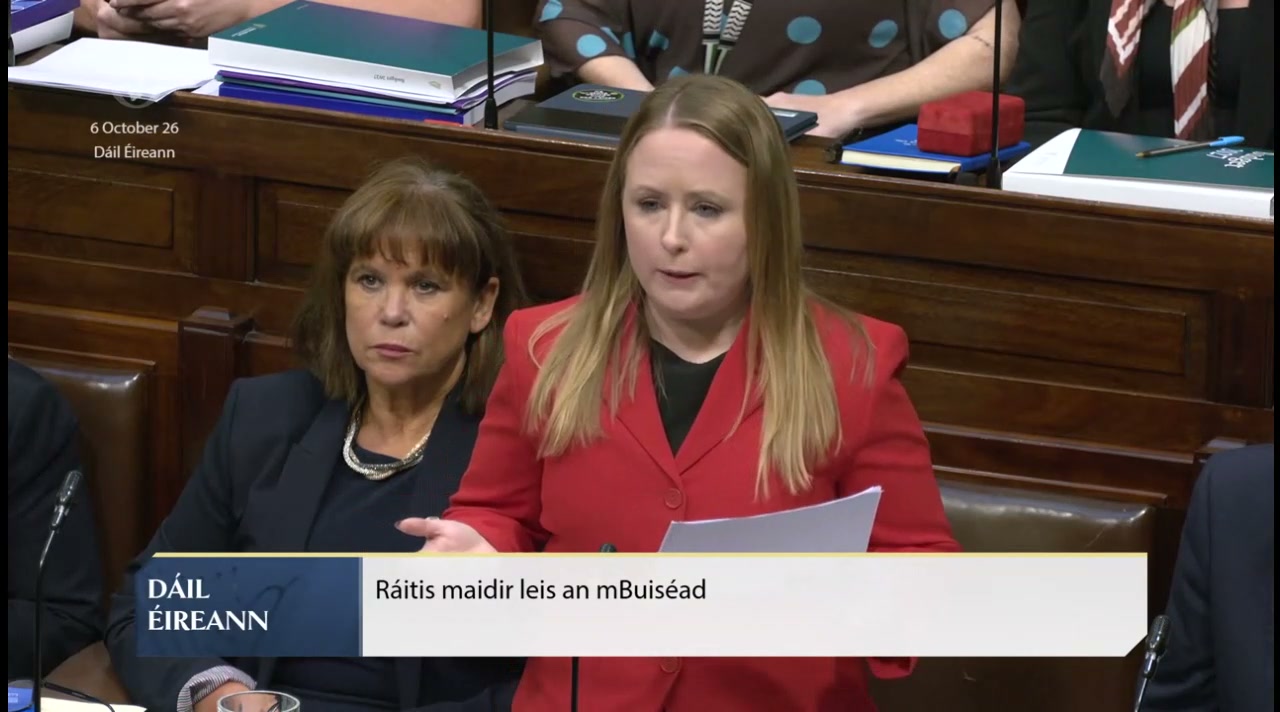
Farrell called for a strong Common Agricultural Policy, support for young farmers and lower green diesel costs. She proposed an inshore fishery stabilisation and climate adaptation scheme, and criticised the budget’s approach to climate resilience and public transport. Watch the recording to hear her full contribution.
Workers and the cost of living
Farrell said people were struggling with fuel prices, rents and grocery costs despite Ireland’s wealth. She called for a further 10-cent-per-litre reduction in petrol and diesel prices and proposed a €500 payment for one million households to help with food costs.
Student fees and apprenticeships
She accused the Government of breaking a promise on student fees, noting that fees had risen by €500 before a later €150 reduction. Farrell said Sinn Féin would halve fees immediately and abolish them by September next year. She also called for apprenticeship fees to be abolished, travel and accommodation allowances to be doubled, and capacity in the apprenticeship system to be increased.
Housing and support services
Farrell described housing as the country’s biggest social crisis and said the budget would worsen it. She highlighted homelessness, including among children and pensioners, and spoke about the housing barriers facing women escaping domestic abuse. She also called for a permanent cost-of-disability payment, improved mental health services and investment in endometriosis care.
Healthcare and public sector pay
She criticised cuts to public service allocations and raised concerns about nurse and midwife recruitment in Galway and patient safety at Cork University Hospital. Farrell called for more medical cards and hospital beds, and condemned the lack of a public sector pay deal amid rising living costs.
Farming, coastal communities and transport
Farrell called for a strong Common Agricultural Policy, support for young farmers and lower green diesel costs. She proposed an inshore fishery stabilisation and climate adaptation scheme, and criticised the budget’s approach to climate resilience and public transport. Watch the recording to hear her full contribution.
We publish thousands of recordings to make Irish politics transparent and resistant to manipulation. Spotted an error? Report it — together we are building a reliable archive of Irish politics.
Other speeches
Tego samego dnia All speeches from this day →
Regina Doherty
Regina Doherty calls for urgent action on housing permits
Jack Chambers
Jack Chambers sets out Budget 2027 investment and reform
Richard O'Donoghue
Richard O'Donoghue accuses Government of ‘cooking the books’
Seán Canney
Seán Canney backs 31% capital gains tax rate
Micheál Martin
Micheál Martin Sets Out Budget Measures to Ease Pressures
Ken O'Flynn
Ken O'Flynn says budget fails hard-working people
Transcript
Ministers and all government TDs, this time last year ye chose to make people's lives
harder.
Ye chose to abandon working people and the ripple effect of that decision led to a year
of discontent.
People literally took to the streets because they couldn't take it anymore.
And this discontent shows no signs of abating with the people that provide our most necessary
public services, who keep this state ticking, engaging in industrial action.
And why?
Because never has this state been so rich but its people felt so poor.
So just think about that.
Working hard should allow you to build a good life for yourself.
A roof over your head, a future for your children, a bit of money left at the end of the week
so you're not just about scraping by.
A decent life.
But none of that is a reality under Fianna Fáil and Fine Gael.
And this week I've heard many people refer to Budget Week as Christmas for politicos.
Well if that were to be the case then it is the scrooges of Christmas that sit before
us here today.
Because it doesn't make sense.
We're a wealthy country with a budget today being announced of about 125 billion euro.
So where's the money gone?
Well let's follow the money.
Because there is money for some.
If you make 5 billion euro in profit like our banks then maybe you're alright.
But if you're the majority of workers earning under 44,000 euro then this budget isn't
for you.
If you're a vulture fund then welcome, this budget is for you.
But if you're working hard, paying sky high rents and can't afford a decent life then
really there's nothing to see here today.
Since fuel prices shot up at the start of the year Sinn Féin did the one thing that
this government has repeatedly failed to do.
Listen to people.
Listen to the workers, to the families, to the businesses within our communities who
are desperately struggling with the price of fuel.
Right now they're telling us that prices are putting them under pressure.
Workers' paychecks no longer stretch as far.
The price of fuel in the car has gone way up.
Hard-pressed families are unable to afford diesel for their tractors and businesses cannot
absorb the endless increases in cost of fuel.
The prices we are seeing at four quarts today weren't unacceptable in April and they remain
unacceptable now.
It is not enough to just extend excise cuts.
The prices on four quarts today demand a further reduction and we are telling you to reduce
the cost of petrol and diesel by a further 10 cent per litre at the pumps.
Today this budget needed to put workers and families first.
It needed to deal with the here and now.
It needed to recognise the extent to which the cost of living is impacting and bring
in measures to alleviate that.
A cost of living package was needed but that was ignored.
A cost of living package that meets people where they're at.
That acknowledges that grocery prices are far too high and that you could have done
something about it.
You could have cut the price of groceries by giving a million households €500 to spend
on getting food on the table but instead you have made the choice to do nothing.
Connachta, you've branded this a budget for workers or people who work hard but this is
no budget for retail workers, for care assistants, for SNAs or any other hard working people
who earn less than €44,000.
In fact the majority of workers don't pay the higher rate of income tax and won't get
a single cent extra in terms of your income tax band changes.
For those workers this budget doesn't even give them a chance to get by, never mind get
ahead.
If this was a budget for workers it would include extensive tax cuts for all workers.
It would provide tax relief for every single worker by abolishing the USC on the first
£40,000 of income.
Now alarm bells should be ringing in relation to that Minister but alarm bells need to absolutely
start ringing in government in relation to our young people.
Our future lies in the hands of our young people and they are telling us that they don't
see a future here at home.
They are telling us that they are considering emigrating in their droves.
Seven out of ten young people believe that they'd have a better quality of life abroad.
There can be no worse indictment for a government than that.
Youth unemployment is increasing and it is predicted to rise further.
Young people are worried about housing, cost of living and jobs.
Now Ministers I'm going to read a quote for you and I think it would be worth listening to.
I want to abolish college fees.
I am now committing to getting rid of the student registration fee.
Tánaise, you said those words.
You told TikTok on the 21st November 2024, eight days before the last general election,
that.
You then asked people to vote Fianna Ghael so that you can get on with that plan.
Great words.
So what happened?
Was it a game?
A game of Simon says but Simon doesn't do?
Was it just pre-election rhetoric?
Promises that you knew well you wouldn't keep?
Last year, the first budget after that with Fianna Ghael in government, you increased
fees by €500.
You went back on your word.
Now you and all of you across on the other side of this chamber might shrug your shoulders,
laugh and say that's okay these things happen.
But it does matter.
Being straight and direct with people matters.
Making a difference in young people's lives matters.
Young people should have a choice of if they want to go to third level education.
It shouldn't be based on where you're living or what your parents do or what your background
is or anything like that.
You should have the right to choose your future.
And it should not be up to a finance minister, a public expenditure minister or indeed a
budget to stop you from doing that.
Tánaiste, you are now the Minister for Finance.
And this is your first budget in that role.
You have power.
You have influence.
And the first chance you get, you have abandoned that promise.
You have abandoned our young people.
A €150 decrease in student fees still makes it higher than when you made that promise.
And do you know what else is higher?
Rents, groceries and youth unemployment.
All key factors in determining whether a young person can go to college or not.
Student fees must finally be abolished.
Sinn Féin would immediately, right now, today, cost our fees in half and fully abolish them
by September next year.
Minister, I can't hear you because I'm speaking and it's my speaking time.
This is the decisive action that our young people need.
A clear, stable future.
Not broken election promises and gimmicks.
Now you do talk about working hard.
And Minister, our greatest resource are our young people.
Including our young people who want to build a better future for themselves and for every
one of us.
And that's to be commended.
Critical to our future are the hands that will build that future.
Our tradespeople are known across the world for their skills and for their hard work.
But too many apprentices have told me that they do not feel valued here at home.
Delays are now synonymous with our apprenticeship system.
And Ministers, I raised the case of one young apprentice who was due to begin his off-the-job
training in January of 2025.
This was cancelled and he was told he would have had to wait for an indefinite period
of time to access this training.
He has now finally received notice and is set to begin the training 22 months after
he was originally supposed to start.
That is not good enough.
That is not the way our young people should be treated.
But the words of one apprentice who contacted me really struck me.
And he said it is not just one trade either.
Apprentices across all trades in Ireland have been dealing with issues like this for years.
And this is only one of many problems.
There is also the accommodation crisis.
Apprentices being sent to the opposite side of the country for training have little or
no choice over their training centre, long waiting lists and plenty more that rarely
gets talked about.
On top of that, many apprentices are expected to survive the first two years on low wages
while trying to cope with the rising cost of living, rent, transport, fuel and everyday
expenses.
The reality is that many apprentices face challenges that people outside the system
never see.
And it is time these issues get the attention they deserve.
Well guess what Ministers, those are the people that get up early in the morning, work a hard
day and build the infrastructure and the housing that our communities so desperately need.
They need to be treated with the respect that they deserve.
Apprenticeship fees must be abolished and they must be abolished now.
We must double the travel and accommodation allowance for apprentices and increase capacity
in our system.
It would not be tolerated for a law degree or a medical degree to take two years longer
than what a student signed up for and that should no longer be tolerated for our apprenticeships.
Because our apprentices will build the housing that we need.
And now Ministers, housing is the biggest social crisis facing our society today.
Tens of thousands of working people unable to put a roof over their heads.
Tens of thousands of families paying rip-off rents and sky-high mortgages.
Tens of thousands of people languishing on council housing waiting lists.
And 17,885 people, including 5,830 children trapped in emergency homeless accommodation.
An entire generation locked out of affordable homes, trapped in their parents' box bedroom
or forced to emigrate.
Nowhere is this government's failures more clearly demonstrated than in housing.
And what did we get from the budget today?
Did we get increased investment to deliver more homes?
Did we get new policy initiatives to reduce homelessness?
Did we get real relief for hard-pressed renters?
No.
No.
And no.
Lack of secure housing impacts on every facet of a person's life.
And now it is impacting on every generation of our people.
Spiring numbers of children trapped in homelessness has been accepted by government as a new reality.
That cannot be normalised.
And now we see pensioner homelessness skyrocketing.
Homeless support groups have called pensioners the new face of homelessness.
And they're right.
That can't be accepted.
A generation that is now moving from the workforce into receiving their pension, trying to navigate
an insecure housing market with sky-high rents, and your response is a €10 increase in pension.
Something doesn't add up, Ministers.
The one guarantee that this government can give is that the housing crisis that they
have created through their failed policies will not discriminate by age.
So let's look at what this budget says.
This is not a budget to fix housing.
It's a budget that will make the crisis worse.
Budget 2027 could have been the start of a real effort to fix housing.
It could have been a housing budget with ambition and determination.
Instead it's just a rehash of what came before it, which means rising rents and house prices.
And today should have been about putting the housing needs of workers and families first.
But once again Fianna Fáil and Fine Gael have sided with the vulture funds, corporate
landlords and big developers.
Unfortunately, Ministers, the housing crisis is not separate from domestic abuse.
It shapes every decision a victim and survivor makes.
It can keep someone in danger for longer, and it can leave women and children in emergency
accommodation with no clear way forward.
Some return to an abusive partner not because they want to, but because the system has offered
them no real alternative.
For those who do leave, the cost is often enormous.
Women tell us of being moved to another part of the county, forced to take their children
out of school and give up their jobs, losing the very supports that helped them recover.
Some have been placed into local authority housing only to find themselves living within
sight of the person they fled.
Others moved between the spare rooms and sofas of friends and family, carrying a constant
feeling of being a burden.
But these women are not a burden.
They are making extraordinary decisions under impossible pressure and doing whatever it
takes to keep themselves and their children safe.
That strength deserves a system that matches it.
No one should have to choose between abuse and homelessness.
One of the most shocking developments that came out of your budget last year was your
decision to leave people with disabilities €1,400 worse off.
It was absolutely shameful.
We know that people with disabilities face unavoidable additional costs just to live
equally.
This needs to be addressed, not by half-measures like the insulting €500 annual lump sum
not delivered until January, but by a new and permanent cost-of-disability payment scheme
separate to income replacement supports for those unable to work due to disability.
It should be available to every person with a disability that incurs additional costs,
whether they are in employment or not, and whether they are dependent on social welfare
income supports or not.
It should be a regular payment paid at rates that actually reflect the costs people incur.
You had the opportunity to rectify that this year and finally introduce a proper cost-of-disability
payment.
You chose not to.
You have promised parity of esteem between mental and physical health, but there is no
commitment to deliver the funding and resources necessary to make that a reality.
Real parity means 24-7 mental health A&E units where no one is turned away or told to wait
until morning to access crisis intervention services, and it also means giving mental
health services access to secure long-term funding that they need to support those who
rely on them.
Eating disorders have the highest mortality rate of any mental health illness, and we
only have three inpatient beds, meaning this critical care is a post-court lottery.
Ministers, I raised this with you before.
I expect you to listen and I expect you to act.
Women who suffer with endometriosis have been failed for generations.
Women have come together to demand more.
They demand world-class endometriosis care here at home.
Today could have been a turning point.
You should have announced €20 million to deliver endometriosis services in this state,
finally ending this injustice and delivering care for every woman that needs it.
What hides behind these glossy pages in this book is a budget that has been utterly butchered.
Minister Chambers, you have taken a knife to our public services and slashed essential
spending across nearly every department.
These are not cuts to additional measures that ministers have sought.
These are cuts to the existing allocations that our public services rely on.
No department has been dragged through the chopping board more than health.
You cut €170 million off their base allocation to fund your education levy, a completely
impossible ask given that this year the HSE are running hundreds of millions over their
allocated budget.
You have managed a situation where core services are underfunded but hundreds of millions in
waste and inefficiency is driving a massive overspend.
This is a result of Fianna Fáil and Fine Gael governments who have failed year after
year to budget for our health service.
Cuts through underfunding are already in motion and we can see their disastrous impacts already.
In Galway, there are dozens of newly qualified nurses and midwives without job offers despite
significant vacancies.
This is the real impact of your supposed efficiency and reform proposal.
What an absolute disgrace.
It is breathtaking inefficiency.
It makes no sense to train nurses and midwives, have vacancies in our hospitals and community
services and then leave graduates who want to work in public health services waiting
for contracts.
And they have been loud about this.
You know about this.
Separately in Cork, the CEO of Cork University Hospital has already warned you that the
HSE spending and recruitment freezes would increase the risk to patient safety.
Make no mistake about this.
These cruel cuts will directly impact patients who will be damned to more uncertainty, longer
waiting lists and greater safety risks.
This government should be working towards an accessible, affordable model of healthcare
that establishes the capacity needed to look after our population.
In practice, this means a long-term plan for a health service and taking immediate action
this year.
That includes 80,000 new medical cards, 400 additional acute hospital beds and ramping
up investment in GP, primary care, community services, ambulances, mental health and children's
care.
This budget again fails to set out a sustainable model of health funding that provides certainty
around staffing, service delivery, that builds capacity in hospital and crucially that reduces
the cost of healthcare for workers and families.
Minister, I couldn't let today pass without talking about the public pay deal, or the
lack thereof.
You talk about a budget for people who get up early every morning and work hard.
Give me a break.
You're willing to go without negotiating a pay deal with the hard-working people who
get up early and go to work in our public services.
It is actually outrageous that the state generates billions of surpluses, that at the same time
this government is condemning our nurses, teachers, Gordie and all other public sector
workers to becoming poorer.
Their wages are being entirely eroded by the cost of living.
They are, Minister.
You can shake your head, but it's the truth.
This year alone, public sector wages will have decreased when compared to inflation.
These hard-working people have been pushed to take industrial action by this government
and by you, Minister Chambers, as you refuse to sit down with the unions to discuss pay.
What absolute arrogance.
Let it not be forgotten that the very first thing that this self-servant government voted
for was a bumper €16 million pay rise for those on the government front benches.
Yet you have the brass neck to deny our nurses, our teachers and Gordie a fair pay deal.
It is truly one rule for you and one rule for everybody else.
Be chór go maith agaibh agaibh agaibh agaibh agaibh agaibh agaibh agaibh agaibh agaibh agaibh
agaibh agaibh agaibh agaibh agaibh agaibh agaibh agaibh agaibh agaibh agaibh agaibh agaibh
You can't take a life when it's not worth it, Áine.
It's not good enough that we don't have the electricity, the electricity and the
signal phone that we need at the moment.
What plan does the government have to deal with that?
What do we have to do if we can't put an end to 999 after Sturrum?
The Gaelic language schools are closed at the moment.
If we are serious about the Gaelic language schools, the government must deal with this issue.
There is a lack of investment and a lack of political will.
From what I can see, there is no political will at all.
There is an infrastructure question for the Gaelic language school.
We have to find a way to get the Gaelic language schools to deal with the lack of infrastructure
and we have to get the Gaelic language schools back to their original 500 year old home.
We have to find the Gaelic language schools to do that.
I am here today to say that the Gaelic language schools are wrong.
When the Gaelic language schools were open, people were right to go to the Gaelic language schools
and we are standing with those Gaelic language schools.
The best thing about going to the Gaelic language schools is that the children are not alone.
They should be able to go to their homes, to their homes and to their families
and that the Gaelic language schools should be open.
In an increasingly unstable world, self-sufficiency and what we can deliver at home
is becoming more and more important.
Food security is a critical component of that.
This budget needs to help farmers and so does the multi-annual financial framework.
We need this government to be a strong voice for farming, both here and at an EU level.
We need a stand-alone CAP that is separate from the proposed national partnership plans
and that retains its current two-pillar structure and CAP cannot be cut.
There is already talk of a 22% cut on CAP
and just last week some EU countries came together seeking for it to be cut further.
Now at the start of the Irish Presidency of the EU,
the government said it would use the Presidency to deliver a strong CAP for farmers
only now we are in a worse position than before the Irish Presidency started.
So make that make sense Ministers.
Generation renewal needs to become an action rather than a slogan.
Every year young farmers tell us that the future of farming for the next generation
is becoming increasingly difficult.
Today's announcement on generational renewal will do little to attract young farmers
to take on farming as a career.
It will not help young farmers to get access to land.
It will not help young farmers get established.
In our alternative budget we propose an installation aid establishment payment
of €10,000 per farmer.
Irish farmers are feeling the effects of the fuel crisis
with the price of green diesel skyrocketing.
You should do what we call for in our alternative budget
which was to reduce the price of green diesel at the pump.
Now Ministers there is something that we can all agree on.
We live on an incredible island.
An island that has been through hard times and good times
but has always pulled through.
And why?
Because the Irish people are resilient.
Our coastal communities epitomise the resilience of the Irish people.
Storms have become a more regular occurrence for any of us who live in the west of Ireland
and we know the damage that changes in weather can bring.
Storms battering through the night, loss of power,
loss of telecommunications and loss of livelihoods.
And no one knows that like our fishing communities and our fishermen.
Most people don't live in coastal communities
but they have a graw for it.
The Irish people would not want the decline of these communities.
If we don't intervene now we are going to lose a massive part of our heritage.
And as you know inshore fishermen are already struggling with fuel and baits.
Their cost to go out to sea has increased massively
while at the same time they are not getting a fair price for their produce.
The changing climate is having a serious impact on their work.
The amount of days that they can't go out fishing due to storms
and the loss of income as a result.
They need compensation in order to survive.
We don't want them to go out in storms and risk their lives.
And there is a solution for this.
An inshore fishery stabilisation and climate adaptation scheme.
A scheme which gives inshore fishermen a basic income
to ensure the survival of this core component
of what our island has to offer.
And this is the first time that our fishermen are coming forward and saying
we need your support and we should listen.
Sinn Féin is saying we will support you.
We are saying that we will help you to stay out on the water
because we know that you are of inherent value to the Irish people.
Climate change is no longer a challenge for the future
it is one of the greatest challenges we face today.
Our climate is changing in front of our eyes.
Last winter we saw some of the worst flooding in my lifetime
which put families out of their homes and escorted
and caused turmoil on our roads and railways
only to be followed by the hottest summer ever on record
where farmers have had to cope with the havoc caused by drought.
Ireland must stop reacting to individual events
and instead start preparing systemically
for a climate of greater extremes.
These are not my words but the words of the Climate Change Advisory Council.
The government have failed to prepare
and as a result continue to fail to respond
to extreme weather events.
This budget should be packed with funding and resources
directed at protecting the most at risk people
infrastructure and communities from our changing climate
but instead of being supported
they continue to be stranded by this government
and left alone to build resilience
against weather extremes
without the support they urgently need.
This budget cements the haphazard approach
of Fianna Fáil and Fine Gael when it comes to transport policy.
There is no vision, no plan and no funding
for building public transit at scale.
For years you have been hiking the price of petrol
to get drivers out of their cars
and into public transport.
Now, unbelievably, the bright minds of government
are hiking the price of public transport.
Working people and families are being squeezed from all sides.
Your transport plan doesn't connect Ireland
it divides Ireland
into those that can afford to travel and those that can't.
People that use public transport
want services that are convenient
more reliable and faster.
People who don't have access to public services
in terms of transport
want an expanded network that meets the needs
of rural Ireland.
This budget delivers on none of those things.
It deepens the transport deficit
between rural and urban communities
while making transport more expensive for all.
But a better Ireland is possible.
There is a different way of doing things.
A way that finally puts families and workers first
that values our people
and supports them to flourish.
While this has been clearly lost
on those of you sitting across from me
that hope and vision is not lost on me.
That is the reason that I
and those sitting beside and behind me
are here and work
every day to create
that new Ireland.
A united Ireland.
An Ireland that delivers for its people.
An Ireland that gives you access
to healthcare
when and where you need it.
An Ireland that guarantees
a home for its citizens.
That Ireland is possible
and I look forward to the day
that that Ireland is delivered.