



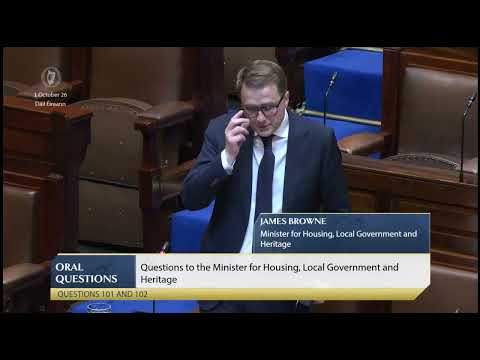
James Browne Says Housing Referendum Would Distract from Delivery
James Browne set out the Government’s position on a proposed constitutional right to housing during a Dáil debate on a bill to amend Bunreacht na hÉireann. He said the Government could not support the bill at this time, arguing that a referendum would not resolve the housing supply problem and that the immediate priority is building homes.
We publish thousands of recordings to make Irish politics transparent and resistant to manipulation. Spotted an error? Report it — together we are building a reliable archive of Irish politics.
Other speeches



Tego samego dnia All speeches from this day →
Mattie McGrath
Mattie McGrath urges talks to avert special school disruption
Martin Daly
Martin Daly questions private profits in child residential care
Richard Boyd Barrett
Richard Boyd Barrett: A right to housing is needed
Michael Moynihan
Michael Moynihan: Housing referendum would distract from delivery
Paul Lawless
James Lawless challenges Tánaiste over whistleblower handling
Brian Stanley
Brian Stanley: Affordable and Cost Rental Homes Must Scale Up
Transcript
Can I start by thanking Deputy Hirne for bringing forward this bill to amend the Constitution
to include a right to housing.
While the government cannot support it at this time, I do welcome the opportunity to
set out the government's position on this important issue.
Our housing plan, Delivering Homes, Building Communities, does set out that housing is
a basic human right.
We are also providing almost one third of all our national development plan funding
is going towards housing, between housing and water infrastructure.
I think it's important to remember that kind of level of funding is almost unequalled in
any other country in the Western world.
We do have to fund other projects such as health care, schools, roads, footpaths, community
centres.
So the level of funding that we are putting in towards housing directly by this government
is extraordinary.
It needs to be extraordinary, but I think it needs to be understood at a level compared
to other countries as well.
As the Deputy will be aware, the Housing Commission was established in December 2021 to consider
housing policy post-2030 and make proposals as appropriate.
It was also tasked with advising government on the critical factors to be considered regarding
a referendum on housing and, if appropriate, to recommend wording for a constitutional
change.
The Commission submitted its overall report on housing and a stand-alone report on a referendum,
which included proposed wording for an amendment to Bunroch na hÉireann, to the then Minister
on 8 May 2024.
A minority report was also submitted by a small number of Commission members, recommending
a statutory strategic plan-based approach rather than a constitutional amendment.
An additional alternative proposal was submitted by another Commission member, accepting that
a referendum should be progressed but supporting an alternative wording and an alternative
provision in the Constitution in Article 45.
What is clear to see is that there were differing views within the Commission on the right to
housing and no full consensus on what is a complex issue.
The wording of the majority report is what is proposed in the Bill or near us.
It is of note that the Commission was also of the view that a constitutional amendment
to provide for a right to housing was not necessary in order to permit substantial and
far-reaching legislative reform in relation to housing and, significantly, that the current
constitutional position in and of itself does not pose a barrier to measures designed to
tackle the housing crisis.
I think that is reflected in the significant measures we have been taking.
I do not reject the right to general concept of a right to housing by way of a constitutional
amendment.
It is very complex.
We should all be in agreement that any such proposal should be taken at the right time,
with the appropriate level of scrutiny and consultation.
Let me be clear.
The state cannot directly provide all the housing the country needs.
To insert a right to housing into the constitution without considering the ramifications would
create false expectations that it can and will likely direct state resources to lengthy
legal complications for years to come.
As I say, there is also a democratic need for any government to balance all of the necessary
needs and demands in any society.
It is not just housing.
It is health care and other social supports as well that people need.
Given that the bill proposes mirrored wording provided in the majority report of the Commission,
the Attorney General has previously provided government with preliminary advice on that
wording and has signalled serious issues arising from it that it would be irresponsible for
us to ignore.
Holding a referendum at this time is a distraction from the delivery of real housing on the ground
in an already challenged housing market.
We can see last year we built the largest number of social houses in the history of
the state.
So it's not holding us back.
But what you see in Spain, you reference Spain, Spain does have it in their constitution.
They're in a housing crisis.
Country's blowing up over the housing crisis over there at the moment.
So a constitutional right to housing doesn't really aid anything unless you want to make
it actually strong to make sure that it does.
And in that case, it is then prioritising issues in terms of government expenditure
that may be needed and may be excluding, for example, health care and other social protection
supports as well.
It is complex in terms of what the expenditure is, but also the legal complexities.
And we have a very strong constitution in this country as well.
It gives people a strong right of access, as it should, to the courts and to exercise
the right to have constitutional rights upheld.
Holding a referendum, as I say, at this time is a distraction.
As is well recognised, a referendum on housing is not going to resolve the housing supply
problem and may have unwanted or even unintended consequences.
And the immediate focus and priority continues to be on the delivery of homes as set out
in the programme for government.
It is important to highlight, however, that we are making real progress.
Between July 2020 and the end of June 2026, we delivered nearly 178,000 new-built homes.
In 2025 alone, there was 36,284 new dwelling completions, an increase of 20% on 2024.
This delivery is backed up by record levels of government funding for housing.
Over €9 billion of capital funding will be provided through the Exchequer in 2026,
along with including funding by the LDA and the Housing Finance Agency.
As a result, we are now seeing an unprecedented level of delivery of new-built social homes,
with 2025 representing the largest number of new-built social homes constructed since
the foundation of the state.
17,700 starter home supports were delivered last year, an increase of 21% on 2024, and
the highest annual total recorded.
These supports were delivered across the Starter Homes Purchase Scheme, the Cost Rental Scheme,
the First Home Scheme, the Vacant Property Refurbishment Grant and the Help to Buy Scheme.
These figures demonstrate the impact of sustained state investment and this government's commitment
to expanding housing options for people across the country.
They represent serious momentum.
They reflect the scaling up of local authority building programmes, increased output from
approved housing bodies and the acceleration of construction activity across the country.
While 2025 was a record year, we are driving on.
The focus now is on sustaining and expanding this delivery, scaling further and ensuring
that more people benefit from access to high-quality and secure homes.
We are making homeownership more accessible and affordable, and we are getting people
into long-term, high-quality and affordable rental homes.
We are supporting the regeneration of old and previously vacant and derelict properties
into new homes, and I am confident this trajectory will continue throughout 2026.
In addition, the pipeline for new homes is strong.
Recent planning figures show permission was granted for 39,354 new homes in the 12 months
to the end of Q2 2026, up 26% year-on-year.
In recent months, commencement figures have increased significantly, with 22,854 homes
again, up 162% on the same period last year.
We are going to continue to build on this momentum.
Measures to tackle homelessness, increase housing supply and affordability, and ensuring
a suitable range of housing across tenure types is available to all is an absolute concern
of mine.
The new housing plan, Delivering Homes, Building Communities, builds on the foundations laid
under Housing for All to enable the delivery of a minimum of 300,000 new homes, while activating
supply, the first pillar of a new plan, will support increased housing delivery.
It commits to ensuring a strong pipeline of zoned and serviced land, and it aims to create
the conditions needed to attract the required levels of investment into the sector so the
new delivery isn't solely reliant on state funding.
There is a dedicated suite of actions to increase skills and support for adoption of modern
methods of construction in the construction sector, and it also focuses on addressing
vacancy and dereliction so that we can best use the homes we already have.
All of this will help us achieve a radical step change in delivery that is now needed.
We are reforming and streamlining the planning process, which is already reducing delays
in housing and strategic infrastructure projects.
The Planning and Development Act 2024 is a major reform that will speed up housing delivery.
Local authorities are updating their development plans to ensure that sufficient and suitable
land is zoned.
Progress is being made in this regard, but it has to continue.
We have also established a Housing Activation Office, which is now backed by a new multi-annual
€1 billion housing infrastructure investment fund to get more housing built by removing
infrastructure delays.
In Budget 2026, we reduced the vast rate on apartments from 13.5% to 9% to improve the
viability of apartment building, and we introduced a corporation tax exemption for cost of rental
income to support delivery and increase viability of cost of rental units.
We are continuing to make real and tangible progress with the Croydon-Hud City scheme.
The scheme is integral to improving the viability of apartments for private sale within our
cities and towns, and currently is expected to deliver 2,370 new owner-occupier homes
that would not otherwise have been built.
There is a great opportunity to activate further supply in addressing vacancy and dereliction
when new targeted measures have been introduced aimed at unlocking unused spaces in cities,
towns and villages by converting vacant and derelict buildings and the unused above-the-shop
areas into residential homes.
All of these measures are designed to bring more of these buildings back into productive
use and provide much-needed homes for people to live in, in their own communities.
We will continue to act as a Government to ensure we remain fully focused on these measures,
which will continue to increase the supply of new homes, bringing about a significant
scale-up in the delivery of housing over the coming years and addressing the needs of the
most vulnerable in our communities, and making buying and renting homes more affordable,
as well as supporting the development of villages and towns and cities across the country.
This practical and real focus on housing supply is my priority right now, rather than holding
a referendum which will not result in the delivery of a single new home.
In short, we are making significant changes, significant investment that I happily compare
to any other country in the Western world, and record delivery on social housing last
year is a prime example of our commitment to solving this housing crisis and doing it
in a manner that supports vulnerable people in our society.