

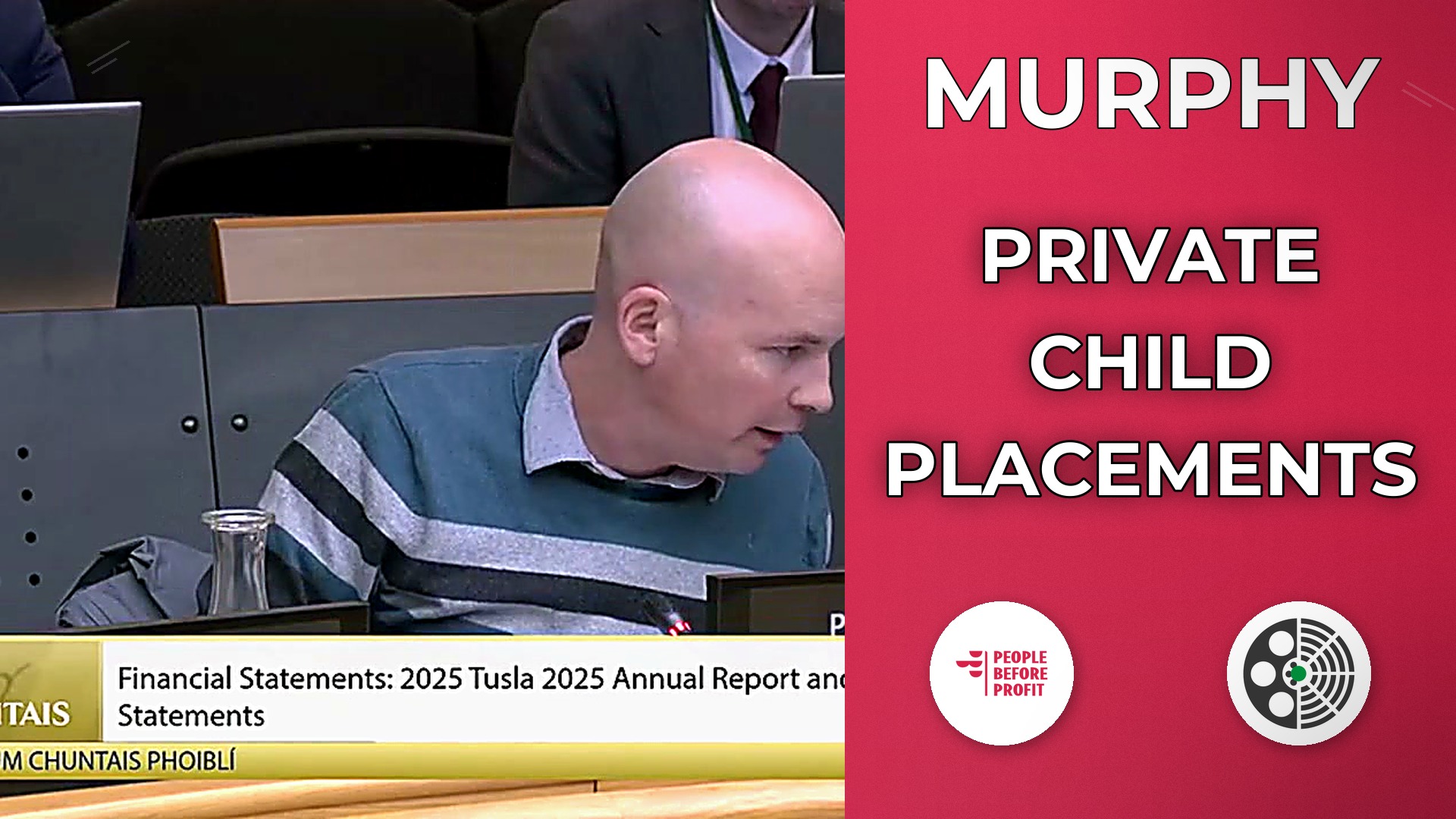


Paul Murphy challenges Tusla over private child placements
Paul Murphy questioned Tusla representatives about supervised access and private placements for children during a committee hearing. He pressed for details on provider oversight, safeguarding checks and the State’s reliance on private companies caring for children in care.
Murphy raised concerns about Supervised Access Ireland, citing reports that some staff supervising visits may not have been interviewed face-to-face or Garda vetted. He asked what lessons had been learned and whether other State bodies had been warned.
Tusla said it had introduced a Central Compliance Unit and a national system for checking new providers, including qualifications and vetting. Representatives acknowledged that the system can cause delays, while saying it strengthens oversight and child safety.
Murphy questioned Tusla about private temporary placements that are not inspected by HIQA, the timeline for providers to apply for registration and the companies holding contracts. Tusla listed 12 providers and said it had raised concerns with some providers, ceased working with several and used additional oversight or improvement plans in other cases.
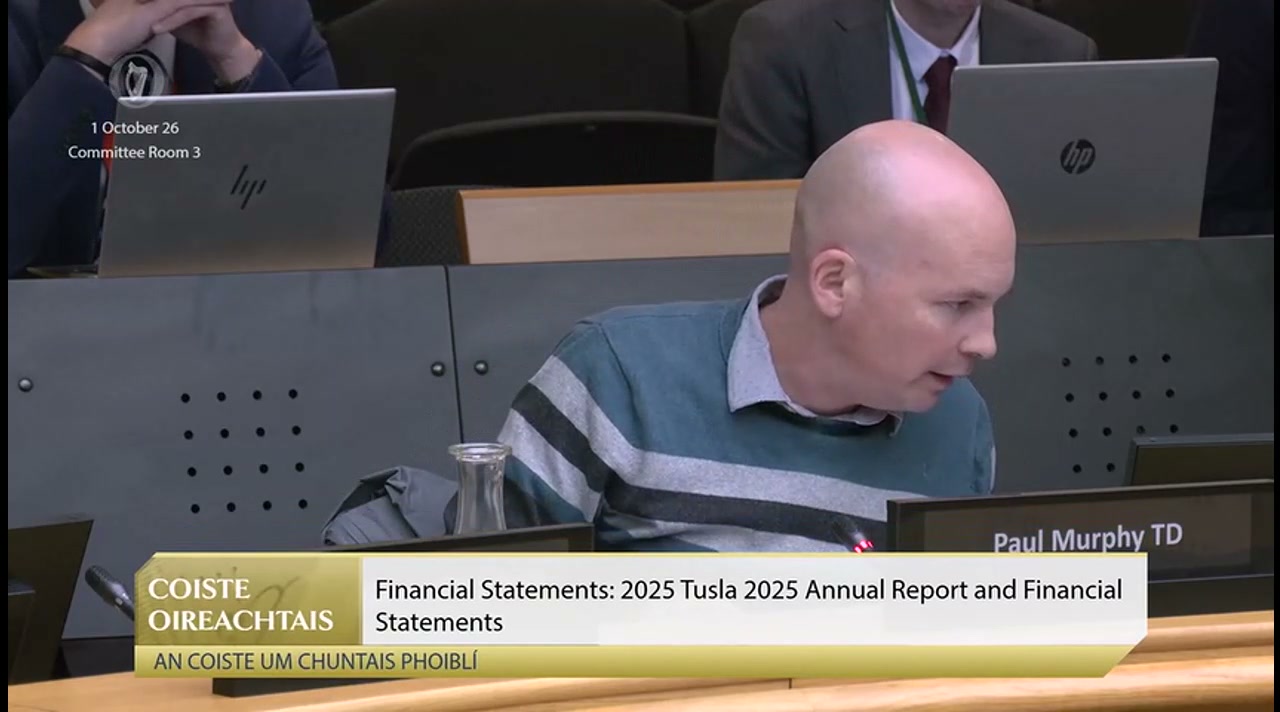
Murphy challenged the potential conflict between private companies’ profit motive and the responsibility to protect children. Tusla said it aims to move from a current balance of roughly two-thirds private provision to a 50-50 split through developing its own centres, staff and services. Watch the recording to hear the full exchange.
Supervised access safeguards
Murphy raised concerns about Supervised Access Ireland, citing reports that some staff supervising visits may not have been interviewed face-to-face or Garda vetted. He asked what lessons had been learned and whether other State bodies had been warned.
Tusla said it had introduced a Central Compliance Unit and a national system for checking new providers, including qualifications and vetting. Representatives acknowledged that the system can cause delays, while saying it strengthens oversight and child safety.
Private temporary placements
Murphy questioned Tusla about private temporary placements that are not inspected by HIQA, the timeline for providers to apply for registration and the companies holding contracts. Tusla listed 12 providers and said it had raised concerns with some providers, ceased working with several and used additional oversight or improvement plans in other cases.
Reducing reliance on private providers
Murphy challenged the potential conflict between private companies’ profit motive and the responsibility to protect children. Tusla said it aims to move from a current balance of roughly two-thirds private provision to a 50-50 split through developing its own centres, staff and services. Watch the recording to hear the full exchange.
We publish thousands of recordings to make Irish politics transparent and resistant to manipulation. Spotted an error? Report it — together we are building a reliable archive of Irish politics.
Other speeches

Tego samego dnia All speeches from this day →
Danny Healy-Rae
Danny Healy-Rae presses for green diesel support for construction
Victor Boyhan
Victor Boyhan Seeks Debate on FOI and Open Government Data
Rory Hearne
Rory Hearne: Government challenged over right to housing
Martin Daly
Martin Daly questions private profits in child residential care
James Browne
James Browne Says Housing Referendum Would Distract from Delivery
Brendan Smith
Brendan Smith calls for higher social housing income limits
Transcript
Thanks a lot for coming before us. I want to start with some questions around
supervised access. So just to start, can you confirm that you no longer use
the services of the private firm Supervised Access Ireland?
I'm not aware that we do use... I understand we don't, but we'll get that in writing to you in the morning.
We'll confirm that for you. No, no longer, Deputy. I don't think we do.
I think, so certainly in an answer I got to a PQ in October 2024,
Teusla had stopped using those services. Are you aware of why you stopped using the services?
There were concerns raised with those in relation to staff qualifications and staff vetting, if I recall.
Yeah, I mean it was quite incredible. I was in touch with some whistleblowers and put it on
the record at the time of the Dáil. I mean in some cases it appeared that staff were deployed
supervising visits when they hadn't even been interviewed face-to-face, never mind
being Garda vetted, as well as lots of other issues. Did you warn other arms of the state
against using Supervised Access Ireland, given your own experience of them, do you know?
I don't know. I'm just checking doors in my own office. I don't recall. I know with some of our
special emergency arrangement providers where there was a concern we notified the HSE in case
they were using them, but I don't recall in Supervised Access Ireland. No, I certainly
didn't notify them. Okay, because they still advertise their services in relation to family
law cases. I'm not sure if the state in another capacity is using them. What lessons were learned
in terms of that? Obviously children were exposed to potentially dangerous situations via
Supervised Access Ireland and what was put in place to try to ensure that those dangers don't exist
again. So we talk about having three categories of provision. So if we look at where we commission
community and voluntary service, we have very rigorous systems of oversight and contract
management through our section 56 service level agreement. Then when it comes on to the procured
private, we obviously again have very systems of oversight and governance, both financially and
from the perspective of the child safety and safeguarding, where we identified concerns in
relation to either special emergency arrangements or a number of small providers like you're using
that example of Supervised Access Ireland. What we recognize is that we had to do something
differently in terms of the oversight and really not taking, you know, maybe organizations and
companies at their word because let's, you know, that's often, of course, you'd ask with the
references. So the first thing we did was have established our own CCU, so our own Central
Compliance Unit in Tusla and we've talked to that already, just to be on the record for the
committee. But the second thing is in July of last year, so 2025, we brought in literally a whole new
system where no new provider could be engaged with without going through a national system
now and that they run then the checks on vetting qualifications, all that you would expect. That
has created delays and frustrations, you know, for staff on the ground who may need access to
something like a therapeutic support or something quickly, but it certainly is safer and then we've
established a whole new program of work with the supportive department. We have had additional
resources in terms of the oversight of third party providers in each region and Crona is leading a
program of work for us on really shoring up and really becoming a best-in-class operating model
for the oversight of third parties. Presumably there is still supervised access happening
under the kind of authority or care of Tusla and that's still happening via private companies?
Through Tusla, through Community and Voluntary Services. I don't have a breakdown, I don't know
if you have. No, I don't have that either, Deputy Mayor, we can check that. Some of our funded
partners. They were contracted previously, you know, to provide it, so is there, did someone
step in a different company? So around the country there's different things, like our community,
our family resource centers would do it. Do it themselves? No, our community and voluntary
organizations that we commission would do it on our behalf, but we certainly can find out if there's
a list of private providers doing it. But mostly, Deputy, that will happen with either a social care
worker or a social worker in the room and, you know, the ideal situation which we try to meet
all the time, it's somebody that the child knows. And access, the function of access is to be a
positive experience for the child and the family, you know, to make that access positive for all
concerned. And also to, you know, there's a professional assessment going on about the
quality of the interaction and what needs to happen to improve it. So it's a very professional task
to supervise access. It's not straightforward and the energy is put into that. And you don't
think then there's currently for-profit companies being used in relation to that? We'll get you the
list. Okay, great, thanks a lot. And just to move on to what were special emergency arrangements
unregulated by HICWA, now effectively private temporary placements, and that's the unregulated
bit still as I understand it. So again, just to say, Deputy, three categories. Yes, I have those
here. Registered private residential care, they're meeting HICWA standards, two emergency standards
are inspected by HICWA, and then there's private temporary placements which aren't inspected by
HICWA. No, but what we have is, I suppose, first of all, we now have a defined timeline by which
they can be in operation under the Act. So they have to demonstrate to us after 45, or within 45
days, they have to have applied for registration to become a registered provider. How long would
the application take? They could apply for it on day 45 and then it'd still be operating? It could
be 60 days. Yeah, 105 days in total is the process from start to finish. But we have, I suppose,
much more robust oversight of those placements now than we would have had. And as soon as, I mean,
certainly if they're not applying and we don't see any indication that they are applying,
they'll be moved across. Okay, and can you tell me what companies have contracts as private
temporary placements? Yeah, I don't have the full list, but, oh no, I have 12 providers, so 24-hour
care, Clarion Healthcare, Care Plus Dublin, City North, Care Plus Dublin South, Care Plus South
Cork, Care Plus Wexford, MCMA, MedForce, Move Healthcare, Springlife, Tender and Victoria.
So Care Plus obviously pops up three times. They're different franchises. Yes. Two, three,
four times, yeah. But are under Beg and Mirza Health Services Limited, I think, is the like
overarching parent company of the care. It's one of them. It's one of the Care Pluses. Okay.
And obviously there were, I think it was mostly the Care Plus Dublin South was the subject of
investigators, which might've been a year ago or so in terms of there was various issues raised.
In May of last year, I think, Toosla received a detailed report of forgeries. The report concluded
the case involved, quote, a serious employee fraud, which involves collusion, forgery, misusing
and compromising companies, staff sensitive and confidential information. You're confident that
any issues in terms of Care Plus? I certainly can give you, there was like to date, there's been
one, two, three, four, five, six, seven, eight, nine, 10 providers where when I say we had
concerns, those concerns could be to do with a practice that a team might've observed when they
were out. And so we have a summary there as to whether all of, so for example, you've just said
Care Plus South in terms of Cork, where there was a concern, those issues are now resolved and there's
no restrictions on the company. So we keep an ongoing analysis of if we feel that we need to
operate with the company, there's about six that we ceased operating with. And then others where
there's more, you know, operational issues and matters. It might be that we've put a service
improvement plan in place or extra additional oversight, but certainly with that organisation,
there's no current issues raised. We work very closely with these companies in an environment
where it's very difficult to find placements. You know, we have to actually work and I make sure
that we work closely with these companies to make sure that they're safe first. That's the
first and foremost consideration. The second consideration is to provide continuity of care
for the young person. So you're supporting the provider where you can to actually keep continuity
of care going. And then when we ask them to register, they come under our list of registered
providers. And more recently, two of them have come under our national placement team, have moved
across to the official tender. So we're moving the companies through the system and regularising
them all the time and improving them through service improvement plans, through various
governance structures, which I spend a lot of my time doing, to make sure that that is done
and it's thorough. And would you like to get away from the reliance on these private companies
altogether? I mean, isn't there inherently a certain conflict of interest between companies
whose legal job is to maximise profit versus your job, which is to protect the interests of
children? There was a district court judge who said in an official judgement, quote,
the fact that these SEAs are owned by private businesses and individuals who are profiteering
out of a placement crisis for the most vulnerable children in care is just wrong and shameful.
Is that where you want to get to with a situation where everything is too slobberated?
I think our ambition that we're seeing, first of all, at the moment it's about two-thirds,
one-third, two-thirds private, one-third statutory and voluntary. And we are really
trying to get to 50-50, really through the purchasing of our own centres and employment
of our own staff and setting up services. But we reckon it's going to take about three to five
to get to that full. Just one final question. Let's say the 12 companies that you listed there,
they might be operating like a mix of registered private residential sectors,
two-star emergency centres and private temporary placements. Might they be across those three
categories or would they be just in one category? Yeah, they might be. I don't have the breakdown
in front of me. They wouldn't be operating as part of the regulators. Sorry, as the...
It could be a section 59 or section 36. Correct.
Yes, okay. So to section 59, then we're taking over the governance of them.
Yes. They may have another centre. That's a section 36.
Okay. So they could be at different stages of levels of kind of regulation or whatever,
a process based on... Yeah.
Okay. Thanks a lot. Thank you.