

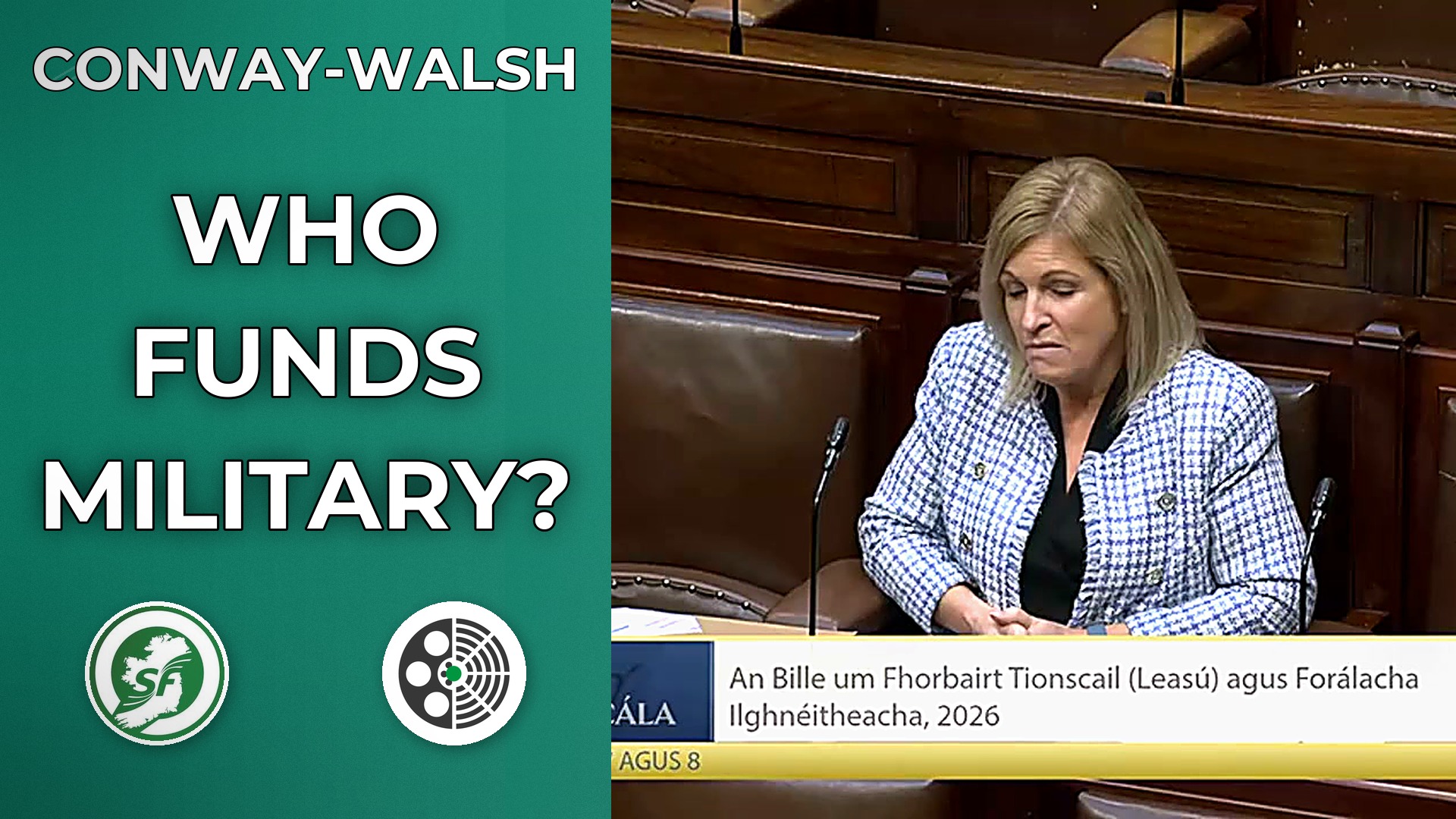


Rose Conway-Walsh challenges removal of government oversight
Rose Conway-Walsh criticised the Government’s proposed removal of a requirement for prior government approval of certain agency activities during an Oireachtas debate on amendments to the bill. She argued that removing the safeguard could leave military-related activity without sufficient oversight and expose taxpayers’ money to risk.
Conway-Walsh asked why the Government wanted to remove the requirement for approval before agencies engage in or promote activities of primary military relevance. She urged the Minister not to delete the paragraph, saying the change was unjustified and the Government would have to answer to the Irish people.
The Minister said the existing provision was ambiguous and created practical difficulties for agencies. The Minister argued that removing it would help agencies support innovative businesses and technologies, while other safeguards would remain, including ministerial direction, project appraisals, export controls and government oversight.
The Minister cited defence procurement needs and technologies including cyber security, sensors, data analytics and maritime surveillance. The Minister said streamlining agency procedures could support Ireland’s defence, security and resilience priorities.
The Minister rejected Conway-Walsh’s amendment, arguing it would reintroduce ambiguity and add administrative burdens. The exchange centred on whether the existing approval requirement should remain as a safeguard or be removed to streamline agency work.
Government approval and agency powers
Conway-Walsh asked why the Government wanted to remove the requirement for approval before agencies engage in or promote activities of primary military relevance. She urged the Minister not to delete the paragraph, saying the change was unjustified and the Government would have to answer to the Irish people.
The Minister’s response
The Minister said the existing provision was ambiguous and created practical difficulties for agencies. The Minister argued that removing it would help agencies support innovative businesses and technologies, while other safeguards would remain, including ministerial direction, project appraisals, export controls and government oversight.
Defence and security technologies
The Minister cited defence procurement needs and technologies including cyber security, sensors, data analytics and maritime surveillance. The Minister said streamlining agency procedures could support Ireland’s defence, security and resilience priorities.
Conway-Walsh’s amendment
The Minister rejected Conway-Walsh’s amendment, arguing it would reintroduce ambiguity and add administrative burdens. The exchange centred on whether the existing approval requirement should remain as a safeguard or be removed to streamline agency work.
We publish thousands of recordings to make Irish politics transparent and resistant to manipulation. Spotted an error? Report it — together we are building a reliable archive of Irish politics.
Other speeches


Tego samego dnia All speeches from this day →
John Clendennen
John Clendennen calls for managed migration and public confidence

Richard Boyd Barrett
Richard Boyd Barrett Challenges Arms Industry Support Bill

Richard O'Donoghue
Richard O'Donoghue challenges fuel tax model
Catherine Callaghan
Catherine Callaghan asks when National Security Authority will open
Martin Daly
Martin Daly warns dental access is failing children
Mattie McGrath
Mattie McGrath Calls for Carbon Tax to Be Ended
Transcript
Minister, it's highly unlikely and it's highly unusual for a government to want
to give away powers and you have to ask the question why does the government
want to enable the agency shall not engage and promote any activity of
military, of primary military relevance without the prior approval of
government. So government don't want to know, they don't want to know what's
happen in this space. They want a free-for-all and they want taxpayers
money to pay for it. This is absolutely and totally wrong. I have put in and I
see you've grouped the two amendments together in amendment 8 and some
wording knowing that, knowing that you're going to refuse to accept the other
amendment. So Minister I have nothing left to say in this space other than to
say please do not delete the paragraph as stated. There is absolutely no
rhyme, no reason for you to do that and but it's you that's going to have to
answer to the Irish people.
Minister.
Thanks, Niais go raibh maith again just to thank the deputies for tabling these amendments and as with the
previous I can't accept them. The section 8.5 provision is ambiguous and creates
ongoing practical difficulties for the agencies. Indeed it hinders agency
support by creating uncertainty about what engagement requires prior
government approval and what does not and this blanket provision is outdated
given the multi-layered regulatory framework which now exists. Increasingly
our defence forces have procurement needs related to the defence and
security technologies required to protect infrastructure in which our
economy and prosperity depends. And not one deputy here in this debate mentioned
our own requirements around investment in our own defence forces. Raising
the level of ambition to where we can continue to protect our citizens, where
we can you know strengthen national security and deliver a more capable and
resilient defence forces. The landscape is changing. I think we all accept that
both in terms of operational need of the defence forces but also the
opportunities needed in terms of domestic and European funding. We have
been very clear on the priorities which are in relation to defence, security
and resilience opportunity and streamlining these procedures facilitate
that. The agencies remain subject to ministerial direction under the
Industrial Development Acts. We will also have robust mechanisms in place around
you know rigorous project appraisals by the agencies, our export control
regulation, ministerial powers and government oversight and defence
procurement safeguards. So it is really important that the agencies remain
subject to these requirements under the Industrial Act. Governance and oversight
remain robust in terms of as I said agency project approval and this will
ensure that every project is assessed carefully, transparently and consistently.
Deletion of section 5 of the 1987 Act as proposed will streamline the work of the
agencies in supporting innovative SMEs and enterprises including cutting-edge
technologies of strategic importance to Ireland such as cyber security, sensors,
data analytics and maritime surveillance and that has been raised many times in
regards to our own vulnerabilities in regards to national security. Regarding
Deputy Conway Welch's proposed amendment I'm unable to accept it because it would
reintroduce the central ambiguity the bill is designed to remove and we
should not delete any ambiguous statutory requirement and replace it
with what recreates that ambiguity. The section 8.5 requirement is no
longer reflecting the reality of how innovation, research, industrial ecosystems
now operate and instead of providing clarity it has the opposite effect. It
has prolonged legal ambiguity and encourages excessive caution in the
system when considering engagement with projects that involve emerging
technologies with defence security and resilience potential and these are areas
of importance for our defence forces. Equally the scope of Deputy Conway
Welch's amendment is open to interpretation and potentially so broad
that would make a requirement challenging for agencies to interpret
and burdensome for any administrative purpose while the bill is designed to
streamline operations and given the nature of the modern economy and the
range of activities across civilian and dual-use activities there is the
potential for the deputies amendment to add an extra layer of bureaucracy to all
engagements with a host of companies beyond those presumably targeted by the
required to assess that in the scope of statutory requirement and what is not. As
a result the work and the focus of the enterprise agencies may be significantly
hindered. Ireland's approach to support for the sector will continue to be
governed by a combination of existing policy frameworks, legal duties,
governance standards and indeed oversight mechanisms including the
supporting export controls.
Go raibh maith agat.