

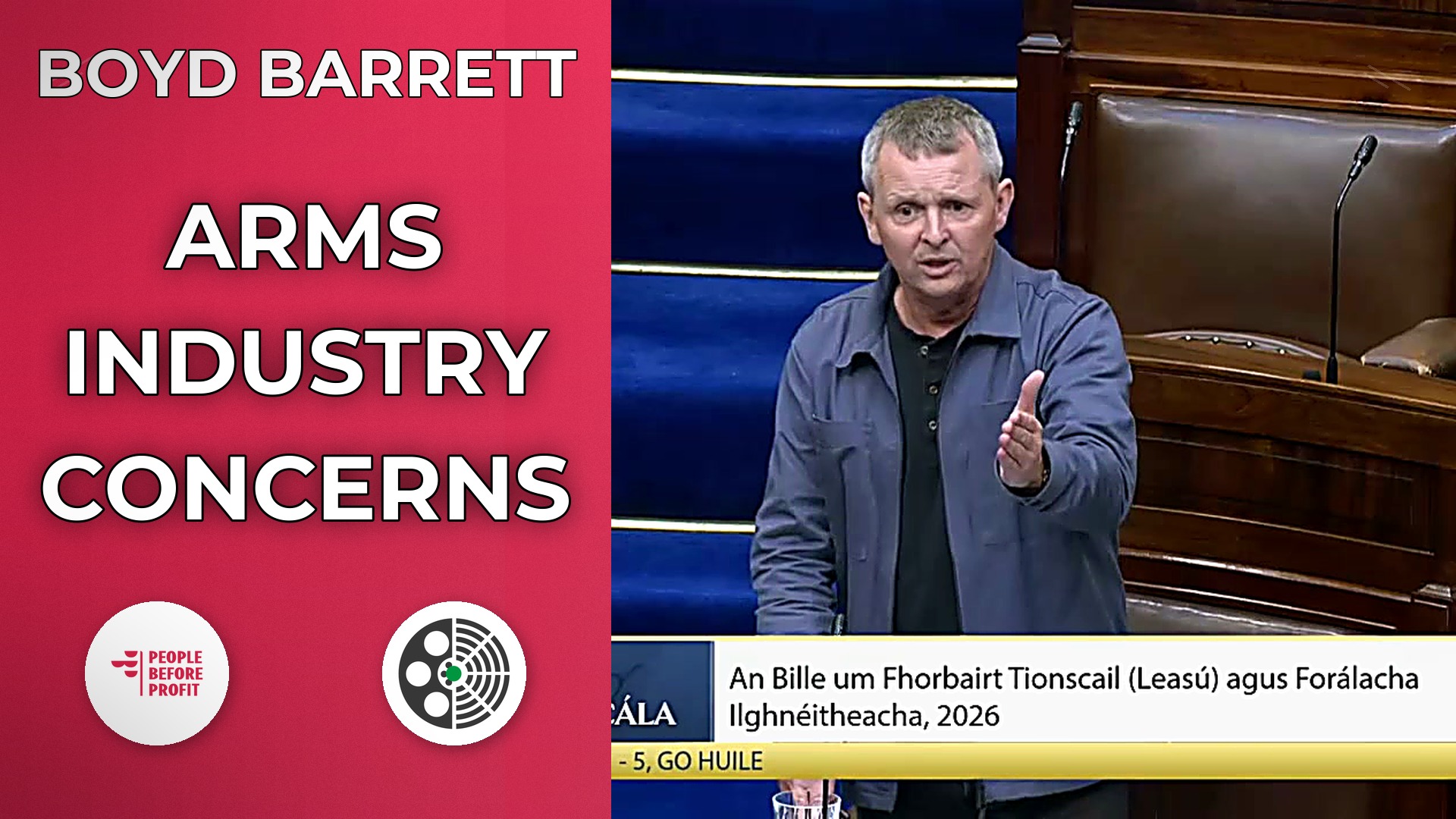


Richard Boyd Barrett Challenges Arms Industry Support Bill
Richard Boyd Barrett argued during committee-stage debate on the Industrial Development (Amendments and Miscellaneous Provisions) Bill 2026 that proposed grants and changes to oversight could expand Ireland’s involvement in the arms industry. He moved amendments to exclude military-related activity from consultancy grants, citing concerns about neutrality, dual-use exports and the removal of reporting requirements for state agencies.
Boyd Barrett said Irish neutrality should mean opposing war, militarism and the promotion of the arms industry. He argued that the bill could encourage greater Irish involvement in military-related business through support from IDA Ireland and Enterprise Ireland.
The amendments sought to prevent consultancy grants being used for advice or studies related to military activity. Boyd Barrett also criticised the bill’s proposed deletion of a requirement to notify the Government when IDA Ireland or Enterprise Ireland promote or support companies engaged in military and defence activity.
Boyd Barrett referred to reporting by The Currency on dual-use technology exports from Ireland to the Israeli military and Israeli defence and security companies. He said departmental officials had raised concerns about possible military end use, and argued that digital technology, AI and drones can have military applications.
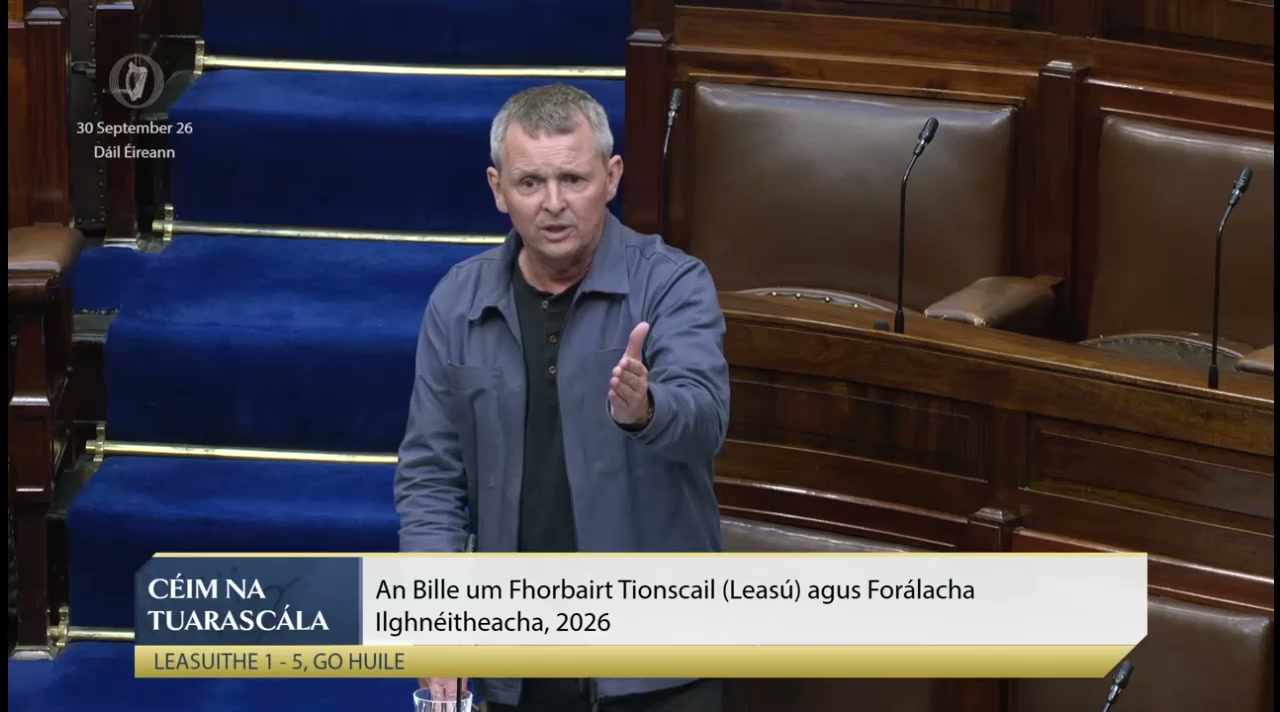
The Minister rejected the amendments, saying the grants were intended to support decarbonisation, green and digital transitions, jobs and regional development, and were not related to military matters. Boyd Barrett questioned why the Government would reject safeguards if the measures were unrelated to the arms industry. Watch the recording to hear the full contribution.
Neutrality and industrial development
Boyd Barrett said Irish neutrality should mean opposing war, militarism and the promotion of the arms industry. He argued that the bill could encourage greater Irish involvement in military-related business through support from IDA Ireland and Enterprise Ireland.
Concerns over oversight and grants
The amendments sought to prevent consultancy grants being used for advice or studies related to military activity. Boyd Barrett also criticised the bill’s proposed deletion of a requirement to notify the Government when IDA Ireland or Enterprise Ireland promote or support companies engaged in military and defence activity.
Dual-use technology and Israel
Boyd Barrett referred to reporting by The Currency on dual-use technology exports from Ireland to the Israeli military and Israeli defence and security companies. He said departmental officials had raised concerns about possible military end use, and argued that digital technology, AI and drones can have military applications.
The Government’s response
The Minister rejected the amendments, saying the grants were intended to support decarbonisation, green and digital transitions, jobs and regional development, and were not related to military matters. Boyd Barrett questioned why the Government would reject safeguards if the measures were unrelated to the arms industry. Watch the recording to hear the full contribution.
We publish thousands of recordings to make Irish politics transparent and resistant to manipulation. Spotted an error? Report it — together we are building a reliable archive of Irish politics.
Other speeches





Tego samego dnia All speeches from this day →
Martin Daly
Martin Daly warns dental access is failing children
Pearse Doherty
Pearse Doherty demands restored energy credits and windfall tax
George Lawlor
George Lawlor challenges removal of military activity safeguard
Mattie McGrath
Mattie McGrath Condemns Dundrum Handling as ‘Scandalous’
Danny Healy-Rae
Danny Healy-Rae Seeks Ferries for Cattle Exports
Brian Stanley
Brian Stanley calls for Budget funding for Family Resource Centres
Transcript
of the Industrial Development Amendments and Miscellaneous Provisions Bill 2026.
I take amendment 1 in the name of Deputy Richard Boyd Barrett.
It arises out of committee proceedings 1 and 5 are inclusive,
are related and will be discussed together.
Okay, Minister.
Sorry, moving amendment 1.
Do I have to move them all?
No, just one. Don't rush it. Just one.
Okay. Moving amendment 1.
That a consultancy grant shall not be made for the engagement of consultants to provide advice or studies in respect of any activity with military relevance.
And then there's a series of amendments from myself and Deputy Gibney in this area.
So, at the second stage debate, the Minister said this bill has no implications for our neutrality.
But it does, in our view.
It has serious implications for our neutrality.
Because my understanding of neutrality is that we do not support or promote the arms industry.
My understanding, and I think the view of most people in this country, is that where our neutrality comes from is opposition to war, militarism and empire.
The Irish Neutrality League, set up by Connolly, Pearce and Markievicz, was set up in 1914 at the outset of the First World War.
Because the people who then went on to fight for the liberation of this country, in some cases laying down their lives, to do so opposed the slaughter of the First World War.
They opposed militarism. They didn't want to be involved with big imperial blocs that sent young working class people in their millions out to be slaughtered.
That's what our neutrality is about.
And, in an apparently innocuous bill about industrial development, and who could be against that, the government actually are trying to integrate us more and promote more Irish involvement in the arms industry.
We'll get on to section 8, the bit that deletes the requirement for the government to be notified if the IDA or Enterprise Ireland are promoting and supporting companies engaged in the military and defence area.
Removing oversight over that area, which wasn't even discussed when pre-legislative scrutiny was done.
Sneaked in at the last minute, this thing is going to remove oversight over involvement of Irish companies and state agencies in the promotion of the arms industry.
I say we shouldn't be involved in promoting that.
It was very, very clear that when we rang the alarm bells about this, and quite honestly this all could have been missed because the government, I think, were engaged in a sleight of hand.
But, luckily, they were rumbled.
The minister gave away the truth when he talked about small and medium enterprise, whatever small is in this context, I'm not so sure.
But an enterprise in this country essentially getting in on the benefits of European defence expenditure, i.e. the European arms industry.
Which is being ratcheted up in a very, very big way and is implicated, crucially, in the horrors that we have seen visited on the Palestinian people in the genocide.
He referenced things like drone technology as an area we want to get into.
In case the minister doesn't know, but of course he does know, drone technology, digital technology, all that kind of stuff was absolutely central to the genocide in Gaza.
Is central. It's absolutely central to what Israel is doing to the Palestinian people.
It's central to modern warfare in what's happening in Ukraine, Russia, to the war in the Middle East started by Trump and so on.
So this is about us trying to cash in on a deadly industry that is about killing and murdering people using the most modern technology.
AI, digital technology, drones and so on.
We should not be promoting that.
We should be promoting industries that are good for humanity.
That move us in the opposite direction from militarism and war and arms spending and so on, rather than further integrating into it.
I don't know if it's been mentioned, a recent article from The Currency, I quoted extensively one that The Currency had done earlier in the year,
showing that in 2023-2024, millions of dual-use exports were sent to Israel from this country in the midst of a genocide.
In the midst of a genocide to the Israeli military.
More recently, The Currency have produced a new article showing that also in those same two years, millions, worth of 28 million euros to be precise,
of technology, dual-use technology, in other words technology that can be used by the military, were sent to Israeli defence and security companies.
In other words, armed companies who produce the hardware and the digital software and so on and so forth,
that the Israeli military are using to commit, as we speak, the genocide, the ethnic cleansing of the Palestinians.
So that's been revealed, I don't even know if that's been discussed in here yet, the more recent article.
So it wasn't just that it was going to the Israeli military, it was also going to Israeli security and defence companies.
Fair play to The Currency.
And what's excellent in the article, fair play to The Currency for doing this, is officials in the department were warning the government
that it could go to the wrong end-users, in other words to end-users who want to use it for military means in Israel.
So for example, they quote in the FAOI stuff they got back, this is officials advising the minister in the department,
the end-user has direct ties to the Israel defence industry, and risk register profile entry,
I believe the end-user is at risk of diverting these dual-use goods to potential military end-uses.
Right? That was ignored.
So the officials could see where this stuff was going, and that it could be implicated in the horrific crimes of genocide,
and it would appear the government decided we don't want to know.
Because we can benefit, we can benefit, we want to move into this area, we want to profit from an expanding area which involves killing people.
Now, I accept that after 2024, because of the uproar over the genocide, and the pressure that's been exercised on government,
things began to change.
But I do not trust, I do not trust the disposition of this government.
And you look at the failure of this government to impose economic sanctions,
we're still doing 3 or 4 billion worth of trade with the Israeli regime that is engaged in genocide.
Do I trust the Irish government when it's now not even going to be notified about this stuff?
No, I do not.
That's why I move these amendments, and I'm sure others will say why they're doing, for similar reasons,
this should not, we should not be engaging and expanding our involvement in the deadly arms industry.
May I take amendment numbers 1 to 5 inclusive, which are related, and as a committee stage, I wish to discuss them together.
Firstly, can I thank the deputies for tabling these amendments, but from the outset, I'm unable to accept them.
I suppose, firstly, I want to focus on the objectives of section 4 and 5 of the bill.
Section 4 of the bill deals with the capacity of the enterprise development agencies,
and these are IDA Ireland and Enterprise Ireland, to provide environmental grants and consultancy grants.
And the objectives of these incentives for businesses is to invest in actions that drive decarbonisation,
and our national objectives with respect to green and digital transition.
They also align with government's goals as set out in the programme for government,
and that is to support high-quality jobs, mitigate climate change, and also drive competitiveness.
The proposals, as Ken Corley has set out in sections 4 of the bill, are in no way related to military matters.
Likewise, the ultimate objective of section 5 is to support jobs, economic growth, and strong regional development.
From listening to the deputies, it is disingenuous to say that the proposal of this bill is aligned to military, to war, to subsidies around the arms industry.
That couldn't be further from the facts.
Every substantial safeguard to protect Ireland's national security, our reputation, our international obligations remain fully in force,
and it does not, in one instance, affect the government's policy on military neutrality.
And certainly, if we look at the availability of suitable property solutions, we are really looking at how we can centrally attract mobile FDI,
and that is particularly in the current high-competitive international markets,
and for them to see Ireland as an attractive place to do business.
And in that context, the joint property ventures provided for in section 5 of this bill can play a really important role in supporting job creation.
Again, section 5 of this proposal is in no way related to military matters.
As a government, we will continue to support Irish-owned companies to grow and scale,
along with providing direct investment towards each step of their decarbonisation.
At the same time, as global competition for FDI intensifies, Ireland needs to remain agile and ambitious to win investment,
and I think the purpose of this bill is to support these objectives,
and through the different sections of the bill amends different acts to specific, defined purposes.
Applying exceptional conditions to unrelated support is piecemeal,
and it's not coherent from a policy perspective that has been brought forward through these amendments.
They are conflating unrelated issues.
I heard Deputy Barrett talk about the issues around export licences,
and I know that was substantially discussed in committee stage,
and I think the Minister was very clear in terms of the export of dual-use items,
and the Department explicitly and carefully assesses export licence application,
having regard to their relevance, their regulations and criteria,
and their authorisations are deemed on that basis.
So I think, for reasons I've outlined earlier, I will not be accepting these amendments.
Okay, so you'll have a more difficult time explaining the deletion of Section 8,
but let's take you at face value and say these things are not connected.
Then what's the problem with our amendments?
If you're talking about giving the IDA powers, for example, to set up DACs for purely benign purposes
that have nothing to do with the arms industry or the military sector,
why would you have a problem with our amendments?
Because, you say, there's no connection.
So why don't you just accept them?
And we're all happy, because nobody has a problem with the IDA or Enterprise Ireland providing grants,
or, although I have problems with DACs on another level, but we'll set that aside for today,
but in supporting the development of companies that are engaged in environmental research
or other areas of research that is non-military, not related to the defence sector
and the areas we're concerned on that might impinge on our neutrality.
And I think the reason you don't want to accept them is because, actually, there is another agenda.
There is another agenda here, and it is to do with Rearm Europe,
and we'll talk more, that was alluded to there by Deputy Gibney, the 800 billion euro,
the big pot of money that Ireland wants to move in on and seize potential benefits from,
but means contributing to an industry that actually visits death and destruction on people
and has done very recently, and the government was caught out in its involvement in that
in terms of companies in Israel, arms companies, the Israeli military itself,
getting dual-use technology from this country, which was almost certainly used to kill Palestinian people
during a genocidal massacre.
So, I don't see why the government would have a problem with our amendments, if what you say is true,
but when you look at the rest of the bill, and in particular what we'll be discussing in a minute,
the government are engaged in a stealth manoeuvre here.
For the purpose of this bill, a lot of the items that are being raised here are unrelated
to what the specific amendments have been tabled.
What I will say again is that we should be making it easier for our agencies,
IDA Ireland and Enterprise Ireland, to meet its objectives,
and if that's consultancy grants or environmental grants,
that's very much a core objective of this government in terms of our green and digital transition.
These agencies are working closely with client companies
as they continue to navigate these strategic challenges,
and this proposed grant would be an important addition to their toolbox.
I will say international challenges are very much on the horizon due to geopolitical uncertainty.
That, for everyone's understanding, is impacting supply chains and the speed of technology change,
and I think that's really important that our agencies are adapting with the growing technology
and the introduction of AI as key consideration for many enterprises.
So, it is really important as a state that we ultimately continue to support companies
who are making that green transition or increasing their digital maturity,
and this is the essence of what we are trying to do within this bill,
and for that reason, we won't be accepting these amendments.
Okay, well look, the arguments have been made,
but I repeat that while the relevant sections that we're trying to amend here,
section four and five, don't explicitly refer to the arms industry
and refer to relatively benign uses,
we're asking for an insurance.
We'll move on to the next section, which is the reason it throws doubt on these sections,
your decision to move out section eight,
but it does refer to, for example, consultancy grants around technological innovation, digitalization, and so on,
and what we're saying in areas like that, it should be absolutely explicit,
not for military and defense sector.
Now, if it isn't, and if grants which could be up to seven and a half million,
I think the figures are, for consultancies, 15 million in total, or land and property and so on,
if it's not under any circumstances going to go to the security or defense industry,
what's the problem with saying it won't?
Why are you refusing the amendments?
Because we're just asking for a safeguard against the use of this money by companies that would be engaged in those areas.
And of course, I think you know, and we'll get on to the next section,
that many of these companies, there's a gray area between digital technology, innovation in that area,
and even so-called environmental stuff, and the military sector.
You know there's actually a gray area.
And that is a gray area that is exploited by those companies in order to produce dual-use technology,
which is then used to kill people.
And we'll get on to, and that's where the relevance of the currency articles, and so on, the dual-use technology,
where officials were warning the department, we think this will be used by the end user for military means,
even though the end user was saying, oh no, of course not.
But of course, the end user was an arms company deeply implicated in Israel's crimes.
Thank you Deputy.