

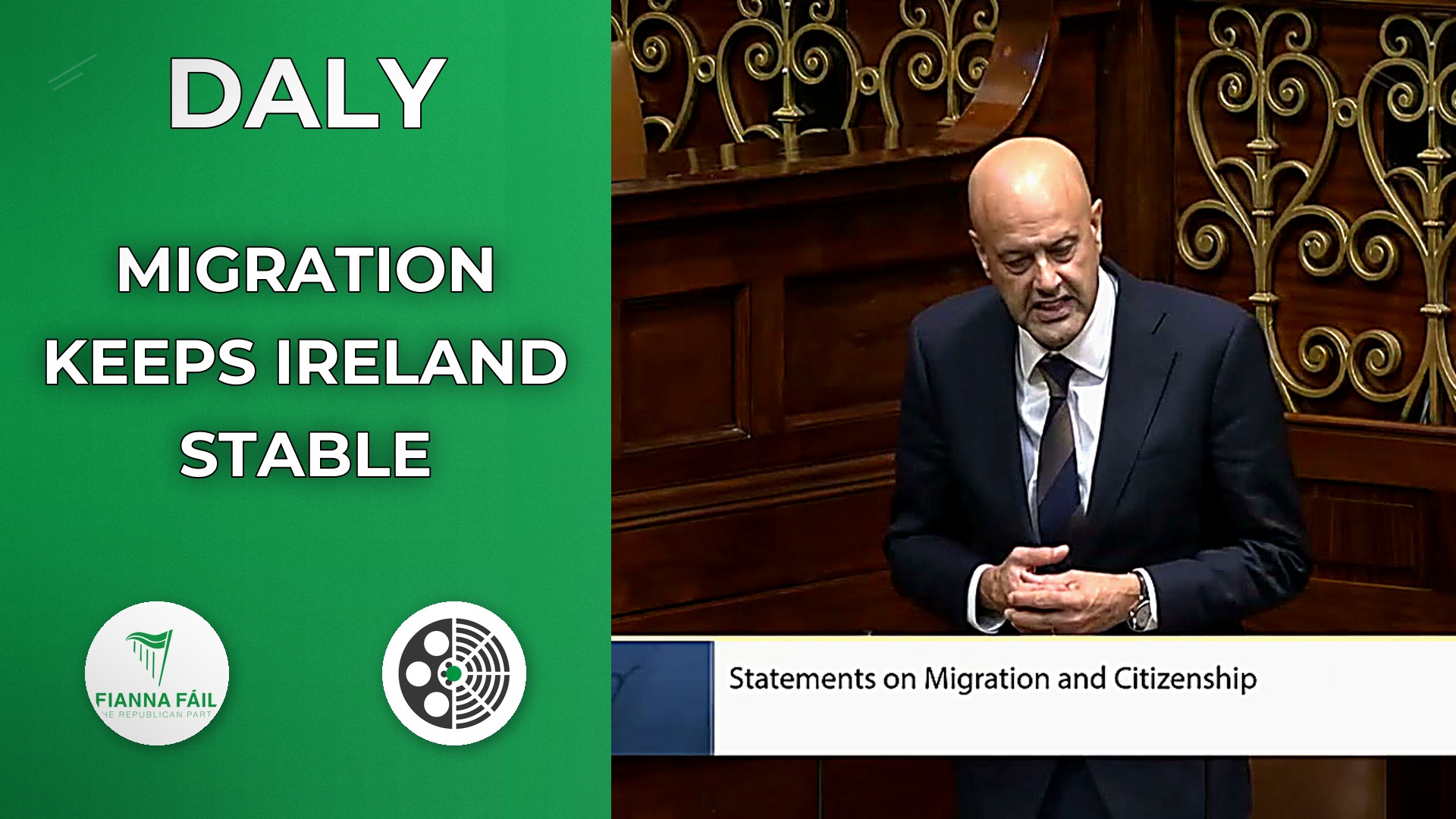


Martin Daly: Citizenship rules need fairness for migrants
Martin Daly speaks about citizenship requirements and immigration, arguing that long-term residents with applications already in progress need fair and flexible treatment. He says migration supports Ireland’s economy and that public confidence in the immigration system must be matched by recognition of migrants’ contributions.
Daly draws on his mother’s experience as an Indian immigrant who lived and worked in Ireland for decades before taking Irish citizenship. He supports reviewing citizenship requirements, including language tests and evidence of contribution, but says lengthy application delays are a serious concern. He calls for flexibility in individual cases, including for families facing long waits for citizenship and reunification.
Daly says migrants have contributed across healthcare, hospitality, construction, pharmaceuticals and IT. He argues that their work and presence should be valued, and that government and public representatives should speak more clearly about migration’s contribution to Ireland.
He supports tightening immigration rules where this helps ensure the system is fair and trusted by the public. Daly warns that a lack of confidence can create room for fascists and right-wing agitators, and says the state must address racism, including attacks on Indian nationals.
Daly points to a falling birth rate and an ageing population, arguing that migration is needed to help keep the country and its economy stable. Watch the recording to hear his full contribution.
Citizenship applications and family reunification
Daly draws on his mother’s experience as an Indian immigrant who lived and worked in Ireland for decades before taking Irish citizenship. He supports reviewing citizenship requirements, including language tests and evidence of contribution, but says lengthy application delays are a serious concern. He calls for flexibility in individual cases, including for families facing long waits for citizenship and reunification.
Recognising migrants’ contribution
Daly says migrants have contributed across healthcare, hospitality, construction, pharmaceuticals and IT. He argues that their work and presence should be valued, and that government and public representatives should speak more clearly about migration’s contribution to Ireland.
Fair rules and public confidence
He supports tightening immigration rules where this helps ensure the system is fair and trusted by the public. Daly warns that a lack of confidence can create room for fascists and right-wing agitators, and says the state must address racism, including attacks on Indian nationals.
Migration and Ireland’s future
Daly points to a falling birth rate and an ageing population, arguing that migration is needed to help keep the country and its economy stable. Watch the recording to hear his full contribution.
We publish thousands of recordings to make Irish politics transparent and resistant to manipulation. Spotted an error? Report it — together we are building a reliable archive of Irish politics.
Other speeches
Tego samego dnia All speeches from this day →
Michael Cahill
Michael Cahill backs review of energy windfall profits

Sinéad Gibney
Sinéad Gibney urges windfall tax on energy company profits
Jen Cummins
Jen Cummins calls for fairer immigration and teacher pathways

Albert Dolan
Albert Dolan questions solar planning in rural Galway
Paul Lawless
Paul Lawless Calls for Tighter Citizenship Rules
Rose Conway-Walsh
Rose Conway-Walsh: ‘Nobody should be freezing in their homes’
Transcript
to speak here today. I'm the son of an immigrant. My mother was Indian. She came here in 1954
to study medicine in the College of Surgeons and the Royal College of Surgeons in Ireland.
She loved this country. She didn't hold citizenship for almost 40 years after having seven children
and working in rural practice. She took out an Irish passport in her later years because
it facilitated travel to and from Europe. The point I'm making is you can have residency
here and we shouldn't conflate that and scare people who are long-term residents here and
haven't applied for citizenship heretofore. And whilst we look at a reform of our citizenship
requirements, we should make that clear to people. So it is important that we have a
review of citizenship requirements. I'm quite happy with the idea that there are certain
requirements such as language tests, a history of contribution to the economy and other such
tests. I don't have a problem with that. The extension of five to eight years, it is something
that can be debated but I've had no representations of real fear around that. Where there is concern
is because the application for citizenship at the moment takes so long. I have a medical
consultant and his wife who's a nurse. They've been here for a number of years. They have two
children in India being brought up by frail elderly grandparents and they're finding it very,
very difficult to affect a family unification. So I do think we need to have more flexibility
and fairness around individual cases where people have demonstrated their commitment to this
country. And let's not forget, migration to this country has been a good thing in spite of the
organised right-wing groups to conflate illegal and legal immigration. The vast majority of our
migration are people we've invited into this country who've added to our economy in all sorts
of spheres. Healthcare, in the hospitality industry, in construction and in pharmaceuticals
and IT. People who've added to this economy and they need to feel that their work is valued and
that their presence here is valued. Unfortunately we have had a rise of racism. Fourteen months,
fifteen months ago we had a spate of attacks against Indian nationals around this country
and I did visit the Indian ambassador at the time, Akhila Mishra, and expressed my sadness at those
attacks where people were being targeted because of the colour of their skin. Driven by social media,
driven by people like Elon Musk and his hundreds of millions of followers. But it is absolutely
crucial that people who are already in the system with their application for citizenship, as that
couple are two years in the system. Another doctor who has approached me, he's been here for 15 years,
his wife is his teacher, she now works as an SNA. She has applied for citizenship, she's two years
in the system and they're fearful that they will be set back. So we really do need flexibility and
fairness for those group of people who already have their application in process. And I think
that it is important that whilst the government has pursued a focus on immigration, part of the
reasoning of that, in my estimation, has been that if you don't have a fair, firm system, that the
public believes in. Because there's a narrative against our immigration system that suggests that we have an
open-door policy and that does create problems. So we have to have a system that the public has a full
confidence in, in order to avoid creating political vacuums where fascists and right-wing agitators
can prosper. So I agree with the tightening of our immigration rules on that basis. We have to
demonstrate to the general public that this system is fair and equitable. In relation to
the whole issue of our migrants, I don't think the state is recognising adequately the contribution
of migrants in the state and to our economy. And I do think that we must have a much more
forceful narrative coming from the state, coming from government, coming from public representatives
around the value of migration to our country. Our birth rate is falling, our elderly demographic
is growing older, a million people over 65 by 2030, 1.6 million by 2045. We need migration to
keep this country and this economy stable.