



Mary Lou McDonald: CHI Inquiry Must Answer Parents
In Dáil Éireann, Mary Lou McDonald challenged the proposed inquiry into Children’s Health Ireland (CHI) over its proposed starting date of 1 January 2019. She said parents need an inquiry that examines earlier failures, investigates individual cases and provides public accountability where families want it.
McDonald said children with scoliosis and spina bifida had been failed by CHI and the health system, while parents had fought for answers and accountability. She highlighted concerns that setting the inquiry’s start date at 2019 could exclude people who experienced failures before then.
McDonald argued that the inquiry should examine individual circumstances as well as systemic problems. She said parents need a process that identifies all failures, including individual failures, to have confidence in its findings.
McDonald acknowledged that some families may want to give evidence in private, but said parents who wish to testify publicly should be able to do so. She called for accountability to be public too.
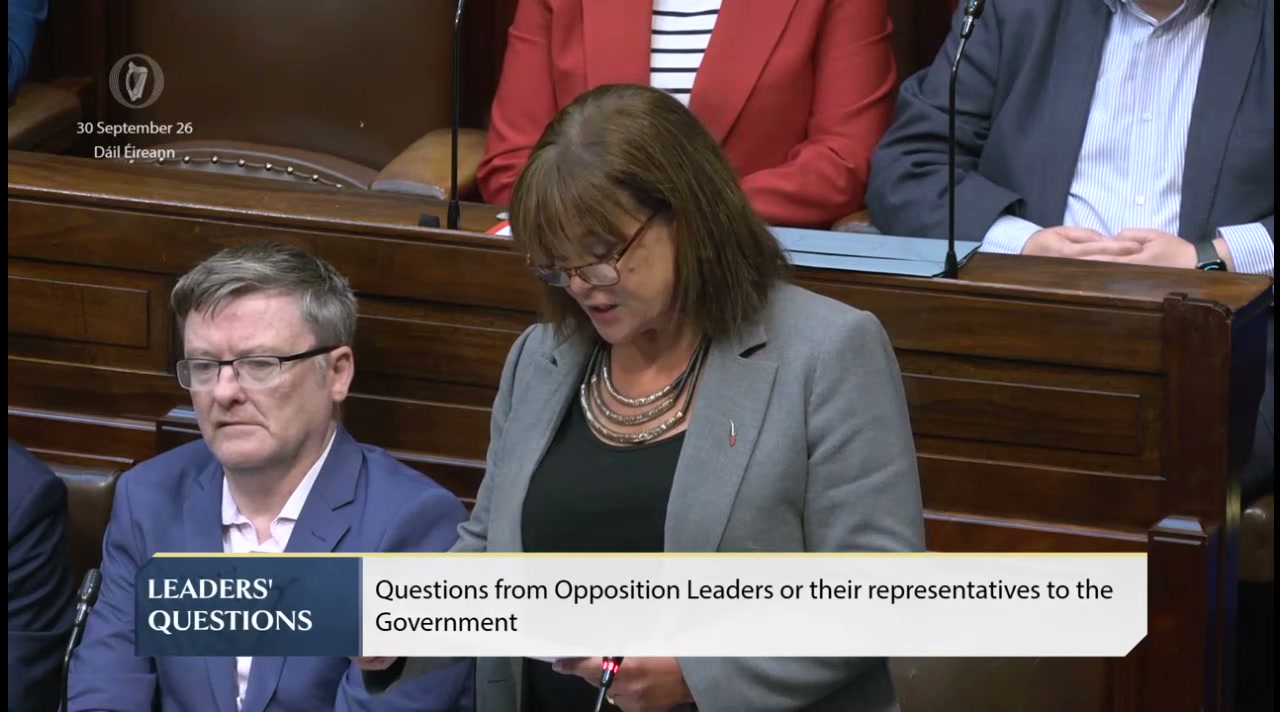
The Taoiseach supported a statutory inquiry and said a commission of investigation could have powers to compel witnesses and documents. He said the inquiry’s chairperson could have discretion to consider issues predating 2019 and that parents and advocacy groups would be invited to contribute to its terms of reference.
Parents seek answers
McDonald said children with scoliosis and spina bifida had been failed by CHI and the health system, while parents had fought for answers and accountability. She highlighted concerns that setting the inquiry’s start date at 2019 could exclude people who experienced failures before then.
Scope and individual cases
McDonald argued that the inquiry should examine individual circumstances as well as systemic problems. She said parents need a process that identifies all failures, including individual failures, to have confidence in its findings.
Public accountability
McDonald acknowledged that some families may want to give evidence in private, but said parents who wish to testify publicly should be able to do so. She called for accountability to be public too.
Government response
The Taoiseach supported a statutory inquiry and said a commission of investigation could have powers to compel witnesses and documents. He said the inquiry’s chairperson could have discretion to consider issues predating 2019 and that parents and advocacy groups would be invited to contribute to its terms of reference.
We publish thousands of recordings to make Irish politics transparent and resistant to manipulation. Spotted an error? Report it — together we are building a reliable archive of Irish politics.
Other speeches
Tego samego dnia All speeches from this day →
Richard Boyd Barrett
Richard Boyd Barrett Challenges Dual-Use Export Changes
Sinéad Gibney
Sinéad Gibney urges windfall tax on energy company profits
Carol Nolan
Carol Nolan challenges committee over three-day wait testimonies
Pearse Doherty
Pearse Doherty demands restored energy credits and windfall tax
Albert Dolan
Albert Dolan questions solar planning in rural Galway
Séamus McGrath
Séamus McGrath urges protection of Cork Domino midwifery service
Transcript
A thíosach tá tais maith fháirí tríona chéile mar gheall ar an coir chuaige
tá bairtead an fhíosarú ar sláinte lanní Éireann. Ní mór don ríoltas ganíobhú
chun dul in leich leann a goidh imni, agus chun cíonsiú go bhfáin an fhíosarú
chun an fhragraí a tá daoí. Thíosach, for years we have heard the harrowing
stories of children with scoliosis and spina bifida. Children who were failed
catastrophically by Children's Health Ireland and by the health system prior
to the establishment of that organisation, left waiting for
operations that could change their lives, living with the fear of becoming
inoperable children who had their hips operated on unnecessarily. They were
profoundly failed by the state and by successive governments. And parents have
fought a long and hard battle for answers. They fought for accountability
and yet they were stonewalled at every turn. And it took the death of nine-year-old
Harvey Morrison-Shirratt for the government to move on an inquiry.
Following meetings with Harvey's parents, Gillian and Stephen, Tánaiste Simon
Harris and Health Minister Jennifer Carroll MacNeill promised an inquiry that
would be child-centred, to provide parents with answers and to deliver
accountability. On Monday, Remy Farrell published his report on CHI and the
recommendations for that proposed inquiry. And parents feel that they still
haven't been heard. They are back to square one. Firstly, Thíosach, they're
because the period to be covered by the inquiry will have a starting point of
January 1st 2019. But the failures of children didn't begin on that date.
Indeed, they long predated the establishment of CHI. In fact, Simon
Harris made his now infamous promise back in 2017, because at that stage we
already had a crisis. He said at that time that no child would wait longer
than four months for spinal surgery. Of course, that promise came to nothing and
meant nothing as children continued to suffer. So it's not acceptable that an
examination of those early years would be excluded from the inquiry, because it
means that people who are now adults, who suffered greatly as children while
waiting for treatment before 2019, will be deliberately cut out of that inquiry.
And that's just wrong, Thíosach. Parents are also upset that there won't be
detailed investigation into individual circumstances and treatment of affected
children. Instead, the focus will be exclusively on systemic problems. So the
question is, how this inquiry will provide parents with the truth about how
their child was failed. For this inquiry to have the confidence of parents, it has
to be a process that identifies all failures, including individual failures.
There is also real concern that the majority of the proposed Commission of
Investigation would be held behind closed doors, and of course some parents
will want to give their testimony in private, and that has to be respected and
accommodated. But remember that many, many parents are done with closed doors.
They were forced to share their children's suffering very publicly, so
they want to give their testimony in public, and they want the accountability
to be public too. Thíosach, can I ask you, do you understand why parents feel so
badly let down? Do you recognize and accept that the starting point of
January 1st 2019 is totally wrong? And can you tell parents today what you will
now do to ensure that this inquiry provides them with the answers that they need?
Thank you. First of all, I'd like to offer my deep condolences
and those of the government and the entire team here at the Oireachtas on
last night's very sad passing of our colleague and friend Seamus Carroll,
husband of another colleague, Trasa Carroll. Seamus was a very respected
member of the Ursa team, and there will be a strong sense of shock and upset
among the team throughout the house today. We think of him and pray for him,
Trasa, and his entire family at this very sad time.
I first of all agree that we need a statutory inquiry in relation to the
paediatric services at CHI, and particularly following the scoping
report on the Children Health Ireland inquiry into spina bifida and
complex scoliosis exercise on the 29th of September, which the government
published and the Minister, Jennifer Caron-McNeill, published. The issues are
very, very serious, and the parents have advocated, and many others,
strongly, for an inquiry. My view is that Senior Consul Remby Farrell did a
very comprehensive piece of work in respect of the scoping inquiry, and
would make the point that officials in the Department of Health will now work
closely with the Office of the Attorney General on drafting the terms of
reference. There will be a call for input from advocacy groups on the terms
of reference, and the final terms of references will then be submitted to the
government for approval. In respect of a number of issues that you have raised,
as you know, Mr. Farrell recommends a commission of investigation, which is
statutory, mandatory, has compellability, has all of the core requirements of a
public, a statutory public inquiry as per the Act. He has defined four modules,
waiting lists, spinal surgery, hip dysplasia, and the cohort of children who
were not transferred to Temple Street post-2008. And then there are two sub-modules
recommended on the module on waiting lists, and the first would be a personal
family statement module, and the second would be a module in relation to the
management to waiting list issues. And he also recommends that a commission
should inquire into whether the management of CHI were aware of the use or
intended use of the non-CE Mark Springs and surgeries undertaken at Temple
Street by consultant A between 2020 and 2022. And then there's further work in
terms of the hip dysplasia, and as I said, children not transferred to Temple
Street. An important point, a commission model can deliver the same core
statutory powers as a tribunal, and arguably then better suited to the
specific subject matter of the inquiry, namely the medical treatment of
children. The commission can compel witnesses, can compel the production of
documents, and will publish, obviously, a final report. Mr. Farrell came to his
based on the personal and medical information of children. He feels this
model is the optimum model to handle sensitively the personal and medical
information of children, and he's concerned, as I would be myself, in terms
of a significant risk that children may be identifiable. Of course, within a
commission of inquiry, there is the capacity for public modules, and that's
an area where the chairperson clearly has significant discretion. Chairperson
could also have discretion in respect of any issues that arise during the course
of the discussion that would have a more historic context pre-2019. That
discretion can be provided expressly to the chairperson to utilize his or her
discretion to go back. And can I too send our best wishes and solidarity to
all of Seamus's family on his sad loss.
I spoke with Harvey Morrison Tratt's mother this morning, Gillian. This is what
she said as regards what's proposed. She said it's so far removed from what we
were promised and expected that we feel like we're back at day one. I think
that's really worrying, and it reflects the reaction of many, many parents, and I
I'm not questioning the essential model that's proposed. I've questioned you
specifically on its point of departure, and I've put it to you that the 1st of
January 2019 is not the correct date, because these problems, these issues,
these really negative experiences, these promises that were made to the parents
also, and children, predate 2019. So why in the name of goodness would you take
that as your point of departure? I think in the terms of reference that needs to
be corrected. And secondly, the explicit recognition that this will be a public
process, except where parents choose or wish to give testimony in private. Those
are two, just two, amongst others, but two core issues that parents are advocating
for. Above all else, this inquiry has to, I'm sure you'll agree, enjoy the full
confidence of those parents and families.
Clearly, Mr Farrell has said, and I would agree with this from experience, that
inquiries do work best when they have a defined scope and time.
Any inquiry that's absolutely open-ended, or has very broad terms of reference, can
go on for a very, very long period of time, and I don't believe that's in the
interests of parents, families, or children involved. So that's why he
219 to 225 inclusive, 2019 being the establishment of CHI, so it's a six-year
period. Now, as I said earlier, the discretion will be there for the chairperson,
and if issues arise that predate 2019, the discretion will be there for the
chairperson to go back and look at those issues also. And again, as I said, there
will be input into this, and the Minister will continue to engage, but I
think that there is an issue here, and there's also an issue then in terms of
if it's, I believe it's, and this is a statutory public inquiry as per the 1921
Act, there's a danger that some may not participate. Quite a number of parents
may not want the particular, you know, their children to be publicly identified.
No, but I just, but that is the, that's why, but that's why, the 2019, but I'm
saying the chairperson would have, would be given sole discretion to go beyond
that, to go back to that data issue.