

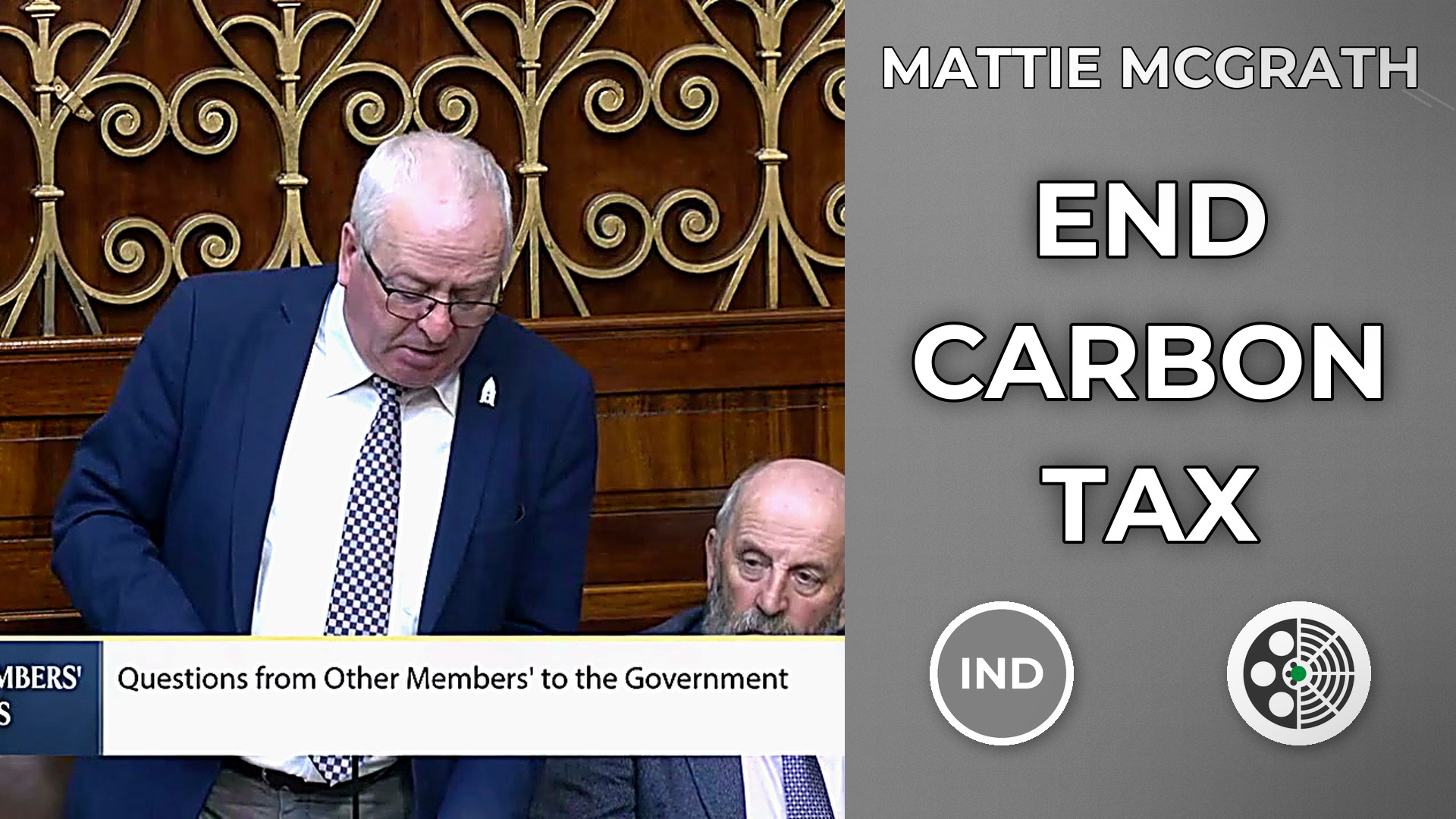


Mattie McGrath Calls for Carbon Tax to Be Ended
Mattie McGrath called on the Government to end carbon tax and provide further support for households and businesses facing high fuel costs during a Dáil Éireann exchange ahead of the next budget. He argued that fuel is a necessity, particularly in rural Ireland, and that existing measures have not eased the pressure on people enough.
McGrath said diesel prices had climbed again after temporary reductions in fuel levies, leaving workers, farmers, hauliers, carers and small businesses under pressure. He highlighted the cost of home heating and the reliance on cars and vans in areas with limited public transport.
The TD said the Government was taking about 91 cent in duties, carbon tax, levies and VAT from a litre of fuel priced at £2.15. He called for carbon tax to be ended, rather than paused, and said pensioners and families needed meaningful support in the forthcoming budget.
The Taoiseach cited the cost of measures introduced earlier in the year, including fuel excise reductions and support for hauliers and contractors, and said the Government was examining further options ahead of the budget. He also defended carbon tax revenue as a source of funding for farmers, home retrofitting and energy-saving measures.
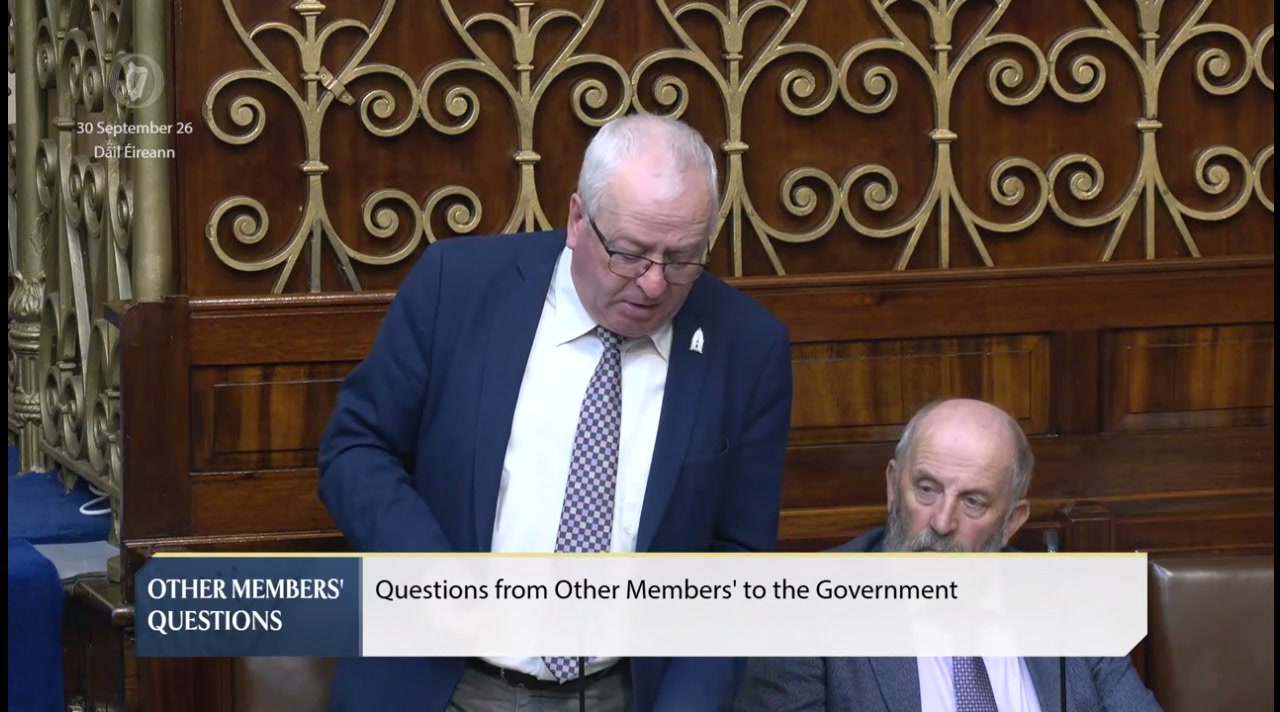
McGrath argued that many households could not afford the upfront cost of retrofitting and were struggling with basic expenses. The exchange also addressed energy prices, the impact of international conflicts and the Government’s approach to supporting households facing higher costs. Watch the recording to hear the full contribution.
Fuel costs and rural households
McGrath said diesel prices had climbed again after temporary reductions in fuel levies, leaving workers, farmers, hauliers, carers and small businesses under pressure. He highlighted the cost of home heating and the reliance on cars and vans in areas with limited public transport.
Call to end carbon tax
The TD said the Government was taking about 91 cent in duties, carbon tax, levies and VAT from a litre of fuel priced at £2.15. He called for carbon tax to be ended, rather than paused, and said pensioners and families needed meaningful support in the forthcoming budget.
Government response
The Taoiseach cited the cost of measures introduced earlier in the year, including fuel excise reductions and support for hauliers and contractors, and said the Government was examining further options ahead of the budget. He also defended carbon tax revenue as a source of funding for farmers, home retrofitting and energy-saving measures.
Retrofitting and affordability
McGrath argued that many households could not afford the upfront cost of retrofitting and were struggling with basic expenses. The exchange also addressed energy prices, the impact of international conflicts and the Government’s approach to supporting households facing higher costs. Watch the recording to hear the full contribution.
We publish thousands of recordings to make Irish politics transparent and resistant to manipulation. Spotted an error? Report it — together we are building a reliable archive of Irish politics.
Other speeches
Tego samego dnia All speeches from this day →
Carol Nolan
Carol Nolan says citizenship rules do not go far enough
Colm Brophy
Colm Brophy sets out Ireland’s migration system reforms
Carol Nolan
Carol Nolan challenges committee over three-day wait testimonies
Danny Healy-Rae
Danny Healy-Rae Seeks Ferries for Cattle Exports
Victor Boyhan
Victor Boyhan questions proposed cap on breeding dogs
Rose Conway-Walsh
Rose Conway-Walsh warns enterprise supports risk neutrality
Transcript
I want to express my condolences on the sad passing of our wonderful friend and
daughter Seamus Carl. A true gentleman and there's a sense of gloom around the house
this morning and to wish his wife and family all the very, very best.
Agus, a freshman at Concal, or less Concal if you'll allow me,
Ayr Cor Laor, Seamus O'Donnell, Seamus O'Donnell,
and Sian O'Poble in Cundai Port Lauderdag. The Chief Whip there would be known him and
worked with him for many years. A special, dedicated, hard-working county councillor
for the 10 years he's been to Waterford County Council. Community activist. Gaelge was a big love
with many other issues but serving people and serving his community was his motto and I wish
they could have a Yanom Dailish for both men. Taoiseach, as we approach another budget,
families, workers, farmers, hauliers and small business people, nearly everybody you can say,
are fully, really, really frustrated with the government's approach to helping them in this
crisis. Following the fuel process, a growing public anger. The government introduced limited
temporary levies and they were welcomed by the people but now when we see prices of diesel
again at £2.20 and even £2.30 in places, look, those are like snow off a ditch, they're gone
and there's no impact at all on them. The reality is that fuel is not a luxury, Taoiseach, it is a
necessity. Workers need to get to work, farmers need machinery to plough and till their lands
and provide the foods, very important, and vehicles to operate and the carers need to
visit the vulnerable people. Small businesses are squeezed to the limit and indeed the transport,
cost of transport is just crippling everybody and above all the home heat and oil and the
pensioners and ordinary families trying to pay the taxes doubled the price of last year and worse,
it is just not really unthinkable and the government continues to pile costs onto motors
to carbon taxes while taking an enormous share of the profit paid at the pump and when we look
at that figure, where a litre of fuel costs £2.15, your government Taoiseach is taking approximately
91 cent from every litre to excise duty, carbon tax, levies and VAT. You give your hand in the people's
pockets every day of the week, yourself and Simon Thomas de Harris and it's time you took it out
of it and gave fair play to the people. Fair play is fine play with me and they need fair play
and they need, they don't want fine play but they need fair play and they need to be respected here
in the crisis that they're in, especially in rural Ireland, you know, where we don't have public
transport, the car and the cars and vans are a necessity, not a luxury, you have to have them
and you're obsessed when you're in government with the Greens of the carbon tax and everything else,
that has to be re-taught, re-examined and indeed totally stopped for the present time anyway and
have a further re-evaluation because the money is not going back into retrofitting an awful lot of
it as I pointed out to you at the House here before. So Taoiseach, do you government accept,
as I said, that the carbon tax must be halted here instead of increases and that we must give
meaning for supports and talks in the media of a 750 for pensioners is not acceptable,
they need a decent modicum of respectable increase to be able to allow to have a modicum of living
that should be available to them and it's not. Taoiseach to respond. First of all thank you very
much Deputy for raising the issue, as I said earlier we are in the midst of a very significant
cost of living issue because of two major wars, the Russian invasion of Ukraine and the war in
Iran which has caused very very significant increases in oil prices. Oil prices have risen
from about 69 dollars a barrel in February last to about 104 dollars in May, while gas prices
increased from 32 megawatts per hour to 47. So these are very significant increases. Now in the
last budget we brought in a series of measures under social protection to protect the lowest
incomes. You said that what we introduced earlier this year were limited temporary measures in
respect of reducing the excise by 27 a litre in petrol, 32 cents per litre of diesel, 7.4 percent
in terms of marked oil and other measures we took in terms of hauliers, contractors and so on. The
cost of that was 1.3 billion and they're still in place, so they're not limited and they haven't
been too temporary either and the government is examining all of that in the context of the budget.
The carbon tax is much lower than any of that, about two cents, that's the increase that would
come I mean, and we are looking at the home heating component of the carbon tax in terms of kerosene
and gas because we realize that home heating is critical for pensioners and so forth
and we examine that in the context of the forthcoming budget, but there is a limit. If we
go below a certain threshold of carbon tax, you then have to pay carbon tax to Europe essentially
under the ETS2 and that makes no sense because the carbon tax is used for farmers,
it's used for the retrofitting and the energy saving measures, the cost saving measures
that Brian I think has been very effective on and he announced a further 115 million yesterday
that will significantly benefit a lot of households in respect to going solar
or other insulation, attic insulation, cavity wall insulation, batteries, all of that will bring down
the cost of energy for individual households by about close to 800-900 euros a year, which would
meet some of the increases here that have occurred over the last while since the wars broke out
and about 287,000 houses now have availed of retrofitting grants and various measures that
will help them permanently reduce their costs, their energy costs, and we have to double down
on that. I think we have to increase availability of TANs for farmers in respect of solar, for
example, and we should make sure that that happens comprehensively because that will make a difference.
Farmers have been shown where we provide a lot of resources across the board,
they will respond in terms of adapting measures, mechanisms such as solar and others to save and
to reduce costs and that is something that we're very focused on doing.
No farmers, no food and the farm contractors, the forestry contractors in Ireland are very wrong to see me here.
Look, people out there are just at their wit's end, Taoiseach, and you don't seem to realise it.
I mentioned the deep pockets, I mean your hands in the people's pockets, but the data centres
and all these other companies have very deep pockets and you seem to be very afraid to even go
near the pockets and even ask them to take out their handkerchief, no touch of a TAN, so fair play is
what's needed here and we need finally to get rid of this excessive carbon tax. It's slipped in a
shoddy way seven, eight years ago around the convention centre for 10 years without ever a vote
in this house again and many parties here now who are opposing it, shouting about it, were party to it.
So it's carnality to think that. People out there can't afford to retrofit their houses, they haven't
the first 25,000 to put up in the first place, they're barely able to put food on their table,
they're barely able to send their kids to school and that's the reality of it and I don't know how
you're so adrift from it and feel the fault of removing so much from the ordinary people.
They're out there and they're struggling and they're willing to put their shoulder on the wheel, they
always do, but they need support and they need meaningful support in this budget and we need carbon
tax, not paused, but ended.
David.
Just for, my understanding is budget 2010, 2010 that the carbon tax was introduced, so it wasn't
introduced five or six years ago. 2010 it was brought in, so the carbon tax is much bigger than
you're suggesting what happened five or six years ago, there was a defined increases
legislated for in respect to the carbon tax but the actual carbon tax itself goes back
to 2010, but in any event it supports a lot of farmers, it supports as I say the retrofitting
program which about 280,000 people have now benefited from and also fuel poverty as well,
but it's the bigger issue is the wars have increased fuel enormously, that's the bigger
issue and yes there's huge pressure on people and that's why we helped haulage, that's why we helped
farmers and contractors with the measures that we introduced earlier in the year.
And also the budget through income tax reductions, through a strong social protection
budget and we're part of no war machine.
We'll conclude on that.
Thank you very much, before going to the, get to the McGrath's, whom you see.