

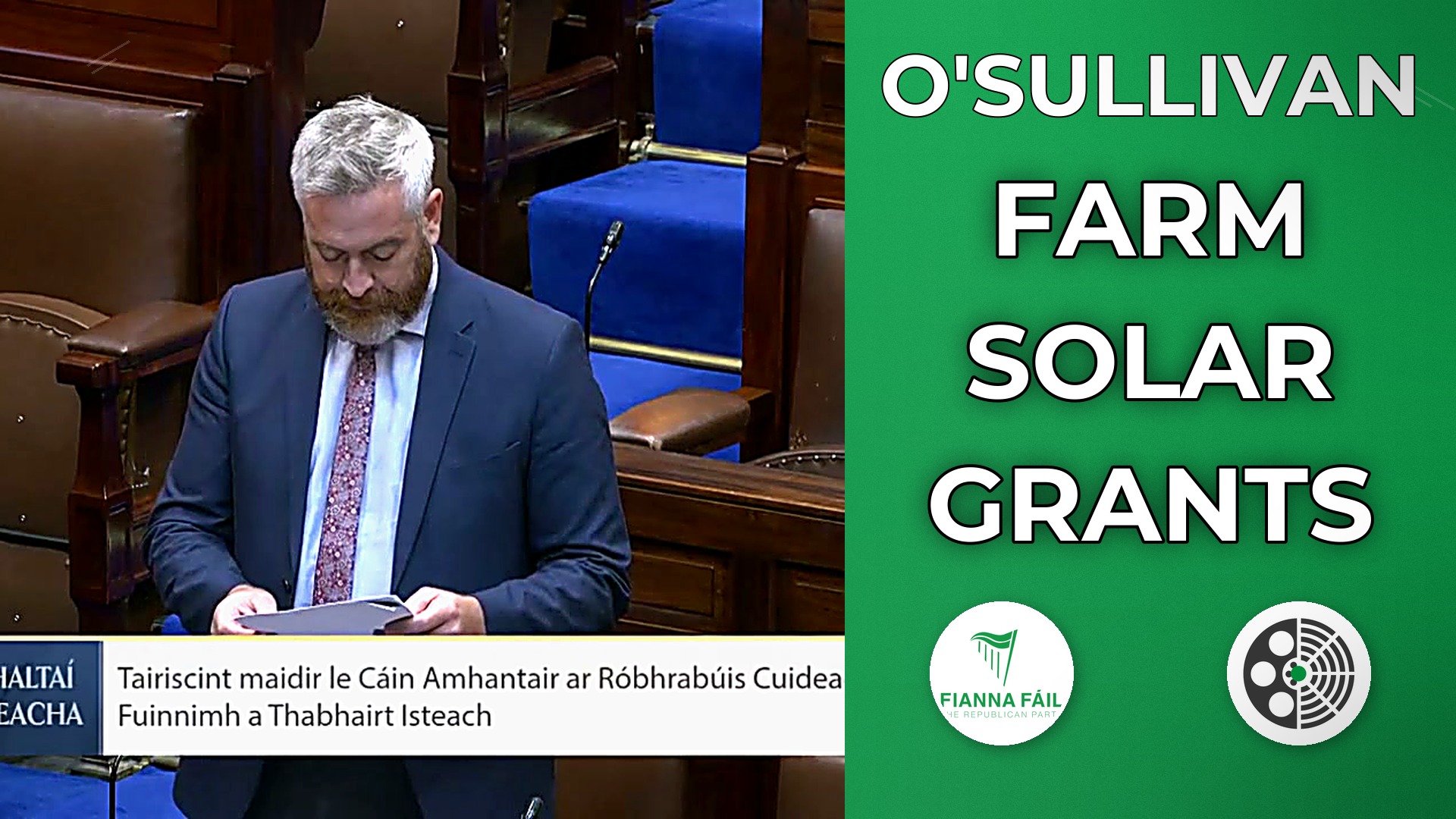


Christopher O'Sullivan calls for better farm access to solar grants
Christopher O'Sullivan addressed Dáil Éireann on household energy costs, government supports and Ireland's energy security. He highlighted barriers to farm rooftop solar funding, saying around 90% of farmers who sought TAMS support were turned down, and called for the issue to be examined in Budget 2027.
O'Sullivan outlined measures including Budget 2026 energy supports, retrofit funding and new storage grants. He also pointed to protections for customers struggling to pay bills, and urged them to engage with suppliers and compare energy plans.
He said Ireland's dependence on imported fossil fuels leaves it exposed to international price volatility. O'Sullivan argued that energy efficiency, renewable generation and stronger interconnection with European partners are important to reducing that vulnerability.
O'Sullivan referred to the National Energy Affordability Taskforce and its forthcoming Energy Affordability Action Plan. He said Ireland would engage constructively with potential EU-wide proposals on a windfall tax or levy, if they were brought forward.
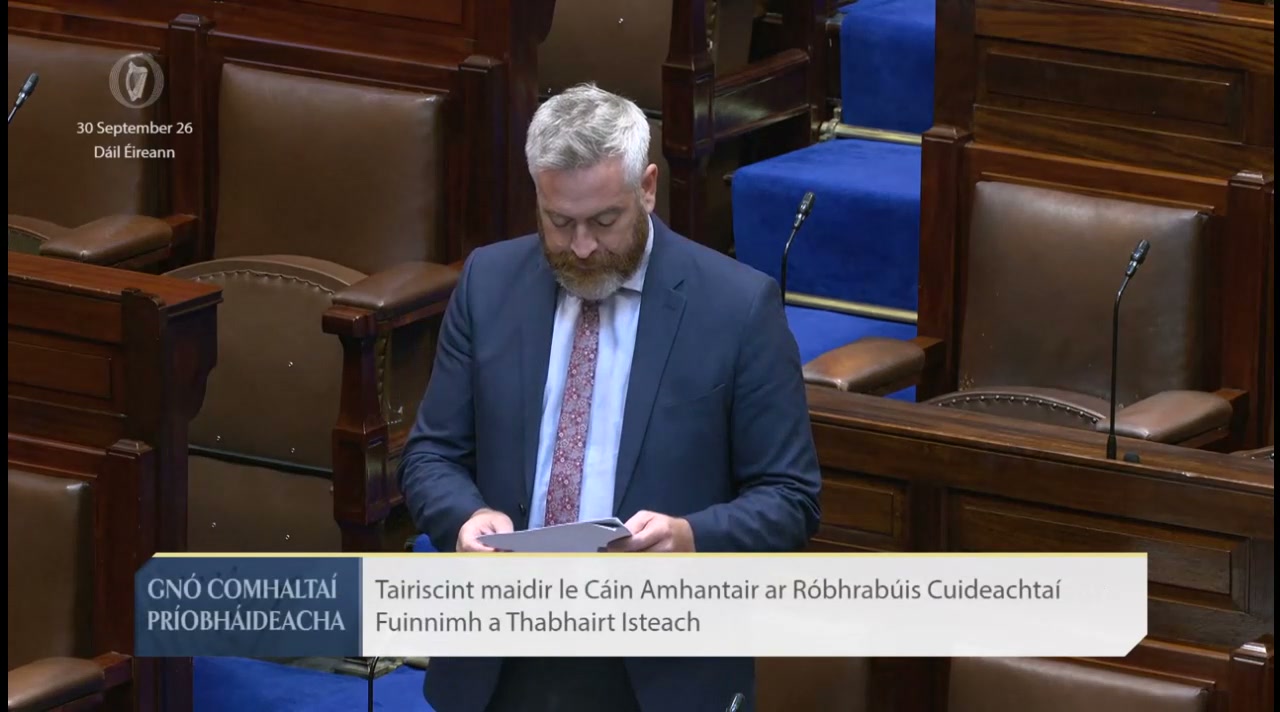
O'Sullivan highlighted farmers' interest in installing rooftop solar to cut emissions and business costs. He said the reported level of unsuccessful TAMS applications for solar support should be investigated, given the role of farming in food security and rural economies. He rejected the motion before the House and supported the government's counter-motion.
Household energy costs and supports
O'Sullivan outlined measures including Budget 2026 energy supports, retrofit funding and new storage grants. He also pointed to protections for customers struggling to pay bills, and urged them to engage with suppliers and compare energy plans.
Energy security and affordability
He said Ireland's dependence on imported fossil fuels leaves it exposed to international price volatility. O'Sullivan argued that energy efficiency, renewable generation and stronger interconnection with European partners are important to reducing that vulnerability.
Windfall taxes and government planning
O'Sullivan referred to the National Energy Affordability Taskforce and its forthcoming Energy Affordability Action Plan. He said Ireland would engage constructively with potential EU-wide proposals on a windfall tax or levy, if they were brought forward.
Farm rooftop solar and TAMS
O'Sullivan highlighted farmers' interest in installing rooftop solar to cut emissions and business costs. He said the reported level of unsuccessful TAMS applications for solar support should be investigated, given the role of farming in food security and rural economies. He rejected the motion before the House and supported the government's counter-motion.
We publish thousands of recordings to make Irish politics transparent and resistant to manipulation. Spotted an error? Report it — together we are building a reliable archive of Irish politics.
Other speeches



Tego samego dnia All speeches from this day →
Rose Conway-Walsh
Rose Conway-Walsh warns enterprise supports risk neutrality
Michael Cahill
Michael Cahill backs review of energy windfall profits
Colm Brophy
Colm Brophy sets out Ireland’s migration system reforms
Richard O'Donoghue
Richard O'Donoghue challenges fuel tax model
Gerard P. Craughwell
Gerard P. Craughwell questions taxi plate rental system
Danny Healy-Rae
Danny Healy-Rae Seeks Ferries for Cattle Exports
Transcript
First of all I want to thank deputies for raising these important matters and welcome
the opportunity to discuss the pressures households are facing as a result of high energy costs.
As has been clearly articulated by the International Energy Agency, this is a global problem which
is causing significant price increases and disruption across the world.
The government is taking action to help households and businesses with the cost of fuel and energy
and have been proactive in introducing support measures on fossil fuel costs and supports
for the transport, farming and fishing sectors.
This is in addition to the range of measures in Budget 2026 aimed at helping households
with energy costs which included extending the reduced fat rate on gas and electricity,
enhanced social protection payments and record funding for SEI retrofit schemes.
As outlined there is significant funding that has been made available for retrofit schemes
and there has been an increased number of applications.
The benefit of even simple upgrades like attic insulation, cavity wall or external wall insulation
cannot be dismissed.
They can improve the warmth and comfort of the home while reducing energy costs at the
same time.
Yesterday government approval was granted to expand the range of supports which we offer
to households.
These are new storage grants, there are new storage grants available as well as easier
pathways for warmer homes and households in RAS tendencies to access retrofitting supports.
Every single one of these changes is designed to make it easier for more households to access
retrofitting measures.
Minister O'Brien has engaged with energy suppliers and the energy regulator to ensure that consumers,
particularly vulnerable customers, are protected.
The CRU has a wide range of protections in place for customers experiencing difficulties
in paying their bills.
Each year the CRU carries out a review on the effectiveness of customer protection measures
over the past winter as well as deciding the measures to be retained for forthcoming winter.
Some of the key measures that remained in place over the recent years include a disconnection
moratorium, reduced debt repayments and discounted tariffs for customers on financial hardship
meters.
The CRU will publish measures in the coming weeks ahead of this winter.
Anyone that is struggling with their bill is strongly encouraged to engage with their
Suppliers will not disconnect customers that engage with them.
It is also important to note that switching supplier or plan could save the average electricity
customer hundreds of euros on an annual electricity bill and I strongly encourage consumers to
seek out the best prices available.
With regards to high energy prices, there are structural factors that are relevant.
Ireland is import dependent for energy, making it particularly vulnerable for price volatility
in the wholesale gas market.
Ireland's isolated island location, low levels of interconnection, widely dispersed low density
population and reliance on fossil fuels are also important price determinants.
Energy is central to every social and economic activity in Ireland, but we remain too dependent
on imported fossil fuels.
The energy crisis caused by the conflict in the Middle East highlights why we must reduce
our reliance on imported fossil fuels and develop our own energy security and strength.
As an island nation with limited fossil fuel reserves, this means developing our own abundant
renewable energy resources and deepening our interconnection with trusted European peers.
The National Energy Affordability Taskforce has been established by government to identify,
assess and implement measures that will enhance energy affordability for households and businesses
while delivering key renewable commitments and protecting security of supply and economic
viability and stability.
The first report of the taskforce published last November set out measures for consideration
in the Budget 2026 process.
The taskforce is working intensively on an Energy Affordability Action Plan which will
be submitted to government in the coming weeks.
The Energy Affordability Action Plan includes the identification of measures such as a market
revenue cap which in a previous form was based on the 2022 EU Council Regulation 2022-1854
while recognising that we have not experienced the extreme price escalation that followed
the Russian invasion of Ukraine and that our EU partners have not introduced either
a market revenue cap or a temporary solidarity contribution.
Ireland would engage constructively on the development of proposals from the Commission
on a potential EU-wide windfall tax or levy if such proposals are brought forward.
Governments across Europe are rightly attentive to developments in energy markets and their
impact on households, businesses and the wider economy.
The topic of windfall taxes was discussed by Ministers at the recent informal Ecofin
meeting in Dublin where the Commission took note of discussions and was asked to report
back to Ministers at the October meeting.
Government will continue to actively monitor the current geopolitical situation and the
impact on energy markets that remain ready to respond to circumstances as circumstances
evolve.
The best long-term approach for Ireland to insulate consumers from volatility on international
and wholesale energy markets is to invest in energy efficiency and renewable energy.
Cutting our dependence on fossil fuels and generating power from our renewable energy
sources will ensure a cleaner, cheaper energy future in the long term.
Just in the couple of minutes I have remaining, there has been a lot of constructive debate
around solar in particular, something that Social Democrats and Deputy Whitmore is quite
passionate about.
Solar still forms such a key aspect in terms of how we can reduce emissions, but reduce
costs for households and also reduce emissions and help businesses, I suppose, survive.
I wanted to particularly touch on some of the challenges that the farming sector in
particular has experienced in relation to access to TAMS grant, and I know that there
is thousands and thousands of farmers across Ireland who are more than willing to put rooftop
solar on their farm buildings, with the intention of, yes, of course reducing emissions, but
just as important for them is reducing the costs of farming and reducing the costs of
doing business.
This is a clear feature, certainly over the summer, it's a clear feature of many of the
farmer lobby groups that they want to see greater access to farmers for solar, and it's
something that, look, I just want to make the point in the few minutes I have here,
I would love to see, of course, in Budget 2027, around 90% of farmers apparently who
looked to seek TAMS support to install solar on their rooftops were turned down, and that
is a figure I think that we need to look at, investigate, and ensure that farming sector
in particular, who play such a key role in food security, in rural businesses, in keeping
rural economies going, and clearly they want to play their part, and I just wanted to make
that comment because solar featured so prominently in a lot of the contributions here.
Other than that, I want to thank deputies from across the House for their contributions
today.
However, I do not accept the motion before the House, and again, I want to push the government's
counter motion in its place.
Thank you.