

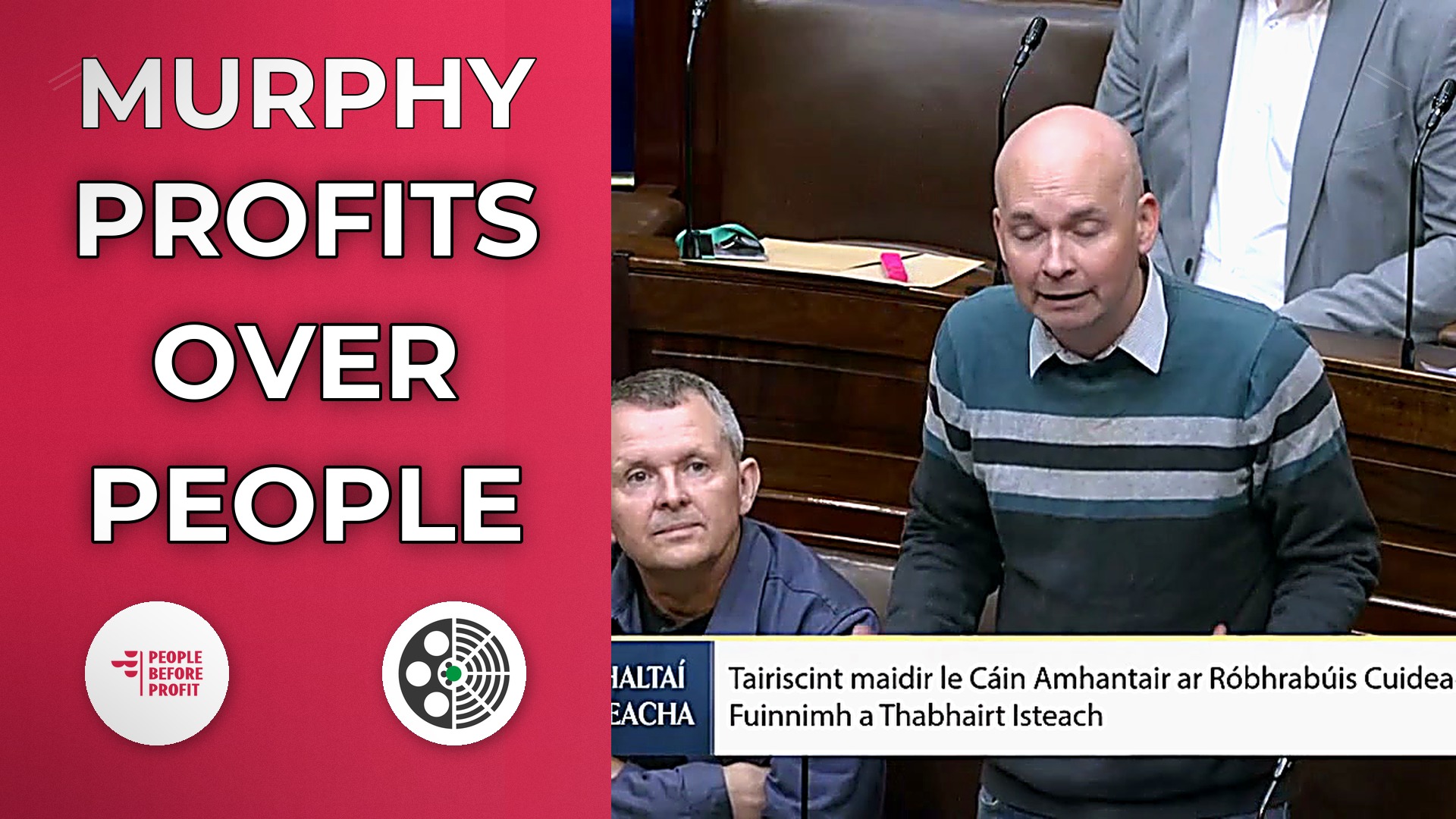


Paul Murphy: Energy Profits and the Cost of Living Crisis
Paul Murphy argued in an Oireachtas debate on the cost of living that record electricity company profits are coming as households struggle to pay bills and put food on the table. He called for windfall taxes and price controls, and for the ESB to be reconstituted on a not-for-profit basis as part of re-nationalising the energy system.
Murphy contrasted record electricity company profits with the pressure on households, citing arrears and parents struggling to provide adequate food for their children. He described the cost of living crisis as a transfer of wealth from ordinary working-class people to the few.
He noted that a windfall tax introduced in 2023 raised nearly half a billion euros before it was abolished, while electricity company profits continued. Murphy also cited the motion’s figure that Irish households pay almost €500 more on average than households elsewhere in the EU.
Murphy blamed the liberalisation and privatisation of the electricity system for high prices. He said householders pay twice as much per unit of electricity as data centres, and argued that the commercial mandate of the ESB prevents its profits being used to reduce household bills.
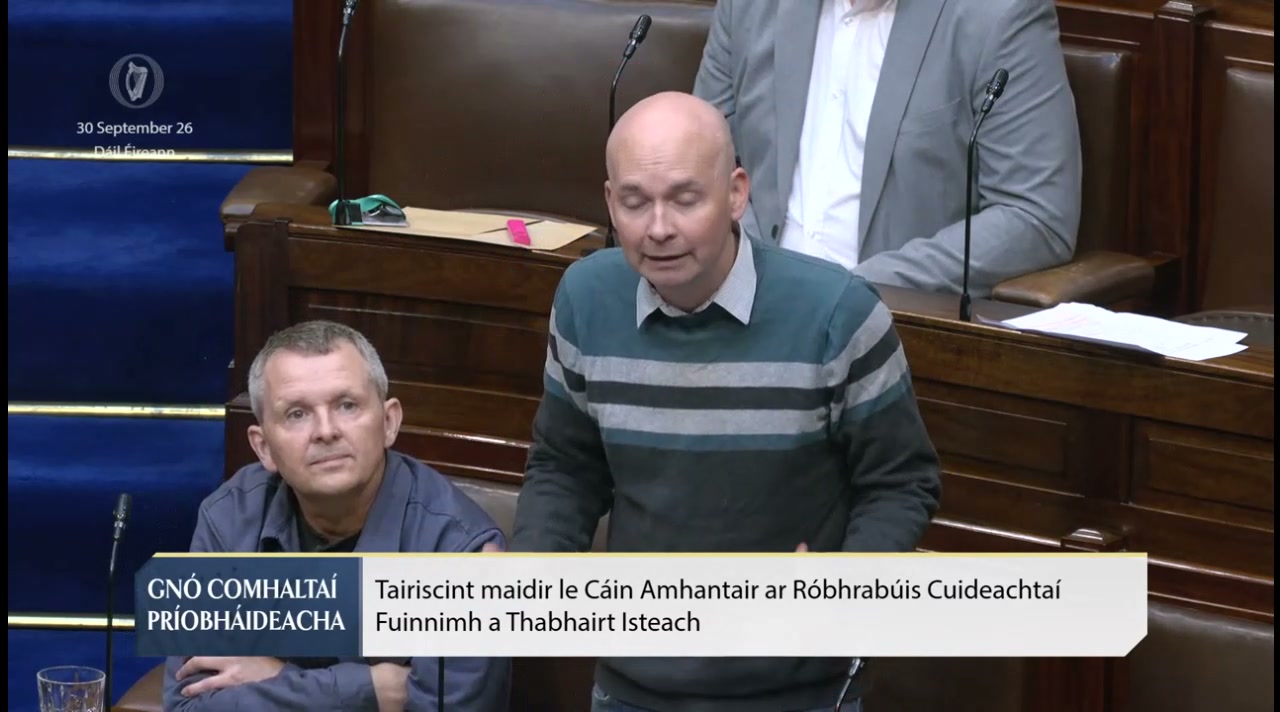
Murphy called for windfall taxes, price controls and an end to liberalisation and privatisation. He argued that a not-for-profit ESB and a re-nationalised energy system could prioritise affordable electricity and a rapid transition to renewable energy. Watch the recording to hear the full contribution.
Profits amid household hardship
Murphy contrasted record electricity company profits with the pressure on households, citing arrears and parents struggling to provide adequate food for their children. He described the cost of living crisis as a transfer of wealth from ordinary working-class people to the few.
Windfall tax and electricity prices
He noted that a windfall tax introduced in 2023 raised nearly half a billion euros before it was abolished, while electricity company profits continued. Murphy also cited the motion’s figure that Irish households pay almost €500 more on average than households elsewhere in the EU.
Liberalisation and data centres
Murphy blamed the liberalisation and privatisation of the electricity system for high prices. He said householders pay twice as much per unit of electricity as data centres, and argued that the commercial mandate of the ESB prevents its profits being used to reduce household bills.
Re-nationalising the energy system
Murphy called for windfall taxes, price controls and an end to liberalisation and privatisation. He argued that a not-for-profit ESB and a re-nationalised energy system could prioritise affordable electricity and a rapid transition to renewable energy. Watch the recording to hear the full contribution.
We publish thousands of recordings to make Irish politics transparent and resistant to manipulation. Spotted an error? Report it — together we are building a reliable archive of Irish politics.
Other speeches
Tego samego dnia All speeches from this day →
Cian O'Callaghan
Cian O'Callaghan challenges Taoiseach over pension increase
Michael Cahill
Michael Cahill backs review of energy windfall profits
Danny Healy-Rae
Danny Healy-Rae challenges electricity costs and regulation
Carol Nolan
Carol Nolan challenges committee over three-day wait testimonies
Colm Brophy
Colm Brophy sets out Ireland’s migration system reforms
Richard Boyd Barrett
Richard Boyd Barrett Calls for Garvaghy Road March to Be Stopped
Transcript
Thanks a lot to the Social Democrats for bringing forward this.
What does it tell us about the sort of society and economy that we live in that while most
people are really suffering, over 300,000 people in arrears, almost half of parents
saying that they're struggling to put adequate food on the table for their children.
What does it tell us that the electricity companies are making record profits?
It tells us that the cost of living crisis isn't a crisis for everybody.
In fact it's an opportunity for those at the top.
The cost of living crisis, like the housing crisis, like the health crisis, is really
a robbery of ordinary working class people and a transfer of wealth from the many to
the few.
That's what the cost of living crisis is about.
How can you have record profits in electricity company after electricity company after electricity
company when people are struggling to afford electricity unless you have something fundamentally
wrong in how the whole society and economy is based.
That what is being prioritised is their profits, not the needs of people to light their homes,
heat their homes and so on.
In 2023, under pressure from ourselves and others, the government actually did introduce
a windfall tax.
It was an inadequate windfall tax, it didn't go far enough, but it raised nearly half a
billion euros.
That was then abolished.
But the record profits have continued and now have accelerated in the context of Trump's
imperialist wars in the Middle East.
We have gone from having the cheapest electricity in Europe to having the most expensive.
The motion makes the point that on average Irish households pay almost 500 euros more
than their counterparts across the EU.
How on earth did that happen?
And the answer is simple, liberalisation.
The privatisation, marketisation of our electricity system is the reason why we're paying so much
for electricity.
Yesterday, in the AI committee, I asked the Commission for Regulation of Utilities, do
they think it's fair that ordinary householders pay twice as much per unit of electricity
as data centres pay?
So the people who are struggling in the cost of living crisis are paying twice as much
as those who are making massive profits, some of the biggest corporations in the world.
And the answer was, oh, this is liberalisation.
So it's yet another reason to oppose liberalisation, which has meant prices going up for people,
it's meant a slow, not a rapid transition.
And it means that the ESB, for example, which made, what, almost 400 million euros in profits
in the first half of this year, legally that money can't be used to reduce prices for ordinary
people because it's set up on a for-profit commercial mandate where it has to pretend
that it's just another private company operating in the market on a for-profit basis.
So yes, we need windfall taxes, we need price controls, but what we fundamentally need to
do is to reverse the process of liberalisation, of privatisation.
We need to reconstitute the ESB on a not-for-profit basis and re-nationalise the energy system
so we can prioritise a rapid transition to renewable energy and providing affordable
electricity for ordinary householders.
Thanks.
Go raibh maith agat.
We'll move to the independent tech.
Go raibh maith agat.