



Alice-Mary Higgins Challenges EU Climate Competitiveness Approach
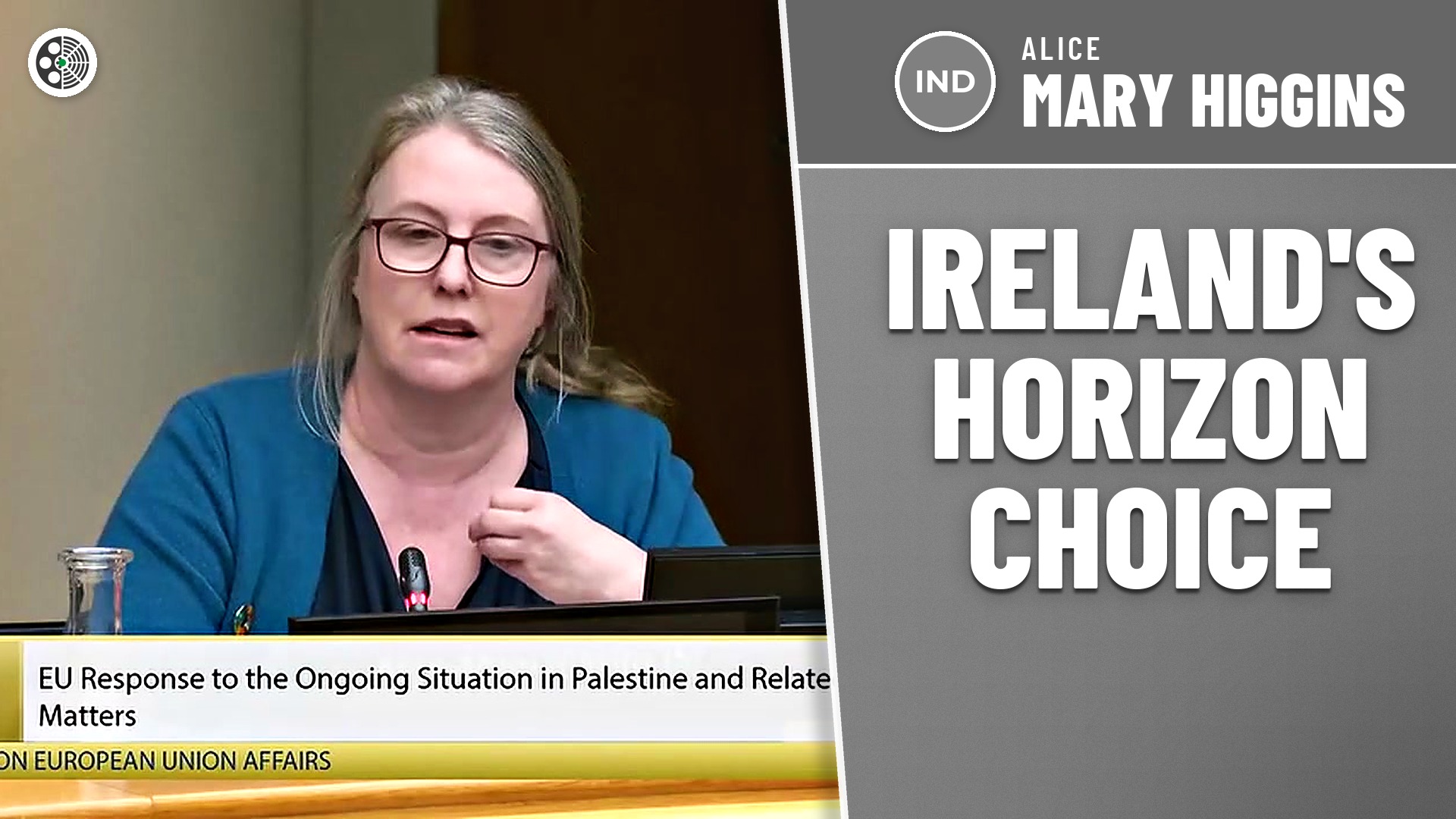
Alice-Mary Higgins questioned the European Commission’s approach to climate policy during an exchange on the EU Emissions Trading System (ETS), climate finance and international responsibility. She argued that competitiveness must operate within planetary boundaries and asked whether the EU would strengthen climate ambition as the United States steps away from the Paris Agreement.
Higgins raised concerns about free ETS allowances for steel, cement and chemical industries, arguing that weakened regulation could undermine climate innovation. She also questioned changes to corporate due diligence and sustainability reporting standards, including requirements for companies to publish climate plans without implementing them.
Higgins said Europe’s historical contribution to emissions should inform its approach to climate responsibility. She asked how the EU would scale up climate finance and support the loss and damage fund, noting the severe impacts on countries such as Nepal.
The Commissioner defended the Commission’s ETS proposal, saying companies would have to invest the value of free allowances in decarbonisation in Europe. The response also pointed to the Carbon Border Adjustment Mechanism and the EU’s wider climate finance commitments.
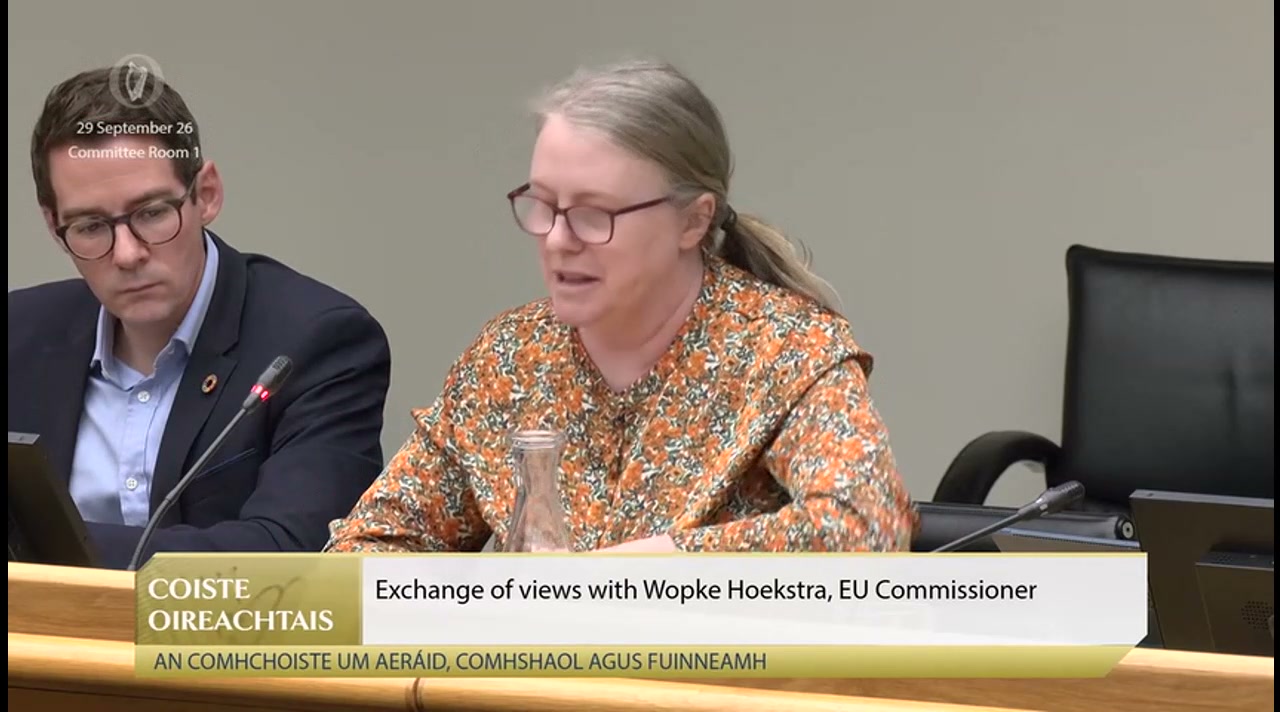
Higgins asked whether the EU would back a roadmap for transitioning away from fossil fuels and increase its ambition if the United States withdrew from the Paris Agreement. The Commissioner said the EU would continue to drive ambition while engaging with major emitters, including China. Watch the recording to hear the full exchange.
Climate rules and industrial innovation
Higgins raised concerns about free ETS allowances for steel, cement and chemical industries, arguing that weakened regulation could undermine climate innovation. She also questioned changes to corporate due diligence and sustainability reporting standards, including requirements for companies to publish climate plans without implementing them.
Climate finance and responsibility
Higgins said Europe’s historical contribution to emissions should inform its approach to climate responsibility. She asked how the EU would scale up climate finance and support the loss and damage fund, noting the severe impacts on countries such as Nepal.
The Commissioner defended the Commission’s ETS proposal, saying companies would have to invest the value of free allowances in decarbonisation in Europe. The response also pointed to the Carbon Border Adjustment Mechanism and the EU’s wider climate finance commitments.
International climate action
Higgins asked whether the EU would back a roadmap for transitioning away from fossil fuels and increase its ambition if the United States withdrew from the Paris Agreement. The Commissioner said the EU would continue to drive ambition while engaging with major emitters, including China. Watch the recording to hear the full exchange.
We publish thousands of recordings to make Irish politics transparent and resistant to manipulation. Spotted an error? Report it — together we are building a reliable archive of Irish politics.
Other speeches
Tego samego dnia All speeches from this day →
Micheál Martin
Micheál Martin: Protecting the Good Friday Agreement
Victor Boyhan
Victor Boyhan calls for farm energy support in Budget 2027
Rose Conway-Walsh
Rose Conway-Walsh presses for action on cross-border tax rules
Cian O'Callaghan
Cian O’Callaghan challenges Taoiseach over special education
Darragh O'Brien
Darragh O'Brien: Fare rises will fund expanded services
Neale Richmond
Neale Richmond Defends Public Transport Fare Adjustments
Transcript
Thank you, Commissioner, you mentioned realism and I suppose when you mentioned also the
idea of things being side by side, but in a realistic perspective, and this is something
I think seems to be a little bit missing from the Commission's current approach, it's not
a matter, and I think even in the ETS reform which talks about rebalancing the climate
aspirations with competitiveness, these are not side by side or balanceable, competitiveness
exists within the real planetary boundaries, and I suppose there's maybe a sense of that
being missing sometimes in the discussion that we're hearing in terms of the real, and
this is even within the innovation frame, one of the drivers of innovation is good regulation,
and I'm concerned that some of the dilution of regulation that we've seen, and in terms
of the ETS scheme, free allowances for the steel, cement and chemical industries up to
2038, over a decade ahead, is actually counter to pushing for innovation in terms of climate,
in terms of environment more widely.
If we're giving them free passes, then the economically sensible thing is to continue
making profit in that context, and I'm concerned about us losing the regulatory driver of
innovation within that, and I'd like if you could comment in terms of that, and on the
ETS, I see a danger there.
And then when we mention other countries, because I know you've mentioned that idea,
but we've removed the standards through the corporate due diligence directive and the
corporate sustainability reporting directive, we're not putting pressure on other countries
and companies operating elsewhere.
We know it was largely American multinationals were in the room and driving a lot of that
competitiveness, ExxonMobil and others.
They're driving down, so we're not attached, I think one of the changes was big companies
now have to publish climate plans but no longer have to implement them, so surely if we cared
about what other countries were doing, we'd be exerting pressure there as well.
I might come back then to the international side.
Well, then I'll give all my questions if that's best, Chair.
And then again within the realism piece, you mentioned the 6% and the 94%, I think to take
that snapshot, I think you'll acknowledge that's not really fair, given that historically
in terms of emissions that have got us to where we are, European countries bear a massive
responsibility and an outsize, that's there in the Paris Agreement, common but differentiated
responsibilities.
And in that context, I would like to know what the approach was.
We know that in the last COP there was a loss and damage fund that has been agreed, there's
barely any money in it.
Countries like Nepal, who did not drive this crisis, are getting the worst impacts.
So what is the European Union going to do in terms of climate finance actually scaling
up and loss and damage must be new.
That is new, so I'm concerned that you say we're going to keep moving within the same
small envelope.
And lastly, the EU roadmap on transitioning from fossil fuels, will you be supporting
that, you'll be aware Ireland is hosting a conference, will there be timelines in
relation to that?
And the final point is the US, the United States, is the elephant in the room here,
are we going to, when the United States steps away from the Paris Agreement, shouldn't we
be stepping up rather than using it as an excuse to downgrade our ambition?
Okay, thank you.
Ma'am, that's a lot of big themes that I would need much more time on.
But I think the essential comment I would make is that we, respectfully, I do have a
different perspective on some of the things you're putting on the table.
We are not stepping down, we're stepping up.
I just look at the numbers of our 90% targets and what we're doing in the ETS, and one of
the things you're right, we're continuing with free allowances, but we're in the proposal
telling companies that then the money needs to be invested in decarbonisation in Europe.
The current system, in my view, has two weaknesses.
One is the lack of reciprocity towards member states, that's the one I just described.
The other one is that currently companies can take their free allowances, sell them
on the market, invest in China, and then come to Brussels to complain about the ETS.
The heart of this proposal tells them that they need to invest every single euro of these
free allowances in decarbonisation on European soil.
And that is going to be a complete game changer because we're talking about billions and billions
and billions of euros.
So I think, and I'm convinced that if we manage to uphold this in the trilogue, this will
do way more in terms of industrial decarbonisation than what we have seen before.
And that is on top of the elements we're adding, and that was the list I just gave in terms
of aviation, maritime, and so on.
Secondly, the key thing that is linked to the ETS, and that is maybe not always appreciated
outside, but is at the heart of this, is that we have introduced CBAM, we have actually
beefed that up, and that is a way to not just create more fairness, but also to ensure carbon
doesn't leak from the European Union.
And that is something that of course has its effects on the world at large.
Now on the international dimension, what is important to acknowledge that, and you're
absolutely right, loss and damage is a, that was the COP 28, it was in Dubai, when we established
that, that is relatively small.
It is also relatively small if you compare it to the whole envelope that European countries
are making available.
Loss and damage is less than a billion.
The total sum that European taxpayers are paying is more than 30 billion.
So it is true that that in itself is not that large, but it is also only a couple of percentage
points of the whole story.
And then maybe last thing on responsibility.
If the European Union and its member states have done one thing, it is taking responsibility
for what is happening here and what is happening outside of Europe, and we are fully committed
to continue with that.
And that is precisely why we continue to drive ambition at the COPs.
The thing I'm putting next to that, I'm not replacing it, but I'm putting next to that,
is that in itself is not going to be enough if we want to take people out of harm's way
across the globe.
So that merits a conversation indeed with the Americans, which is hugely complicated.
Indeed with the oil producers from the Gulf.
Indeed with countries that have created much more affluence than maybe 20, 30, 40, 50 years
ago, like Singapore.
But also a country like China, responsible for 30% of global emissions, has a GDP per
capita that is higher than one of our own member states.
That merits a conversation with the Chinese, while we are at 90% and we are at, what is
it, 75% or so in 2035, the Chinese come up with an NDC below 10.
And they're building new coal plants.
So that merits conversations with these countries about how we jointly are going to be solving
this problem.
That is what the Commission is up to.