

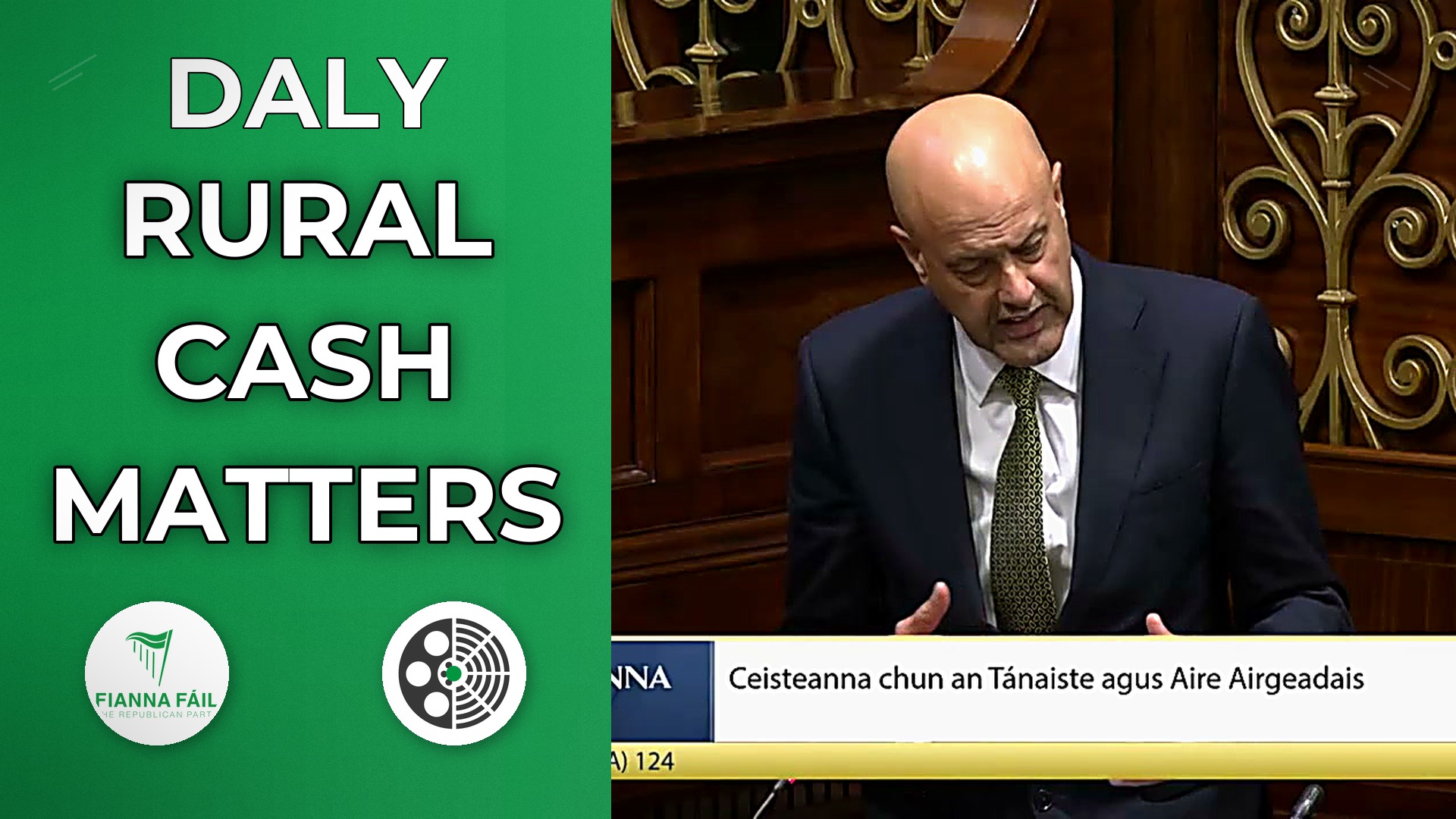


Martin Daly: Cash is a vital safety net
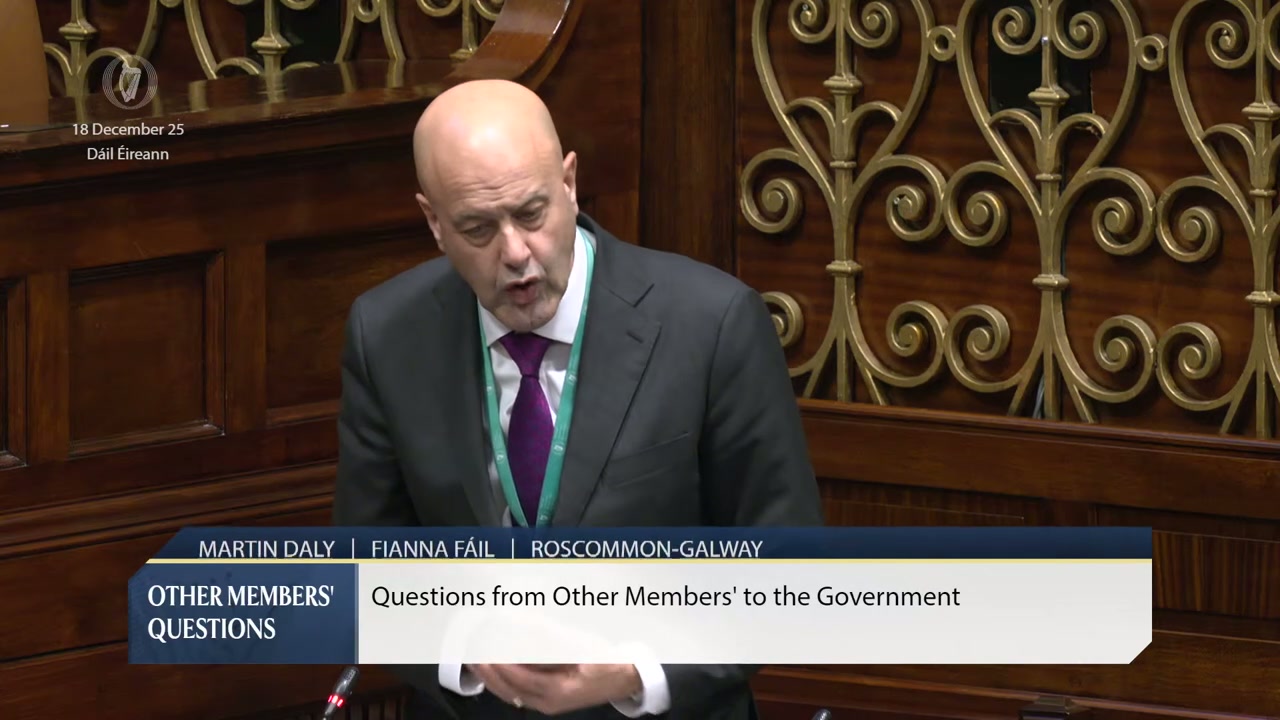
Martin Daly raised access to cash and in-person banking in rural Roscommon and Galway. He highlighted the loss of banking services in Ballygar and the importance of cash for inclusion, privacy and everyday payments.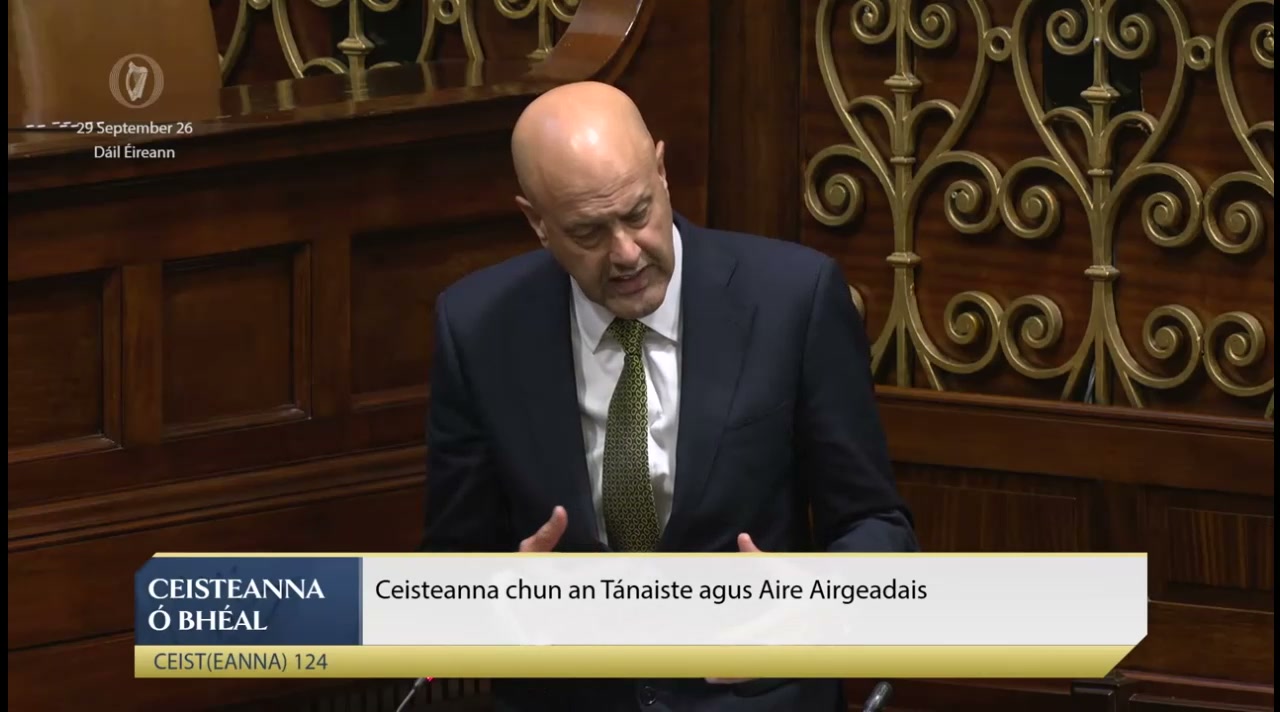
We publish thousands of recordings to make Irish politics transparent and resistant to manipulation. Spotted an error? Report it — together we are building a reliable archive of Irish politics.
Other speeches
Tego samego dnia All speeches from this day →
Brian Stanley
Brian Stanley calls for 15% public transport fare rise to be halted
Richard O'Donoghue
Richard O'Donoghue Calls for Whistleblower Protections
Brian Stanley
Brian Stanley Seeks Debate on Garvaghy Road Parade
Victor Boyhan
Victor Boyhan calls for Seanad debate on Irish horticulture
Catherine Ardagh
Catherine Ardagh on SLAPPs and protecting public participation
Paul Murphy
Paul Murphy presses ESB on data centres and housing connections
Transcript
I'd just like to ask the Minister the steps he is taking to ensure adequate access to
cash and in-person banking services in rural communities, particularly in towns and counties
of Roscommon and Galway, and how the effectiveness of the Access to Cash Framework is being assessed
under the Finance Act provision of Access to Cash Infrastructure 2025.
Thank you Deputy Daly for raising this issue today and just to say the Government is committed
to ensuring that cash remains available as a means of payment and last year put legislation
in place to achieve this aim.
The Finance Provision of Access to Cash Infrastructure Act 2025 commenced on 30 June 2025.
The Act implements a recommendation from the 2022 Retail Banking Review.
As part of the legislative framework, the Section 5 Order issued under the Act established
criteria to ensure that access to cash infrastructure across the state remains sufficient and effective.
Designated entities, which are credit institutions that hold prescribed percentages of current
accounts and household deposits in the state, are responsible for ensuring that those criteria
are met.
The Central Bank is responsible for monitoring and enforcing the Access to Cash Framework
on a quarterly basis.
This includes assessing the number of cash service points and the ATMs against the criteria
prescribed in Section 5 Order.
The initial quarterly reports published by the Central Bank indicate the levels of cash
infrastructure remain broadly in line with those criteria.
Where non-compliance is identified, the designated entities are responsible for taking the necessary
steps to address it.
In addition to the Access to Cash Criteria, the Central Bank has implemented a Local Deficiency
Framework effective since 1 July this year.
The framework allows members of the public to notify the Central Bank where they believe
there is inefficient access to cash services in their locality, even where the Access to
Cash Criteria for the wider region has been met.
Perhaps that's something the Deputy is referring to in his own constituency.
The Central Bank has published guidelines detailing how they will assess submissions,
make determinations as to whether a local deficiency in cash infrastructure exists and
if a remedy is required.
The guidelines are available on the Central Bank's website, along with a cash access
map, helping individuals identify the location of cash services in their area.
I thank the Minister for his answer and I'm reassured with what he tells me because cash
is still a vital component of our economy, especially in rural areas.
In my own town of Ballygarh, County Galway, we lost the Bank of Ireland in 2021 and access
to 24-hour cash.
It took a considerable campaign by the Ballygarh Regeneration Group to get the Attenray Credit
Union to install an ATM in June of this year.
Cash still remains a critical safety net for individual groups, especially elderly people,
people who are living with a disability or may have an intellectual disability.
It's a tool for social inclusion.
It allows for immediate settlement of bills and cash and it is a fundamental safeguard
for consumer privacy.
It is also a real backup in cases of where the digital infrastructure around money transfers
may fail or in place of a natural disaster.
Thank you.
I can't agree more with the Deputy.
I think it's critically important that we retain to use cash and that it's available
and acceptable by all businesses.
It is a legitimate way of paying for goods and services.
Just in relation to what's been done to correct deficiencies in your own constituency, because
I know that's what you're focusing on here this evening, and just to say that the most
recent quarterly access to cash report published by the Central Bank, based on data collected
as of 30 June, identified a non-compliance with the criteria in the West Region of which
Galway and Roscommon is part of.
Specifically deficits were identified in the number of the ATMs per 100,000 people and
the percentage of the population that should be within 10 kilometres of a cash service
point.
Detailed information on the number and location of the ATMs and cash service points is available
on the Central Bank website.
The Central Bank has issued non-compliance notification to the designated entities and
after receipt of the notification, the designated entities have at least one month or up to
eight weeks to present proposals to the bank for addressing each instance of non-compliance.
So perhaps in specific to what you're raising here today, the Central Bank is acutely aware
of where there is deficiencies and is already acting on that.
Thank you Minister for his reply and I take the reassurance that there is a constant monitoring
of this cash access and also that the system is responsive to individual communities and
groups who have a problem accessing cash.
Again, I come back to the idea that rural communities certainly depend on cash, a lack
of transport links and accessibility to ATMs or to banking services.
It helps the people who are unbanked, people who rely on settling their day-to-day grocery
bills and transactions in cash.
It's accessible physical means of exchange for vulnerable citizens and it also helps
increased budget management for many people because cash is a tangible thing for them.
But the most important thing I think we need to take in a world of increasing loss of privacy
for the individual citizen, where major corporations control our identity and our data,
it is really important that we have the safety net of cash in our society.
I suppose just to make the point that local deficiencies in the term and the legislation
for locations within Notch Tree regions where particular difficulties arise in accessing
cash, even if areas are meeting the designations but the local areas feel that particular pockets
within the overall area is more adversely affected, there is the mechanism now where
that local person or representative can notify the central bank directly and where the central
bank will then assess each submission and determine whether that particular local geographical
area warrants a remedy.
So there is a very clear mechanism there where local areas can ensure access to cash is readily
available and I suppose as a postmaster myself, a fourth generation postmaster in a small
little village in Westmead, what I would say is if people don't use services such as that
they will lose them and it's critically important that people use the services that are there
because you only miss the water when the well runs dry and services such as the post office,
services such as credit unions, particularly in rural Ireland are critically important
to ensure those people who aren't banking literate have the availability to carry on
their daily lives, pay their bills, access to cash etc.
So I would put the call out there to use the services that are in your localities because
if you don't you will lose them.