

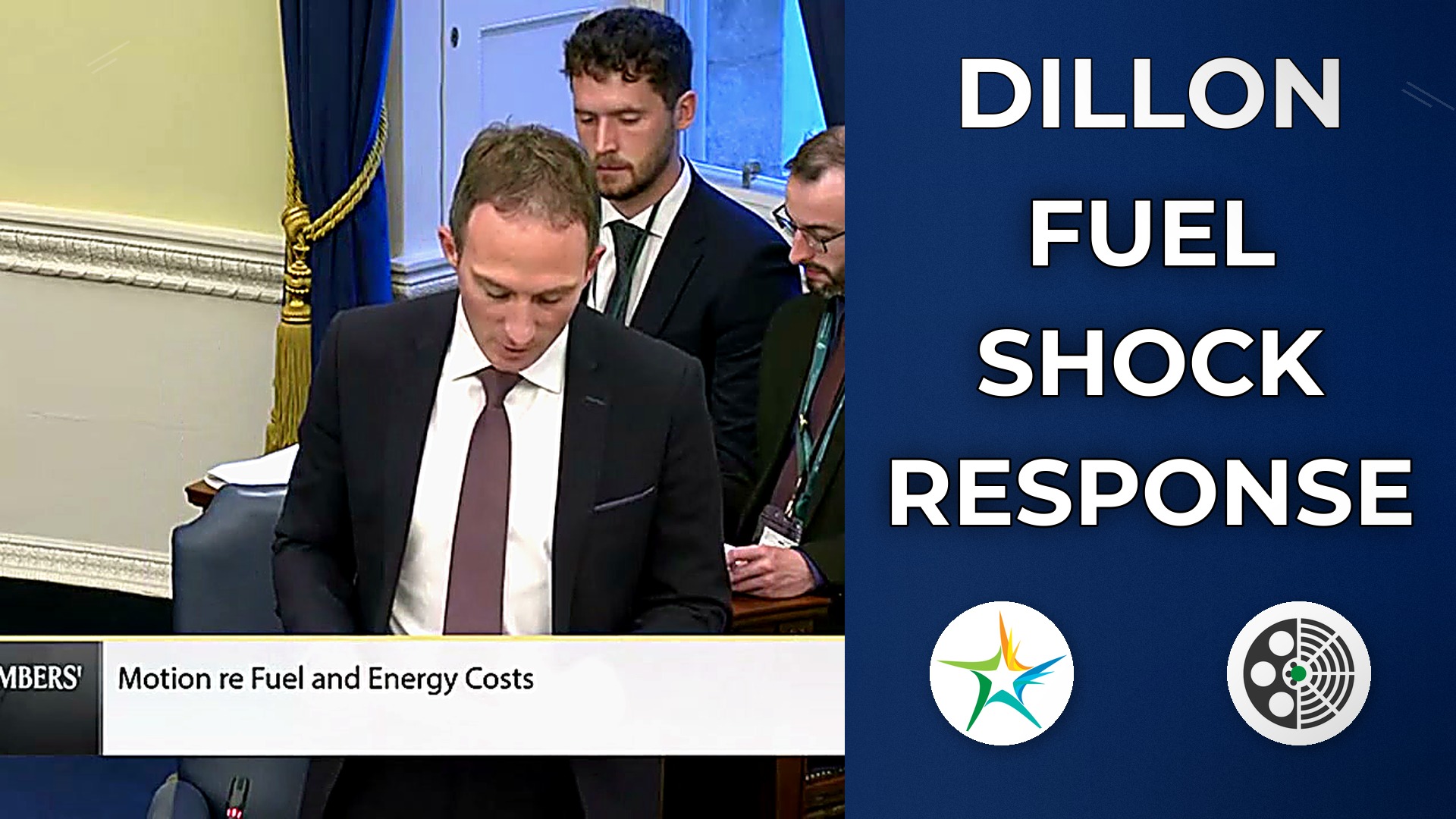


Alan Dillon: €1.4bn in energy supports as fuel costs rise
Alan Dillon set out the Government’s response to high fuel and energy prices during a Seanad debate on household and business costs. He outlined more than €1.4 billion in support and argued that reducing reliance on fossil fuels is essential to long-term energy security and lower costs.
Dillon said existing measures include support at the petrol pumps, an extended fuel allowance, deferred carbon tax increases on home heating fuels and assistance for sectors including agriculture, fisheries and haulage. He said further measures are under consideration through the National Energy Affordability Taskforce and the Budget 2027 process.
He highlighted a record allocation of more than €640 million for Sustainable Energy Authority of Ireland residential and community grants, targeting over 75,000 home energy upgrades this year. Dillon said insulation and full home retrofits can reduce annual energy bills, and pointed to increased applications for retrofit and solar PV schemes.
Dillon noted that home heating oil prices had risen sharply and said around 500,000 households use oil as their main heating fuel. He said the fuel allowance was extended by four weeks, providing an additional payment of over €152 to each of 470,000 recipients, while the Government is examining options for households that do not qualify.
He outlined payments through agricultural and fisheries fuel support schemes, the Areas of Natural Constraints scheme and the diesel rebate scheme. Dillon said the Government intends to extend support for affected sectors through Budget 2027.
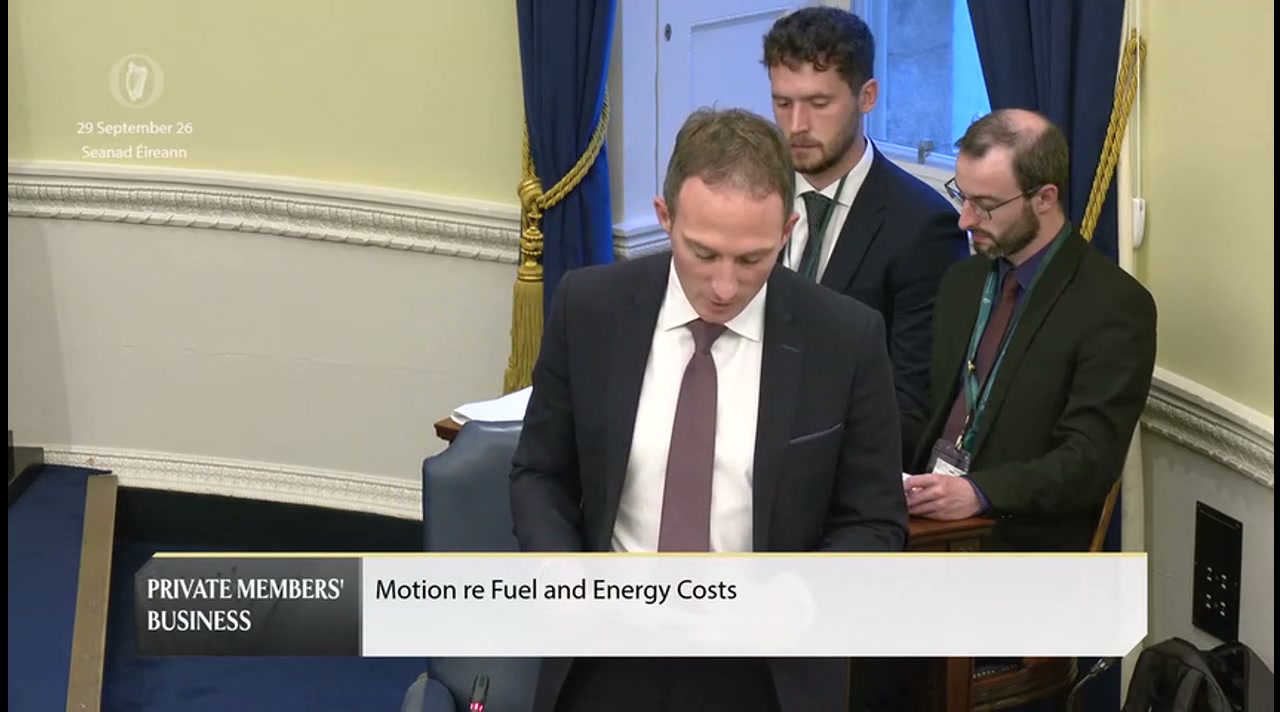
Dillon said Ireland’s renewable generation capacity had grown to over 8.7 gigawatts, from 4.8 gigawatts in 2020. He argued that expanding renewable electricity and investing in the grid are central to reducing dependence on expensive fossil fuels and improving price stability. Watch the recording to hear the full contribution.
Government support for energy costs
Dillon said existing measures include support at the petrol pumps, an extended fuel allowance, deferred carbon tax increases on home heating fuels and assistance for sectors including agriculture, fisheries and haulage. He said further measures are under consideration through the National Energy Affordability Taskforce and the Budget 2027 process.
Retrofitting and home energy upgrades
He highlighted a record allocation of more than €640 million for Sustainable Energy Authority of Ireland residential and community grants, targeting over 75,000 home energy upgrades this year. Dillon said insulation and full home retrofits can reduce annual energy bills, and pointed to increased applications for retrofit and solar PV schemes.
Home heating oil and rural households
Dillon noted that home heating oil prices had risen sharply and said around 500,000 households use oil as their main heating fuel. He said the fuel allowance was extended by four weeks, providing an additional payment of over €152 to each of 470,000 recipients, while the Government is examining options for households that do not qualify.
Support for farmers and transport
He outlined payments through agricultural and fisheries fuel support schemes, the Areas of Natural Constraints scheme and the diesel rebate scheme. Dillon said the Government intends to extend support for affected sectors through Budget 2027.
Renewables and long-term energy security
Dillon said Ireland’s renewable generation capacity had grown to over 8.7 gigawatts, from 4.8 gigawatts in 2020. He argued that expanding renewable electricity and investing in the grid are central to reducing dependence on expensive fossil fuels and improving price stability. Watch the recording to hear the full contribution.
We publish thousands of recordings to make Irish politics transparent and resistant to manipulation. Spotted an error? Report it — together we are building a reliable archive of Irish politics.
Other speeches
Tego samego dnia All speeches from this day →
Malcolm Byrne
Malcolm Byrne seeks safeguards on AI chatbots aimed at children
Conor D McGuinness
Conor D McGuinness on Young Voices in the Irish Language
Danny Healy-Rae
Danny Healy-Rae: Bus Costs and Capacity in Kerry
Matt Carthy
Matt Carthy challenges legacy bill’s national security veto
Darragh O'Brien
Darragh O'Brien: Fare rises will fund expanded services
Neale Richmond
Neale Richmond Defends Public Transport Fare Adjustments
Transcript
Firstly, can I thank all the Senators for raising these important matters and welcoming
the opportunity to discuss the continued high cost of fuel and energy costs for households
and businesses.
And indeed, as referenced by many Senators this evening, the conflict in the Middle East
and the Ukraine has caused significant disruption to global energy markets, and the government
indeed recognises that these pressures are resulting in high energy prices and are placing
Irish consumers and businesses in a vulnerable, difficult state.
This government understands that any price increases can place significant pressures
on households and business budgets, and as a result we have been proactive and introduced
a series of measures to reduce fuel prices, and further measures are under consideration
by the National Energy Affordability Taskforce as part of the budgetary process.
Specifically, on fuel, the package of government support measures, which now totals over €1.4
billion, is helping to reduce the cost burdens at the petrol pumps and assisting key sectors
such as our agricultural, our haulage, transport, which are critical to keeping our economy
moving.
A range of measures in last year's budgets also supported households with energy costs,
and that included an extension until 2030 of the 9% fat rate on the gas and electricity
bills.
Also, we've enhanced social protection payments, including an increase in the fuel allowance
rate, and an expansion in eligibility rules, as well as a €400 income disregard for households
involved in micro-generation, which has extended for a further three years until the end of
2028.
The best way of insulating our economy and society from future fuel price shocks is to
reduce our dependence on fossil fuels, and this is why we're investing record amounts
in retrofitting, both through part and fully funded schemes.
Budget 2026 also provided a record allocation of over €640 million for the Sustainable
Energy Authority of Ireland residential and community grant scheme, and that's allowing
us to target over 75,000 home energy upgrades this year.
In January of this year, we expanded and reformed retrofitting schemes to ensure that homeowners
can now receive grants, and these new measures included increased attic and wall insulation
support, an increased grant of over €12,500 for heat pump insulation, and new grants for
windows and doors.
Simple upgrades like attic insulation, cavity wall and external wall insulation can reduce
heating bills by up to €230 annually, and a full home retrofit can lead to savings of
over €750 to €1,120 per year on energy costs.
Almost 89,000 applicants have been processed up to the end of August this year, and this
compares to 41,100 applicants received at the end of August last year.
That saw a 116% increase year-on-year, and follows changes to the scheme that Minister
O'Brien has introduced earlier this year.
Capital expenditure of over €2 billion has delivered over 287,000 home energy upgrades
from 2019 to the end of August this year, including over 39,500 fully funded upgrades
for households at risk of energy poverty under the Warmer Homes scheme, and at the end of
August of this year, the domestic solar PV scheme has supported 21,000 homes to install
solar PV panels this year, and over 35,000 applications have been received.
And that's a 72% increase in applications year-on-year, and indicates that the scheme
is working well, and householders are recognising the benefits of investing in solar PV.
While these are all positive indicators, this government is also very conscious of the price
increases in home heating oil, and kerosene price increases from approximately 75 cent
per litre before the conflict, to €1.77 in April this year, and that current average
price is around €1.62 per litre, and that conflict in the Middle East has resulted in
the economic pressures that can be felt far beyond the countries involved, and has severely
impacted the cost of kerosene for many households.
In order to ease the financial pressure on households, earlier this year the government
extended the fuel allowance by four working weeks, resulting in an additional payment
of over €152 to each of the 470,000 fuel allowance recipients, and this government
also deferred the planned increase in carbon tax on home heating fuels, which was due to
occur on 1 May and 14 October, to help mitigate price increases, while appreciating that the
people living in rural Ireland are twice as likely to use home heating oil as their main
heating fuel, and according to the latest CSO figures, around 26% of households in Ireland
use this as their main heating fuel. That's around 500,000 households.
This government understands that these are disproportionately older households, disproportionately
rural, and in a lot of cases low-income households, so many of these households would be eligible
for the aforementioned fuel allowance, but government is also very conscious of these
who use home heating oil who don't qualify for the fuel allowance payment, and that's
why in the upcoming budget we also want to deliver for middle-income families, and government
is examining different levers available to it in relation to the cost of home heating
oil, and there will be an energy tax package as part of budget 2027, and I think the final
composition of this is currently under consideration.
This government is also acutely aware of the pressures arising from the agricultural sector,
and it has been referenced in this House this evening, as a result of the prolonged high
fuel prices, high fertiliser prices, and indeed additional fuel costs, we will deliver
a strong budget to protect farmers, fishers, foresters, helping to secure the future of
our agri-food sector.
The agri-food sector has demonstrated its ongoing resilience despite current uncertainties,
rising fuel and fertiliser costs and the challenging weather conditions, and payments are continuing
under the fuel income support scheme, with a spend of over €26 million to over 30,000
applicants to date, and under the areas of natural constraints scheme, this government
has delivered €179 million in payments to over 85,000 farmers.
A specific €15 million tailored fuel support scheme for owners of registered vehicles in
the fisheries and agricultural sector has been developed with payments to date of over
€10 million under the fishing and agriculture registered vehicle support scheme and agriculture
business vehicle fuel support team, and that's to support our hauliers, our road transport
operators, and government has also increased the maximum repayment allowable under the
diesel rebate scheme from €0.05 to €0.12 per litre of diesel, backdated to January,
and currently applies up to 30 September 2026 to help temper inflation on food and public
transport costs.
It is the government's intention as part of Budget 2027 to extend the timeframe in order
to give continuing support to these sectors, and at a time of real global energy uncertainty,
it is now more important than ever to continue to develop and accelerate the deployment of
indigenous renewable resources and associated green infrastructure to provide long-term
energy security and price stability for Irish households and businesses, and the programme
for government does reaffirm Ireland's target of 80% of energy demand to be met by renewables
in the near term, with plans to move to net zero by 2050, and we have made substantial
progress in the deployment of renewable energy capacity in recent years, doubling our wind
capacity and establishing a thriving solar industry. Accelerating and increasing the
deployment of renewable energy generation, especially onshore wind and solar, is fundamentally
in our transition to a renewable-led system, and we have now reached over 8.7 gigawatts
of renewable generation capacity, up from 4.8 in 2020, and this growth in renewable
electricity capacity has been supported by government policy measures such as the Renewable
Energy Support Scheme, the Small Scale Renewable Energy Support Scheme, and indeed the Microgeneration
Support Scheme, and we're also investing record funds in ensuring that our electricity
grid is fit for purpose, and that is a key priority for this government. In relation
to the EU-wide windfall tax, the European Commission published an Accelerated EU Communication
in April of this year, which addresses the EU rising costs and volatile fossil fuel markets,
and aimed to accelerate the clean energy transition and strengthen the EU energy resilience.
While the Commission notes Member States may take domestic measures, no EU-wide approach
has yet been agreed. Previously, we had the Temporary Solidarity Contribution, the TSC,
and that was introduced in line with the Council's Regulation 2022-1854 on 6 October 2022 to tackle
windfall gains being made in the energy sector at a time following the commencement of the
war in Ukraine, and the TSC formed part of the coordinated response reflecting the high
inter-connected nature of EU energy markets, and we did so at an EU level, and I think
the view that an emergency intervention to mitigate the effects of higher energy prices
at a time could not be sufficiently achieved by Member States at an individual basis.
So the taskforce currently is working intensively on the Energy Affordability Action Plan, and that
has been submitted to government in the coming weeks, and we are very much focused on short,
medium and long-term measures to again support households and businesses in terms of meeting
their energy costs. It also continues to be the government's view that tackling energy
crisis in a coordinated way is the best way for EU Member States to ensure that we have
inter-connectedness of the energy markets, and we are working with our Member States to achieve
this. So in conclusion, the government has introduced substantial supports, as I said,
1.4 billion euros to date, during a very volatile period. They are very timely,
they are necessary, and we will continue to monitor the situation. Ultimately, we need to
deliver our reliance on expensive, or reduce our reliance on expensive fossil fuels, and if we are
to reduce energy costs in the long term. I think tough decisions will need to be made during this
budget. We are very fortunate that we are in a very strong position due to a strong economy,
and the way out of fossil fuel dependency and high energy costs is a shift to electricity
generation to renewables, and very much that's what this government is supporting. So again,
I just want to commend the Senators for bringing this motion to the House,
and thank you for your contributions very much.