



Ivana Bacik: Parade Decision Risks Renewing Trauma
Parade decision and community concerns
Bacik said the Parades Commission’s decision had reopened deep wounds for a community affected by decades of violence. She argued that the circumstances behind previous refusals had not materially changed and warned against a return to the dark days of the 1990s.
Bacik urged the Government to remain closely engaged with the British Government and Northern Ireland’s political parties. She said proactive steps were needed to restore calm and trust, and warned that some actors wanted mediation to fail and the Good Friday Agreement institutions to be undermined.
Bacik asked whether the Secretary of State would use the powers available under Section 11 of the Public Processions Act 1998 if mediation failed. She said the power to prohibit a parade should be considered to reduce the risk of violence and further trauma on Garvaghy Road.
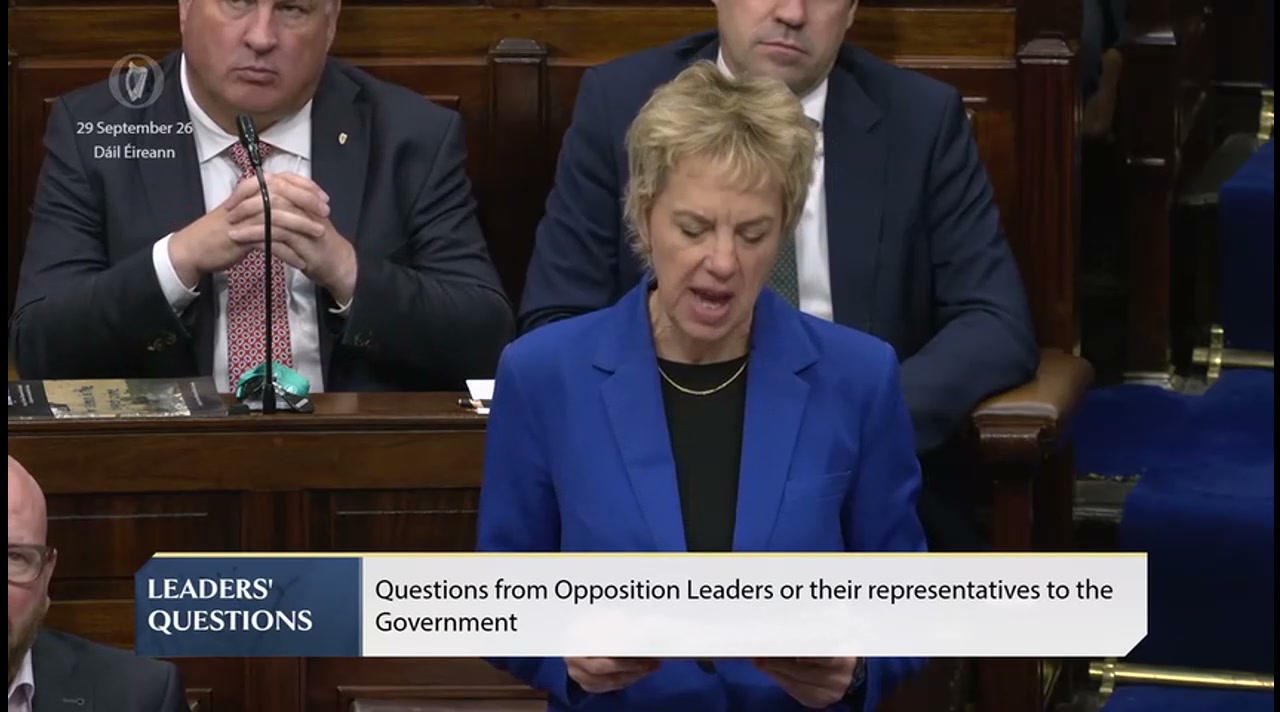
The Taoiseach said the decision was difficult to understand and wrong, and that the priority was to find a way forward that avoided harm and enduring trauma. Bacik highlighted residents’ concern for children who had grown up in peace under the Good Friday Agreement, and sought clarity on when a mediator could be appointed.
Bacik said the Parades Commission’s decision had reopened deep wounds for a community affected by decades of violence. She argued that the circumstances behind previous refusals had not materially changed and warned against a return to the dark days of the 1990s.
Mediation and restoring trust
Bacik urged the Government to remain closely engaged with the British Government and Northern Ireland’s political parties. She said proactive steps were needed to restore calm and trust, and warned that some actors wanted mediation to fail and the Good Friday Agreement institutions to be undermined.
Section 11 and the Secretary of State
Bacik asked whether the Secretary of State would use the powers available under Section 11 of the Public Processions Act 1998 if mediation failed. She said the power to prohibit a parade should be considered to reduce the risk of violence and further trauma on Garvaghy Road.
Protecting the next generation
The Taoiseach said the decision was difficult to understand and wrong, and that the priority was to find a way forward that avoided harm and enduring trauma. Bacik highlighted residents’ concern for children who had grown up in peace under the Good Friday Agreement, and sought clarity on when a mediator could be appointed.
We publish thousands of recordings to make Irish politics transparent and resistant to manipulation. Spotted an error? Report it — together we are building a reliable archive of Irish politics.
Other speeches




Tego samego dnia All speeches from this day →
Paul Murphy
Paul Murphy challenges government over Palestine and FAI
Richard Boyd Barrett
Richard Boyd Barrett calls Drumcree march naked sectarianism
Victor Boyhan
Victor Boyhan calls for farm energy support in Budget 2027
Richard O'Donoghue
Richard O'Donoghue Calls for Whistleblower Protections
Mark Wall
Mark Wall: Cut public transport fares, not raise them
Paul Murphy
Paul Murphy challenges data centre electricity costs
Transcript
I want to welcome our visitors in the gallery who are campaigning for children with additional
needs.
And I want to pay tribute to Miriam Lord in the Press Gallery.
Miriam, you've contributed to the gaiety of the nation significantly, and many of us
will miss your column on Saturdays, even when we're sometimes the brunt of it.
Your witty and sometimes barbed words were always a treat to read, so thank you for all
you did.
Taoiseach, last Thursday I met with residents of the Garbhaie Road here in Dublin.
From them I heard directly of their distress at the prospect of the Portadown Orange Order
marching down the road they call home.
Now their fears are being realised.
The grant of permission last Friday by the Parades Commission has reopened seriously
deep wounds.
I think we can all be clear, none of this is about infringing on anyone's traditions.
More than 90% of marches in the North have proceeded without issue.
But the reason this march has been rightly curtailed for nearly 30 years is the enormous
horror it causes for a community that has grappled for decades with a legacy of violence.
Violence linked to so many killings.
We think of Michael McGoldrick, the Young Quinn brothers, Rosemary Nelson, PC Frank
O'Reilly and more.
Taoiseach, we cannot afford to return to that dark past, those grim days of the 1990s.
Granting permission for the parade was reckless, irresponsible and wrong, with no material
change in the circumstances that had led to the march being refused on previous occasions.
Taoiseach, you have said that you want to see calm restored, and I think we all agree
with that.
And it seems today that an international mediator may be appointed to intervene in the dispute.
You said that your government remains in contact with the Executive and with the British Prime
Minister and Secretary of State, Chris Bryant.
That's important, and indeed I appealed to the British government to remain closely engaged
when I spoke at the British Labour Party conference in Liverpool yesterday.
But Taoiseach, it's a failure of Northern Ireland's political system that the situation
remains so tense and volatile today.
And clearly residents may feel well that the institutions set up to protect peace have
abandoned them.
So we must not abandon them.
As co-guarantors of the Good Friday Agreement, you have a role in restoring trust.
And Taoiseach, we know that there are sinister actors who want to see mediation fail, who
want to explore the dysfunction in power sharing and devolution, to bring down the institutions
of the Good Friday Agreement.
And we cannot allow them to win.
Proactive steps must be taken to restore trust and calm, as the SDLP has said.
So Taoiseach, have you asked the PSNI why it told the Parades Commission that the Drum
Cree Parade could safely take place, as it clearly could not?
Will you use all diplomatic channels to ensure that the people of Garvaghie Road are not
subjected to further trauma, and to ensure that the march does not take place?
And if mediation fails, will you call on the Secretary of State to exercise his powers
to prohibit a parade under Section 11 of the Public Processions Act 1998?
First of all, I thank the Deputy for raising this.
And I would say to you that, again, I concur that nobody wants to go back to the terror
and trauma of what transpired over 28 years ago, and during that particular period.
And as I said earlier, I found the events of the past weekend deeply depressing.
And I think we have to focus on next steps and how we mediate a way through this.
And I've given my views on the decision.
I can't, I'm not going to attempt to take the house through that, or indeed through
whatever rationale the Parades Commission itself has given.
I think we need to be careful of placing responsibility on the PSNI in terms of that decision.
I think the PSNI would say there were caveats to that, but I want to take the opportunity
to pay tribute to PSNI.
I think John Boettcher, the Chief Constable, had one singular clear objective.
I think he used the phrase that he didn't want one hair on one head hurt or injured.
So he's overarching a priority after the court's decision and so on to try and protect human life.
And that's important.
And I think we should be clear about supporting the PSNI in that objective and avoiding any
action that would precipitate injury or harm to people.
And so I'd make that point.
And in terms of, the Parading Commission has made its decision.
And I'm clear that I found it difficult to comprehend.
I believe it's the wrong decision.
From our perspective, if you look at 28 years, it's difficult to understand why this year
it's allowed.
And even if you go through the very manner in which it was allowed, it seems to suggest
to me that there are clear issues, if you're only allowing 35, et cetera.
But I think we need to focus on how we can bring all different dimensions to this together,
or how we can have a conversation and develop a conversation between the communities involved
to try and resolve this once and for all, or to get a pathway to resolution of this.
Because I listened to Chris Nelson this morning, the son of Rosemary Nelson.
And he articulated the immense trauma that he endured as a result of the murder of his
But he also, I think he said this morning, we must think of the children of this community
above and beyond everything else.
And we just must do everything collectively that we possibly can that avoids any harm
or any enduring trauma for the younger generation
of the community in Drumcree, and particularly along the Gavrati Road.
And that has to be our singular, I think, objective.
And I think we now need to concentrate on how we get a resolution to this, which will
not be easy.
And I think we have to move beyond the fact that decisions are being taken.
The courts are independent, by the way.
And I don't care about that.
But I think if we can engage with the parties involved, I think hopefully we can find a
way forward.
Well, I think what was particularly impressive about the calm dignity of the Gavrati Road
residents when we met them last Thursday was their concern for a younger generation to
ensure that the dark days of the past wouldn't be repeated for a generation of people who
had happily grown up under peace and under the Good Friday Agreement.
And this is why this is now so grim.
And I do agree with, and indeed welcome, Taoiseach, your strongly worded views on the decision
of the Parades Commission.
I think we all share your view that it was an unacceptable and incomprehensible decision.
And of course, the most important thing is to ensure that nobody is injured or worse
now.
But of course, the longer uncertainty prevails, the longer the standoff continues, the worse
the risk for Gavrati Road residents, for the younger generation, for all of those who
we had hoped would never experience those horrors again in their lifetime.
So I think what we would like to know from the opposition side, and for us in the Labour
Party and our sister party, the SDLP, is what is that pathway you speak of?
When will the mediator, can we see a way to appoint a mediator as soon as possible?
And if not, then why aren't we talking about Section 11, which is part of the architecture
of the Good Friday Agreement?
It's there in the 1998 legislation, the power of the Secretary of State to prohibit a parade
without any veto from the PSNI or the Commission, enabling consultation, but no right of veto.
So the Secretary of State must be prepared to utilise that power rather than run the
risk of violence on the Gavrati Road.
And again, could I just acknowledge, of course, the presence of Every Child Matters and the
and hopefully get a chance to say hello to you later.
Deputy, I think the Minister for Foreign Affairs, Helen McAtee, has been in constant contact
all weekend with various parties and with the Northern Ireland Secretary of State.
I've been in contact with the British Prime Minister.
And we're well aware of the legislative framework governing actions that the Northern Ireland
Secretary of State can take, or could take.
But I do think that the context has to be one where whatever decisions are taken,
ensure a pathway towards trust and reconciliation between both communities on the ground.
Otherwise, decisions can get subject to subsequent legal actions as well, as we saw.
So the contact will continue.
There hasn't been, I think it's fair to say, I don't think a consensus has emerged,
clearly, in terms of a pathway forward.
And people are mindful of the different perspectives and stances that people have on this
current situation.
We may regret, and certainly I do, that because of the decision we find ourselves in this
position, our objective now has to be, collective objective, is to find a way out of it that avoids
the terrible trauma that we witnessed in the past.
It would be a singular failure of progress in Northern Ireland if we were to witness
something similar to that now.
Thank you.