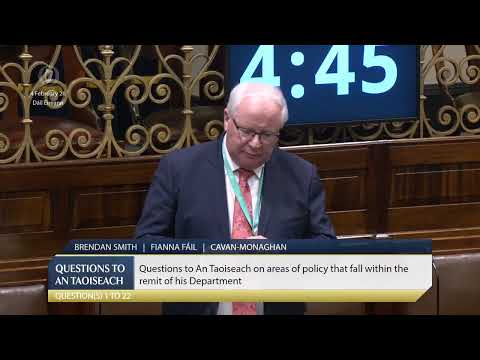
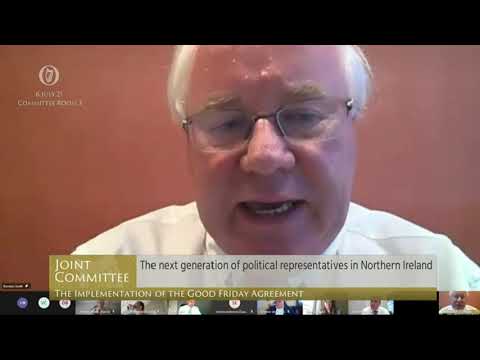
Brendan Smith calls for public bodies to answer the phone
Brendan Smith raised concerns about public bodies failing to answer telephone calls during an Oireachtas committee discussion with the Office of the Ombudsman. The Fianna Fáil TD also questioned access to complaint services, unsuitable nursing home placements and the operation of healthcare schemes.
We publish thousands of recordings to make Irish politics transparent and resistant to manipulation. Spotted an error? Report it — together we are building a reliable archive of Irish politics.
I welcome Mr. Dearing, Mr. Tang to the committee and thank Mr. Dearing for his comprehensive report to us and also it's very evident that the Office of Ombudsman is proactive, you're not just reacting to complaints and I compliment you on that, you're pushing out and letting people know that your service is available. Just a few questions along with a few comments. Has any effort been made to bring public utilities under the Office of Ombudsman or the Office of Regulators? Because nowadays we're getting plenty of complaints about the lack of efficiency and the lack of response by those particular bodies and you take public utility, I have to say I exclude the ESB from any criticism, they've been fantastic over the years in responding to complaints from ourselves in the face of very severe storms when I have to say that the time of storm we own in my own part of the country was very badly affected, we were getting responses in the middle of the night from ESB personnel and phone calls as well where there was real hardship that we had brought to their attention and I think it's a model public utility in responding to the public. In my estimation, I think that's shared by a lot of colleagues here in the Oireachtas as well and at local authority level. I'm interested in the piece of work you've done with the County and City Management Association with the local government management agency and I'm glad that so many public sector personnel have taken place in that particular project complaint handling for public bodies. Colleagues here on the committee will have heard me talk often about why can people not answer a phone? So many irritations, so much annoyance could be evaded, could be avoided by people answering a phone and I think it's a thing we might develop later in the meeting as well. Could we do a bit of work together as an Oireachtas committee along with yourselves in regard to the need to say to government departments, statutory agencies at national and local level that there has to be a policy of answering the phone? Everybody unfortunately doesn't have the literacy skills and we all know instead of doing a long winded email, two minutes of a phone conversation could resolve issues and I have to say, and again, we're all informed by where we come from. The local authorities in my constituency, Camden and Monaghan, the officials there in housing and the officials who deal with homelessness, they're always talking to the people, ringing people back, if I call them, they'll ring people, try in difficult circumstances but they're conscious of those vulnerable people that they should have access to talk to a person on the phone. Oftentimes they don't have an address to send correspondence to or whatever. So I have to say in my own experience, my own two local authorities work hard to bring the best possible level of service to people who are very vulnerable and in very, very whether it's public utility, statutory agency, government departments, it's not acceptable that we get correspondence that there's no phone number on it to ring back and then nobody answering phones where there are phone numbers. So I have to say that it's an issue I think we need to highlight more. It's absolutely frustrating. Could I just say, the only 65 is in nursing homes. Obviously that's a huge issue. Do you come across any instances in general, sometimes a young person in a nursing home in an unsuitable placement, if they're to go to a suitable placement, maybe it's very distant from their family and that creates another difficulty. I came across it once or twice maybe where there may have been an offer to provide residential care for a person but it was very far away from their family. I know that that can be, but people being in unsuitable accommodation, unsuitable residential care is detrimental to their overall wellbeing and health as well. Could the, I'm very glad that you highlight the whole transport scheme. It's outrageous that it's taken so long to devise a new scheme. That was past the parcel and you state, Mr Dearing, that no department wanted to take on the issue. That's appalling, so it is. It's absolutely not good enough and in the meantime, as you said, people being deprived of a basic facility and a basic support in life. With regard to the cross-border healthcare scheme or the Northern Ireland planned healthcare scheme, the treatment abroad, I have to say in my experience with the HSE, with the public service, that office has been one of the most efficient and accessible there has been in public service in my years in public life, which is considerable amount of time now. I think they've gone out of their way, in my experience, to facilitate people, to try to move applications on, being very conscious that the person they've gone out of their way, in my experience, to facilitate people, to try to move applications on, being very conscious that the person who's seeking that approval for treatment abroad, they have a health issue, that person, and I have to say that my experience is that that section, division in the HSE has been exemplary. That is my experience over the years. Could I just say, the issue you make in regard to people who work here on a permit, who are not being denied the right to appeal to the Ombudsman, they're contributing a huge deal to our society. They're people we need, and those of us who have been, the Curriculum itself and many others who have been speaking at the Dáil at different times, why are we not recruiting more people from abroad? And you know, the HSE, to their credit, they have had a very strong campaign of recruiting people from abroad. I remember one young lady came from South Africa and I met her along with friends she had from work and I said, was that a particular reason you came to Ireland to work? She said, can I show you my LinkedIn page? She was targeted, targeted, targeted because of her particular qualifications by recruitment agency for the HSE, and that's why she came to Ireland. So we have to give credit on that side. We are criticising that we don't have enough therapists for children with additional needs, and then at the same time when these therapists come here, they don't have the same rights as the rest of us. That's not acceptable. I'm glad that you make that point, Mr Dearing, as well. So just with regard to, you mentioned as well, your broader investigation, the part an individual contains. Have you any other particular pieces of work on the way at the minute that you're doing investigative work on, and maybe if you have a chance, with the permission of the Curric, you might reference how together we might be able to try to create an awareness and let people know who are in public service, deliver in public service, they have an obligation to talk to the public. Thank you. Thank you very much. Thank you, Deputy. Thank you for your support on the people who are denied access, who have to get their residency and issues like that in order to work here from the Department of Justice. I just think it's straightforward, it should happen. There's no reason why they, and I can't say much more than that, that they should be allowed access to our office. On the cross-border scheme, I would agree with you, and always when we talk about that scheme, we're always careful to say the schemes themselves are very good, and for the vast majority of people, they work really well and they make a huge difference. When we did our investigation on foot of a number of complaints we received, the issues we were finding was just slightly too bureaucratic on a number of issues. For example, if there was a mistake with the doctor's letter, a person would have gone and had the treatment done in good faith, paid for it, but because maybe the doctor hadn't signed the letter, the doctor might have intended, or somebody else might have signed it on behalf of the doctor, or in other cases, it was because my sister paid for it rather than me paying for it. So when we pointed those issues out to the HSE, they immediately said, we're going to rectify those. So I would agree with you, the patients are now at the centre of these schemes, and that's really good. But where there is an issue, and I'd be grateful for any support you can give to getting this message out to people, is if you use an intermediary, and some people are, there are agents now who are selling these services, and they don't tell people that if you don't pay the hospital or the health service provider directly, you may not get your refund. And the other thing that needs to be looked at is we're looking at some of these cases, and we're seeing a big gap between what the hospital would have charged you had you gone directly and what the agency that is referring you. And that's something that needs to be looked at, but everybody, whether it's the agency, and some of them do have legitimate advertising and say, this is what you're likely to get, this is what we'll charge you, and this is what you're likely to get back from the HSE. And then a person can make an informed decision. But not everybody is warned in advance that if you don't pay the hospital directly, you may not get reimbursed. And we're working with the HSE themselves. To be fair, they have that on their website, but we think it could be more clear, we think it could be more precise, and certainly there's a need for an awareness campaign for people using it. Because I completely agree, they're really good schemes, and when they work, they work really well. And we never want anything that we've done to sound like a criticism of the schemes. We think the schemes are good. We just want to make sure that they're completely accessible and that people don't find themselves inadvertently unable to make the claim, claim the refund. The under-65s, yes, your point about finding a local location, sometimes people are in the nursing home because it is convenient for them or for their family. You reminded me, and I'm glad you did. One of the key things in the report that we're going to circulate to you is that the number of these individuals in the nursing homes has reduced. Now that might sound obvious, but it's a really important point, because we're working on trying to get them more suitable accommodation, but if people were still going in and staying in nursing homes, then you'd still have the same problem. But we're actually seeing a decrease. There was a 72% decrease since the end of 2025, and a 221% decrease since January of 2021. So progress is actually being made. But I would say to you as well, and it's an important point, the types of facilities that people go to range from community residential specialised placement, a new personal home of their own, a residential placement, a return to their own family home, and community residential sheltered living. So what's really important here, and this is where the work goes in, in fairness, is the work, the wraparound that person before they leave the nursing home. You can't just say to a person, well, we have a house for you somewhere. It doesn't work that way. There's a lot of work goes into working with the person to establish what their needs. And the HSE did a really good pilot down in Cork with the NGO Headway. They did a good pilot there. And I think the way forward here is, I think we can't expect the HSE to do everything. I think there are other organisations who are working in this space, and they can do, I think, a good deal of the work in preparing the person and identifying the needs, and then team up with the HSE around actually providing the facilities. And of course, what we have to remember as well, in fairness, there's an ongoing support. The project doesn't end when you get the person. There's a wraparound, there's home care, there's a whole range of supports that are needed to help people live more independently. But for the people who it has worked for, and I visited actually some of the homes up your direction, actually, where one person had come out of a nursing home after it was 30 years. He had had an accident at 25 years of age, and he was, you know, so that's too long, you know, to put it mildly. But it's definitely going in the right way. And you know, it's probably an example of what can be done when people decide they're going to do it. And the HSE did decide they were going to do this, and they're doing it. And of course, we'd all like to see it happen quicker. But for the people that it's happening for, it really is so important. And again, I can't stress enough the other supports that people are getting through that scheme. The people who, for whatever reason, can't leave a nursing home, don't want to leave a nursing home, they're getting separate schemes. And I've said to this committee before that people don't always realize some of the people in the nursing homes, they actually go to work. You know, they have jobs, but there's just no accommodation for them, no more suitable accommodation. On the phones, people will be sick listening to me saying this, Deputy, I agree with you. I call it old-fashioned innovation. We use the phones a lot in our office. And sometimes when the complainant comes in, we often contact the complainant by phone, and they're quite surprised because it's the first time they've actually spoken to somebody. And you also mentioned the local authority work we've done. That's at the fore of that is saying to local authorities, engage with people, engage with them quickly. And the whole dispute resolution process that we recommend to people and that we've worked on is actually about fixing it as quickly as you can. Because as things get escalated, people become more entrenched and more dug in. So there are phases in that, but our whole emphasis, and the same with ourselves. We resolve about 80% of our complaints informally within about three months. That may be slipping with the numbers we have at the moment, but certainly that's our aim. And when you get on the phone to the person and find out what's the real issue here, what would resolve it, and you get on to the provider, sometimes just through those phone calls, you're able to actually resolve things. So I agree with you. If people could be heard and actually speak to people, that certainly helps them a lot. On the broader investigations and future investigations, we don't have anything at the moment. We're working in a number of areas where we're developing and looking at a number of issues that will become investigations, and we'll come back to you with that information when we have those developed a little further. And as regards the public utilities, no, we don't deal with them. We certainly get complaints sometimes that are misdirected to us. My predecessor, I suppose, tried hard to get Iskairn when it was being set up under the auspices of the Ombudsman, but there was no interest in doing that. And I suppose our focus has been more on could we get all of the public services that we should be able to deal with in first before utilities would be a very big step for us if we were to go that route. But the answer is no, we can't deal with them at the moment.
Thank you for downloading 🙏
If you publish this material on social media, we would be very grateful if you tagged VideoParliament. It helps us reach more people and keep building a transparent archive of Irish politics.