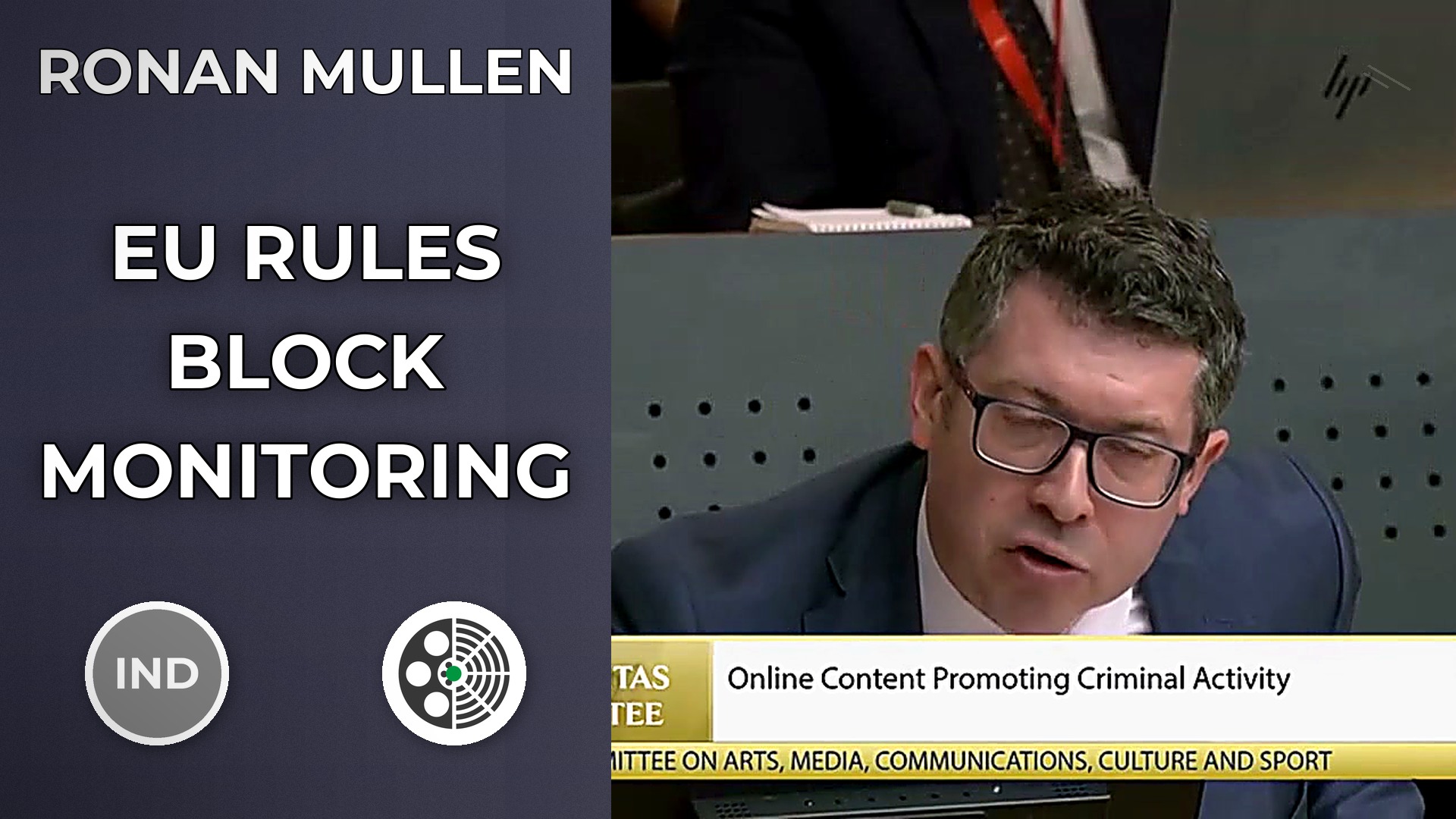
Rónán Mullen challenges EU limits on online monitoring
Rónán Mullen questioned officials during an Oireachtas debate about whether European law is preventing Ireland from requiring pre-emptive monitoring of online criminal activity. He also pressed for stronger age verification for pornography and greater protection for children online.
We publish thousands of recordings to make Irish politics transparent and resistant to manipulation. Spotted an error? Report it — together we are building a reliable archive of Irish politics.
I want to pick up right there. And I want to note in passing what you yourself said earlier, Chair, where you emphasized two things. The need for domestic law in this area, building on or replacing what is missing in the European legal setup. And secondly, the need for a focus on criminal liability. I've been saying this a long time in relation to a separate issue, not under our discussion today, which is the requirement for strict age verification around access to pornography. Today, we're obviously talking about the promotion of criminal activity. And that particular point that you're making, that it isn't just that the current EU legal setup prevents you as a regulator acting under that setup from requiring preemptive monitoring, but it actually prevents Ireland from having a law that would enable you or require you to require preemptive monitoring. That is the position to the department and to yourselves, Commissioner Law. The European law is an obstacle to progress in that direction if it was the will of people. Is that correct? Yeah. Yeah. And what I want to ask the department then is, have you received any direction from government? Because from time to time, European laws give problems. And member states make it known that there is a problem, and they seek for an adjusting measure. Maybe a derogation when it's being prepared, but subsequent to problems emerging, there can be a change in the law. Is there any direction from government at this point that there needs to be negotiation at European level so as to enable member states to require preemptive monitoring? There isn't at present. And why is that the case? Because we've been going on about this for months. And as I said, I was going on about it in relation to it. And when we had the European Commissioner McGry in here, I thought we were hearing a softening of the dead hand of the European bureaucracy. And there was supposed to be various developments taking place around social media, bans, and so on. And it seemed to appear that member states had more leeway. But it seems that on this issue, we're back to square one, which is the EU won't let us. Well, what I would say is, I mentioned the DSA is to be reviewed next year. If there were proposals to change it brought forward, then that will obviously be discussed. If, if, if. The minister hasn't told you to take any particular direction on this yet or to prepare a line of approach for the Irish government. That much seems to be clear. Well, I suppose we have to wait to see what proposals are brought forward. But what I would say is that there is an awful lot of really good proposals in the EU Kids Act. Look, I heard enough last week when I heard that they were proposing the children under three shouldn't be on social media at all. And I said, we're dealing with damp squibbery here, wherever we were, you know. So I'm afraid people have lost faith in the capacity of EU-wide regulation and directives alone to deal with this problem. Every country has a duty to protect its own citizens. We are still member states of a bigger union. And it seems to me that many people are absolutely fed up of the way we seem to be sponsored by our European obligations when it comes to taking the measures that are needed. And to commission them on, I would say, you know, it isn't just a matter of you saying, well, we have to await a policy direction for our masters. You are the ones who see what's going on. You see what's working. You see what's not working. You see how few actions you're currently taking. It is within your capacity, is it not, to say to the government, life would be better if we sought some changes at European level so as to allow preemptive monitoring. Isn't it? Yeah, absolutely. It's part of our role to advocate for changes to the law or to include it. Including at European level. So why aren't you? So we have been very focused on the protection of children. Well, you haven't really. We've heard nothing about strict online verification. It's not today's discussion. But like, we're still in that vague area of, you know, age assurance, this, that, and the other. And kids are still able to access pornography, you know. So I mean, how serious are you about pushing for more and strict law? The chairman has talked about the need for criminal liability. We're not there. We're not on that page at all, are we? So we've been quite vocal in what changes we think need to be made to the law to protect children better, including effective age assurance or age verification for services that are not safe for children. We've been vocal in saying that we think... OK, but you haven't got to the point. Sorry now to interrupt you with time in short. You haven't got to the point where you're recommending to the government that there would be more leeway at member state level so that preemptive... By the way, I think I know the answer to that, which you haven't. But isn't it the case that since those, that European legal architecture was set up, the technology has moved on so as perhaps to make it more possible to require companies to engage in this preemptive monitoring? Wouldn't that be true? Yeah, I think the no general monitoring obligation is of quite long history. Began in the e-commerce directive several years ago. So the practicalities of general monitoring are, as we've heard from the companies, it is a more practical thing to do, whether it's how that balances against fundamental rights from a policy point of view. So it's the free market, is it? It's the free market and freedom of expression, even if people end up being endangered. No, absolutely not. The measures that are taken to protect people can and do justify some constraints on freedom of expression. Finally, have you taken any survey of, sorry now to be so cutting you short, but have you taken any public surveys of public attitudes? Because I think there is, and would be, serious public support for mandating preemptive monitoring, which is my own term for it, you know what I mean. Have you any interest in surveying public attitudes on that point? I think we had surveyed quite, recently surveyed quite a lot on, actually saw the social media ban. We could look at that from a research point of view. But I would say that despite the fact that preemptive monitoring is not required by regulation, it does in fact happen. And so there's a question about how effective that is. Oh, but we're at the mercy of the companies who do it. So is our arm.
Thank you for downloading 🙏
If you publish this material on social media, we would be very grateful if you tagged VideoParliament. It helps us reach more people and keep building a transparent archive of Irish politics.