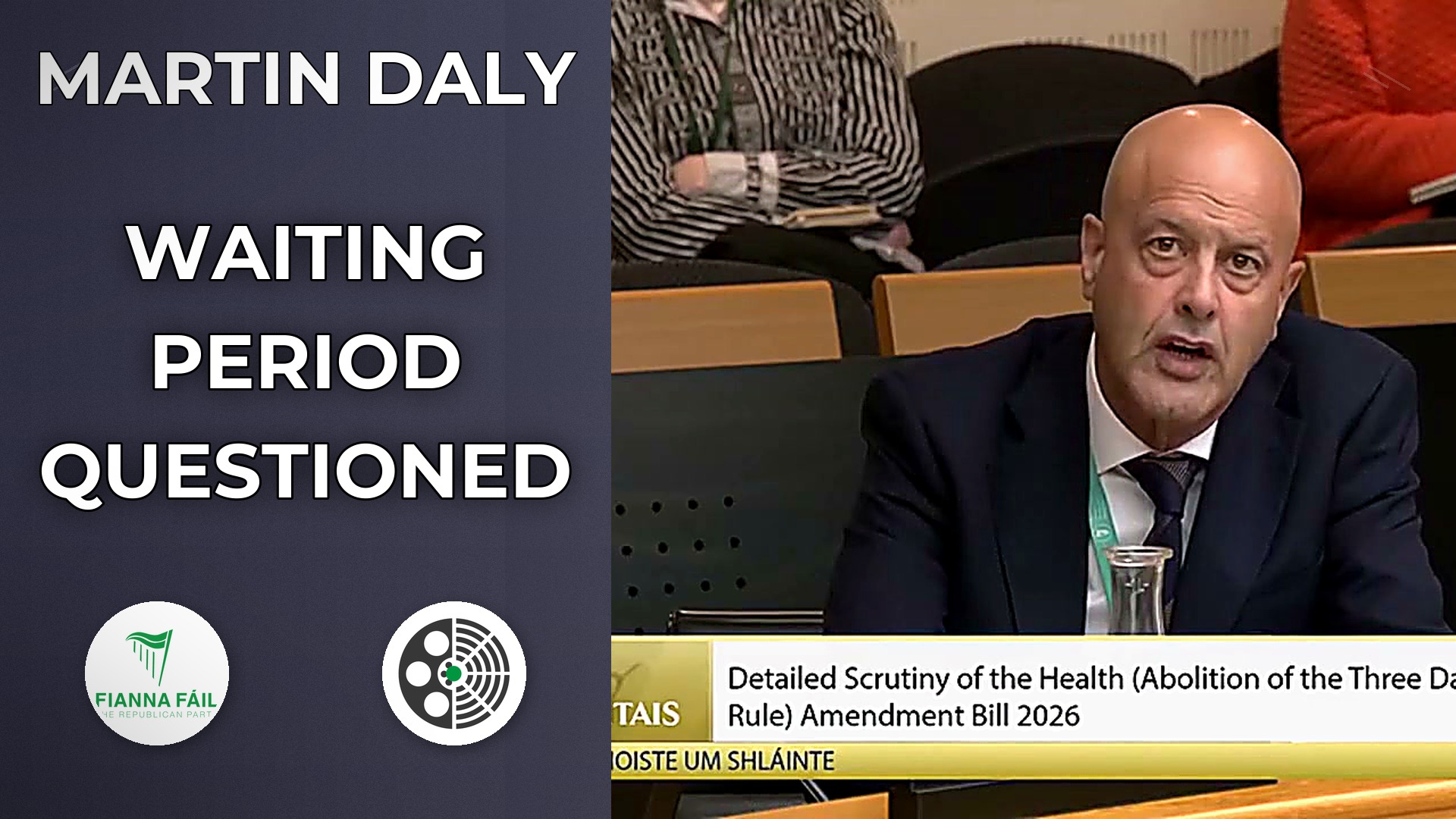
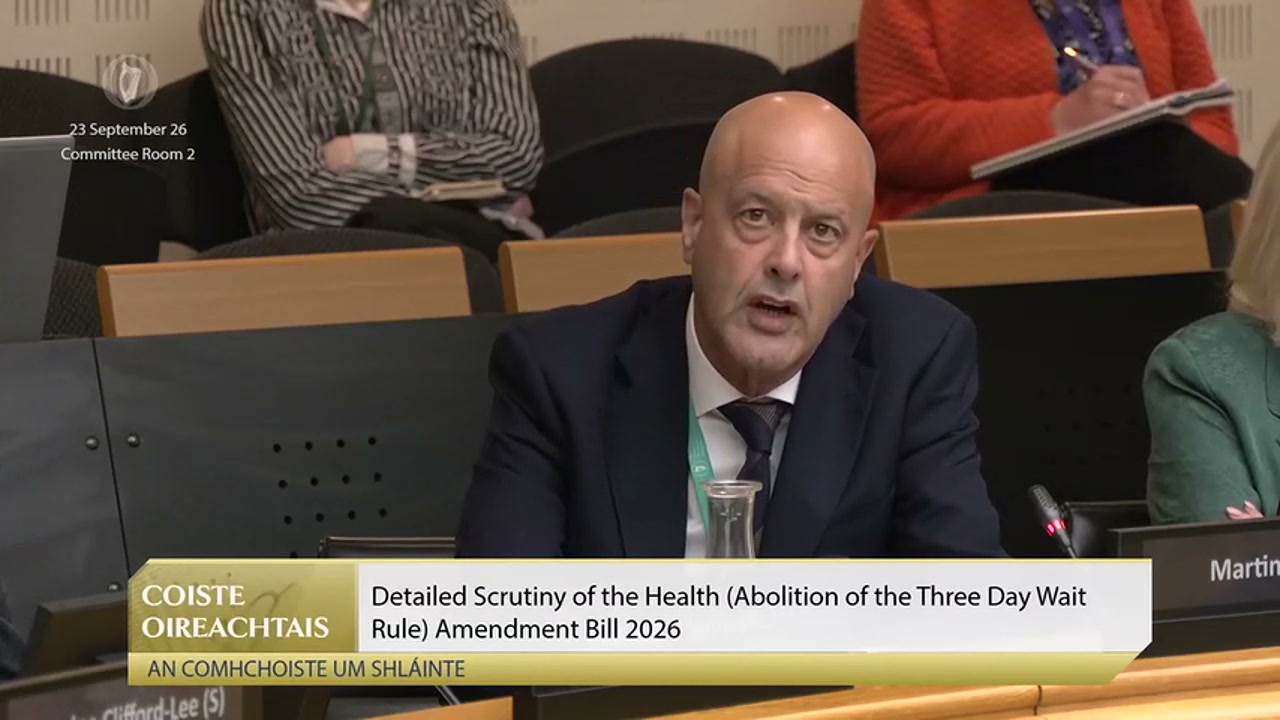
Martin Daly Questions Three-Day Abortion Waiting Period
Martin Daly questioned witnesses on the medical basis for Ireland’s mandatory three-day abortion waiting period during Health Committee discussion. He asked whether the requirement delays care and disproportionately affects women facing financial, travel or personal difficulties.
We publish thousands of recordings to make Irish politics transparent and resistant to manipulation. Spotted an error? Report it — together we are building a reliable archive of Irish politics.
Thank you to the witnesses for coming here this morning and for your statements, which I've read both of the statements, and I suppose we start out with the premise under the legislation that, and I note in the HSE's document, is a legal entitlement, and women are entitled also to have the highest quality service delivered by well-trained professionals in the health service, and that's really important to note. Coming to the, and I know from both documents, and I might ask both of you, Dr. Horgan and Dr. Murphy or Dr. Mulally, to comment on this, is there any scientific or medical or clinical rationale for a three-day mandatory wait between the consultation and then the procurement of a termination? There's no medical reason for a mandatory wait. Okay. Dr. Murphy? No, there's no medical reason. There's plenty of research that shows that women have actually made a considered decision before approaching a doctor, so we do have the MyOptions. There's a lot of information available, so experience would show that women have discussed this with their partners, with their close confidence, and have come to a considered decision before meeting a doctor. There are situations where people do need additional time, but in most instances and in other countries where they have had a 72-hour waiting, it led to a longer time before accessing care, but the evidence would suggest that those women were not conflicted when they presented. So Dr. Mulally? I agree with my colleagues, and I suppose we have overwhelming evidence from the WHO abortion care guideline, which was published in 2025, against waiting periods. So that was a meta analysis of 33 scientific studies, and I might just go through some of those in some detail. So seven studies showed that mandatory waiting periods contributed to abortion delays by increasing the time from counselling to the abortion appointment and by contributing to logistical difficulties in accessing care, and that effect is magnified when two visits are required, as with our current model. Seven studies show that mandatory waiting periods do not contribute to any changes in abortion rates, unintended pregnancy or birth rates in general. One study showed that among minors, mandatory waiting periods are associated with an increased risk of reporting an unwanted birth, and 18 studies reported that mandatory waiting periods contributed to financial, emotional costs, such as logistical burdens, emotional stress, financial costs, travel time and out-of-state travel. And for most women, mandatory waiting periods do not impact the woman's certainty in abortion decision, and certainly as an abortion care provider, that is something that I would see very clearly when I meet women. And they don't align with WHO recommendations, human rights standards and modern clinical practice. And as doctors, we are used to dealing with the concept of informed consent all of the time. We are very much used to dealing with patients who exhibit signs of indecision and uncertainty, and we are very aware of the concept of giving patients time. Yeah. There's a couple of specific questions I'd like to put to you in relation to some of the issues that were raised. Firstly, if you could confirm, what's the natural rate of spontaneous abortion in the first natural abortion or miscarriage in the first 12 weeks of pregnancy? Is it in the order of 30%? It's approximately between 20 and 25%, depending on the age of the woman. So, I am concerned about one thing, because the providers, again, working from the premise that it is a legal right for a woman to have an abortion in this country, under the legislation. I know that there are certain parts of the country there is a dearth of providers, which means that there is considerable travel and logistical issues for women. Does the published evidence show that women of lower income groups who are vulnerable, perhaps financially, perhaps are in controlling coercive relationships, where it is difficult for them to share with the partner what's going on? Is there published research to show that those women are disproportionately affected by a mandatory way? Yes, that's absolutely correct. That was included in the WHO guidance. We know that vulnerable and marginalised women already experience difficulties accessing healthcare, and more importantly, they have poorer health outcomes. So, they will absolutely be more affected by any mandatory waiting period, whether it's three days or any other number of days. I would be aware in practice that in the West of Ireland, women have to travel two or three hours to find a provider, may have inadequate public transport, have issues around resources, and that. So, I just wanted to know what the published research says in relation to this. In relation to healthcare in general, I mean, we trust people to make their own decisions, don't we? I've noted in both documents, informed consent is based on patient's capacity, understanding, and voluntary decision-making rather than a prescribed waiting time. Is there any other area of healthcare other than minors where mandatory wait times are enforced? There is not, and I suppose it's worth noting that healthcare is becoming increasingly complex, and people make very complex decisions about their own health every day in collaboration with their medical practitioners, and we do not impose mandatory waiting periods on any other decisions. So, my time is short now, so it's really important around the area of reflection, because I think there's general agreement that there should be a period of reflection if the woman wants reflection, or a patient, but a woman in this case wants reflection. I suppose we're coming around the whole area of a mandatory period of reflection. My experience would be that people have already reflected on this situation before they come to a doctor. What would the evidence show? I mean, that is certainly true, and the UNPAC study, the women that were surveyed and interviewed in depth in that would certainly say that, and I think it is important that there is a period of reflection allowed for within any amended model of care, but that is consistent with any other area of healthcare. So, what we're saying is that what the published evidence is saying, is saying that this is, there is no clinical or medical or scientific reason for a mandatory three day, that reflection is good, but it doesn't need to be mandatory, that women have already reflected before they present to a doctor, and have the opportunity to voluntarily reflect on this case in conjunction with the provider, and that the mandatory aspect of it, there is no real basis for it in science, that this is a political policy decision, respecting people's personal views on that. Thanks, Steffi.
Thank you for downloading 🙏
If you publish this material on social media, we would be very grateful if you tagged VideoParliament. It helps us reach more people and keep building a transparent archive of Irish politics.