Ciarán Ahern Defends Carbon Tax as Cost-of-Living Measure
Labour speaker Ciarán Ahern addressed Dáil Éireann during a debate on energy and the cost-of-living crisis. He argued that scrapping the carbon tax would undermine supports for households in energy poverty and prolong Ireland’s dependence on fossil fuels.
Energy costs and household pressure
Ciarán Ahern acknowledged the severe pressure facing households and small businesses, including rising electricity, heating, petrol and diesel costs. He said more than half a million gas and electricity accounts are in arrears, leaving many people facing difficult choices between heating their homes, travelling to work and meeting other essentials.
Criticism of the Independent Ireland motion
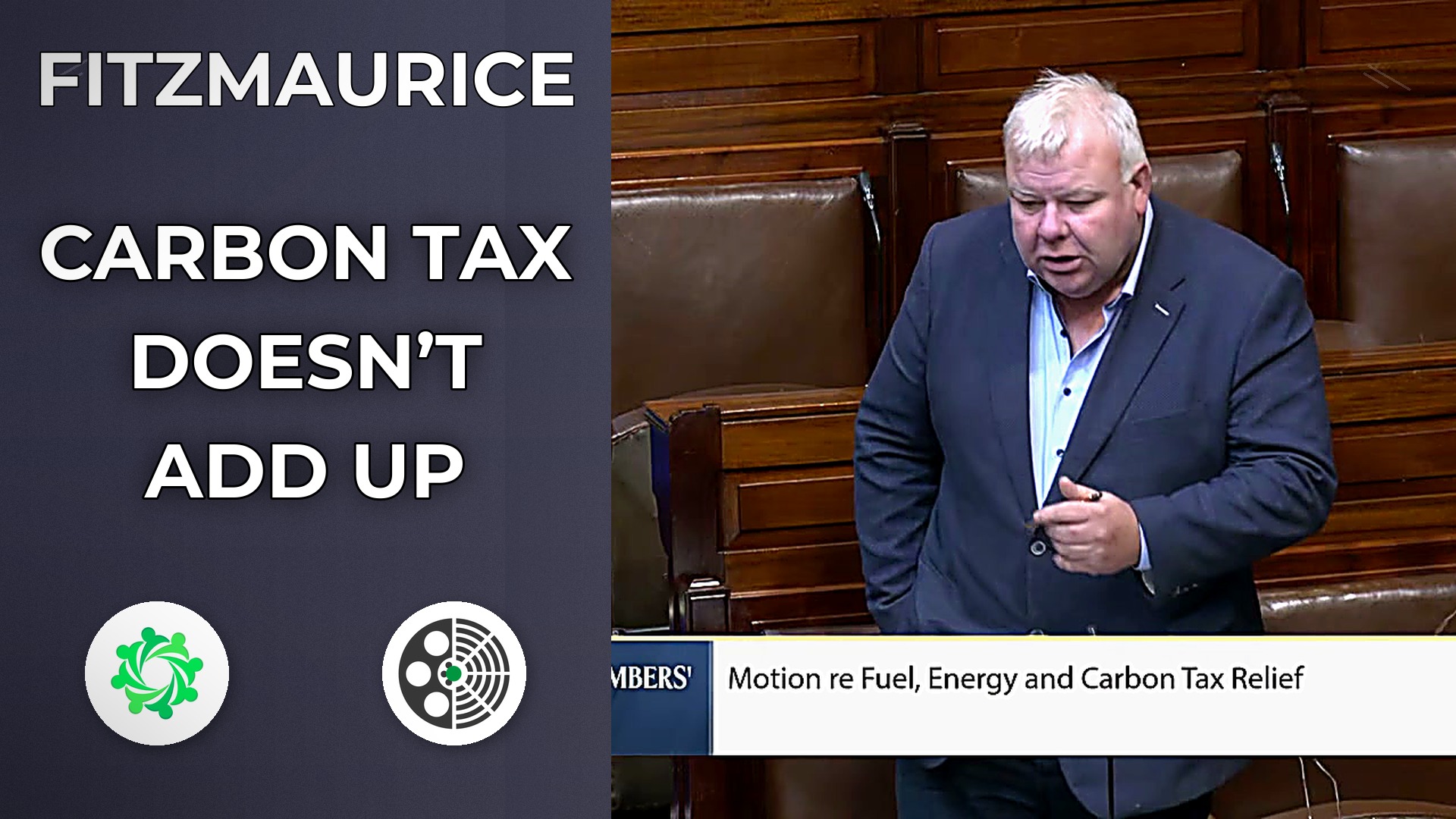
Ahern criticised an Independent Ireland motion for failing to address the climate crisis, excess profits by energy companies, data centres and public transport fare increases. He argued that the motion focused on subsidising fossil fuels without setting out measures to reduce Ireland’s exposure to international energy markets and geopolitical shocks.
Labour’s case for a just transition
The Labour speaker said the carbon tax should form part of a just transition, supported by targeted measures for low- and middle-income households. He called for greater investment in retrofitting, electric vehicle grants, heat pumps, insulation, solar panels, batteries and public transport, with particular attention to rural communities and low-income households.
Carbon tax revenue and fuel poverty
Ahern said carbon tax revenues had funded retrofitting, social protection and supports for farmers, including the Warmer Home Scheme and the Acres scheme. He cited €558 million for retrofitting and €350 million for social protection payments in the previous budget, arguing that the tax can be progressive when its proceeds are properly targeted and scrutinised.
Immediate support and long-term energy reform
Ahern called for targeted energy credits alongside greater investment in energy efficiency. He argued that temporary reductions in petrol or diesel prices would not reduce Ireland’s dependence on oil, while retrofitting, renewable energy, public transport and electric vehicles could lower household bills over the longer term. Watch the recording to hear the full contribution.
We publish thousands of recordings to make Irish politics transparent and resistant to manipulation. Spotted an error? Report it — together we are building a reliable archive of Irish politics.
My thanks to the deputies from Independent Ireland for bringing this motion forward today. Everyone in this house knows and agrees that we're going through a severe and extended cost of living crisis and we all want to do everything in our power to protect people most at risk from energy poverty and so many people in this country are struggling right now. But the vast majority of us in this house, and in opposition at least, agree on the reasons for the cost of energy crisis and the long term solutions. The climate crisis isn't mentioned once in this motion. That is just wild. There is an acknowledgement, and I'm sorry where, where is the acknowledgement in this motion that the current energy crisis has been directly caused by Donald Trump? Where is the acknowledgement that Trump, who Independent Ireland welcomed with open arms into this country a week ago in the Phoenix Park, whose politics some of the deputies here try to ape and assimilate, that he is the direct reason why energy bills are high here and across the world. Trump's illegal, reckless, pointless war on Iran has brought us here, not the carbon tax. Donald Trump, Mark Zuckerberg and their billionaire class are the only economic migrants into this country who are actually responsible for our problems. But Independent Ireland can't find it within yourselves to criticise them. You can't punch down on them. Where in this motion are the proposals for a tax on the excess profits of energy companies? Where is the support for a moratorium on data centres which are being added to which are adding to household bills and being built to placate the tech billionaires? There are none, because these are the guys that you want to cosy up to. And where was Independent Ireland when we have been protesting against the hikes in public transport fares that are facing commuters, students, people with disabilities, people who can't afford cars? You say you're concerned with transport costs, but, just like this government, only for certain cohorts. Now, where we can absolutely agree is that there's no questions that households and small businesses across Ireland have faced extraordinary pressure from energy costs. Families are seeing electricity and heating bills rise, motorists have faced much higher costs at the pump, and so many people have been left with difficult choices between heating their homes, travelling to work, and meeting other household essentials. Such is the scale of the energy crisis, and the cost of living crisis more broadly, now that we have more than half a million gas and electricity accounts in arrears in this country. So the pressures are very real, and any serious discussion of energy policy or climate policy has to begin by recognising them. But there is an equally important point that needs to be made. Those pressures are being exacerbated and prolonged by Ireland's continued dependence on fossil fuels, those which the deputies are seeking to subsidise indefinitely in this motion. The existence of a cost of living crisis does not remove the need to address Ireland's dependence on fossil fuels. The experience of recent years has demonstrated why reducing that dependence should be an economic and social priority as well as an environmental one. Our over-reliance on imported fossil fuels means that we are massively overexposed to international energy markets and geopolitical shocks, as we have seen following Trump and Netanyahu's misadventures in the Middle East. The Minister has pointed out previously that our dependence on imported fossil fuels is a vulnerability, including the fact that approximately 80% of our gas is imported from our nearest neighbour. We urgently need to reduce our dependence, and the carbon tax has an important role to play in that. What is important is the policy framework we put around it, how the proceeds are used, and whether we give people realistic and affordable alternatives. This motion does note that for a lot of people in rural Ireland, and notwithstanding the process that has been made with respect to the local link in recent years, there is still a lack in rural Ireland of alternatives to private cars or fossil fuel-powered homes heating systems, and I agree with that. So we need to go further and faster in rolling out supports and incentives to allow people to wean themselves off fossil fuels, EV grants, heat pumps, insulation, solar panels, batteries and so on. And we need to make all of these things more accessible to larger cohorts of the population, particularly people in rural communities and low-income households. But we're not going to be able to do that if we do away with the mechanism designed to fund those supports. Labour's position has always been that the carbon tax should form part of a just transition rather than being considered in isolation from household incomes and energy affordability. And to be fair, we have supported increases in carbon tax while arguing for a refundable carbon tax credit for low- and middle-income households. That distinction is important. Carbon tax is intended to reflect, through the price of fossil fuels, some of the environmental costs associated with their use. And yes, it is also designed to incentivise the move towards lower-carbon alternatives. Carbon tax detractors often claim it is a regressive form of taxation, but I just don't believe that. If we look at last year's budget, over a billion euro raised through the carbon tax was allocated to alleviating fuel poverty and reducing our dependency on fossil fuels, thus protecting those who need it most from inflationary shocks. The largest stream of ring-fenced funding went to retrofitting, social protection and – independent Ireland might be surprised to learn – farmers through the Acres scheme. The evidence shows, and has shown for years, that carbon tax is a progressive measure and that our most vulnerable households are better off as a result of it. Of course, the precise treatment of revenues from it should be transparent and scrutinised, but the underlying principle is straightforward. If the state asks people to change how they heat their homes, how they travel and how they consume energy, the state must invest in making those changes possible. That sentiment is somewhat reflected in the motion, but the proposal seems to lean towards more of the state just ceasing to ask people to make those changes. I would lean the other direction. We must continue to encourage people to transition towards cleaner energy, but crucially we have to support them in doing so and protect those who aren't yet capable of doing so. Because the unfortunate reality for some deputies in this House is that climate change is real and it is accelerating. We have just emerged from a summer of extreme weather events both at home and abroad, so we need immediate, targeted protection for households under pressure. But we also need sustained investment that reduces the underlying need for that protection. Scrapping the carbon tax would be catastrophic in both respects. Just looking at the figures from last year's budget, €558 million, the largest stream of ring-fenced carbon tax funding, went to retrofitting, including the Warmer Home Scheme, which gives grants to low-income households to improve the energy efficiency of their home. That's funding that's helping struggling families to keep their homes warm and lowering their bills. The second largest stream of funding, €350 million, went to social protection payments to help alleviate poverty and protect people from the cost of living. These payments were chosen on the basis of research by the ESRI, which focused specifically on determining how to make the carbon tax progressive and to ensure that the most vulnerable weren't worse off as a result. So if we're going to be in the business of making policy here, we have to ensure it's evidence-based. Contrary to proclamations that the carbon tax is regressive, the opposite is in fact true. The tax helps us to alleviate poverty. It particularly targets groups known to be at greater risk of energy poverty. Low-income families, single adults living alone, exactly the people most in need of support in the current moment. So are the deputies advocating for cuts to the carbon tax going to go back to their constituencies and gleefully tell pensioners on fuel allowance the good news that they won't be getting any further increases anymore because they've successfully gotten the carbon tax slashed? Delaying the increase in carbon tax costs the government millions that would otherwise go to targeted supports for those who need them most. Low-income households, single pensioners and farmers. In Budget 2026, there was £163 million more in ring-fenced funding from carbon tax than in Budget 2025. Because of the suspension of the carbon tax increase, there will be no such additional funding for just transition measures next year. It's worth noting as well, in all of this, that some of our sectors here, including heavy industry, haulage and farming, are already eligible for partial or even full reliefs from the tax. Of course, the government has utterly failed to make clear the value and purpose of the carbon tax, how it works and who it helps. And none of this is to say that I or the Labour Party don't have issues with certain aspects of the carbon tax. For example, the first €20 per tonne of the tax is not ring-fenced for just transition measures. And I think it should be. But this motion amounts to simply prolonging our dependence and subsidisation of fossil fuels to international price shocks like the ones we're experiencing at the moment, as well as defunding the supports available to help people wean themselves off fossil fuels. So, we need a two-pronged approach, one that protects the most vulnerable in the immediate term while also supporting people to reduce their dependence in the longer term. That's what a just transition should be. We in Labour have consistently called for targeted energy credits to help households struggling with bills and at the same time we want to see far greater investment in retrofitting schemes so that more households can improve their energy efficiency and bring those bills down in the first place. A temporary reduction in the price of petrol or diesel might bring the price down for a few weeks until Trump decides to, in his words, annihilate another country. But it doesn't reduce our dependence on oil. A retrofit does, renewable energy does, public transport does and EV does. That's why Labour has consistently put these measures at the centre of our climate proposals because not only are they climate measures in their own right, they will also help with the cost of living. Not just today and not just this electoral cycle, but in the long term. Households that are given the right supports can afford to retrofit their homes today and can reduce their energy consumption and lower their bills tomorrow. Those supports are funded by the carbon tax. This motion presents a false choice between helping people and tackling climate change. For more UN videos visit www.un.org
Thank you for downloading 🙏
If you publish this material on social media, we would be very grateful if you tagged VideoParliament. It helps us reach more people and keep building a transparent archive of Irish politics.