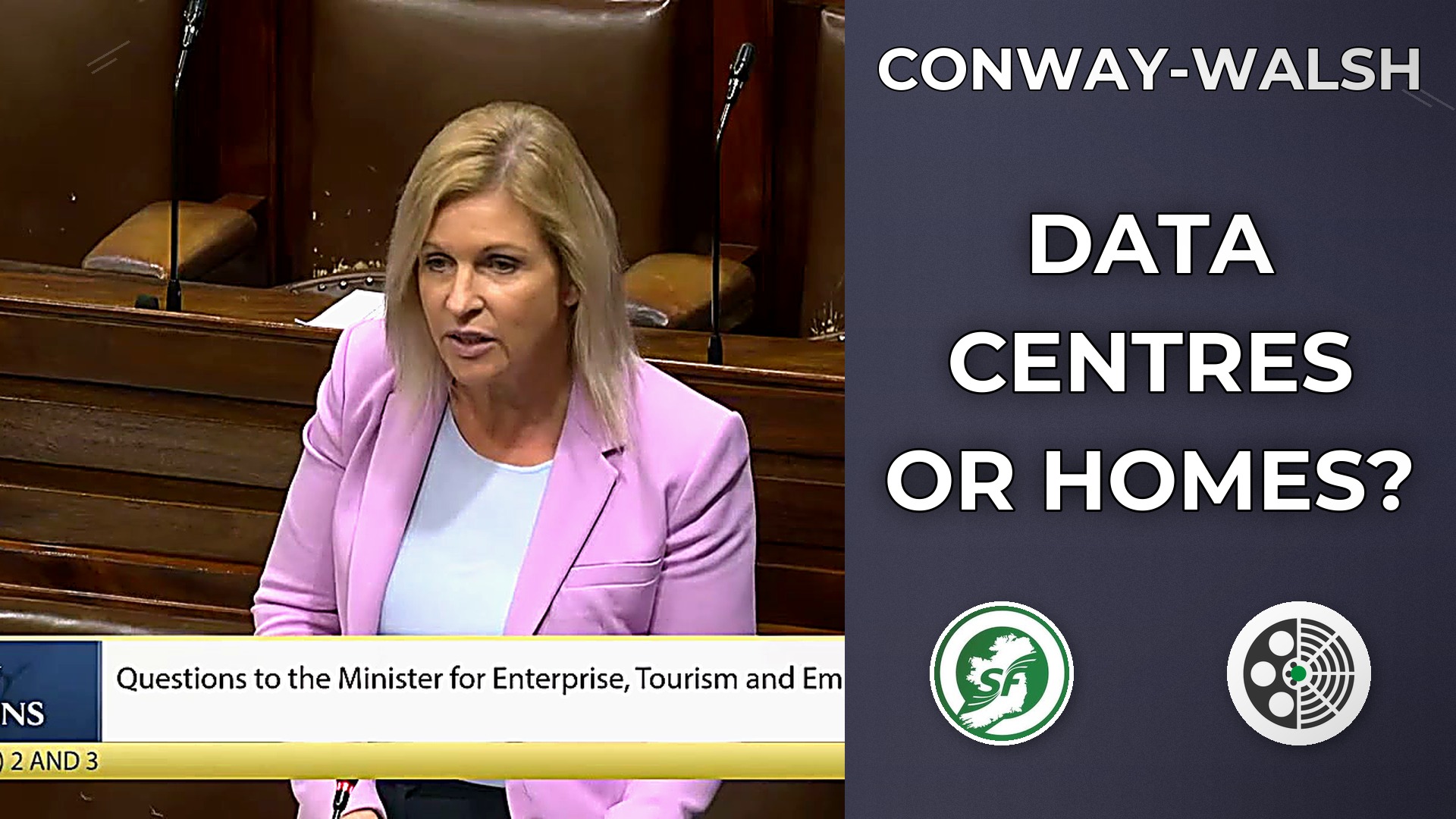
Rose Conway-Walsh Challenges Data Centre Expansion
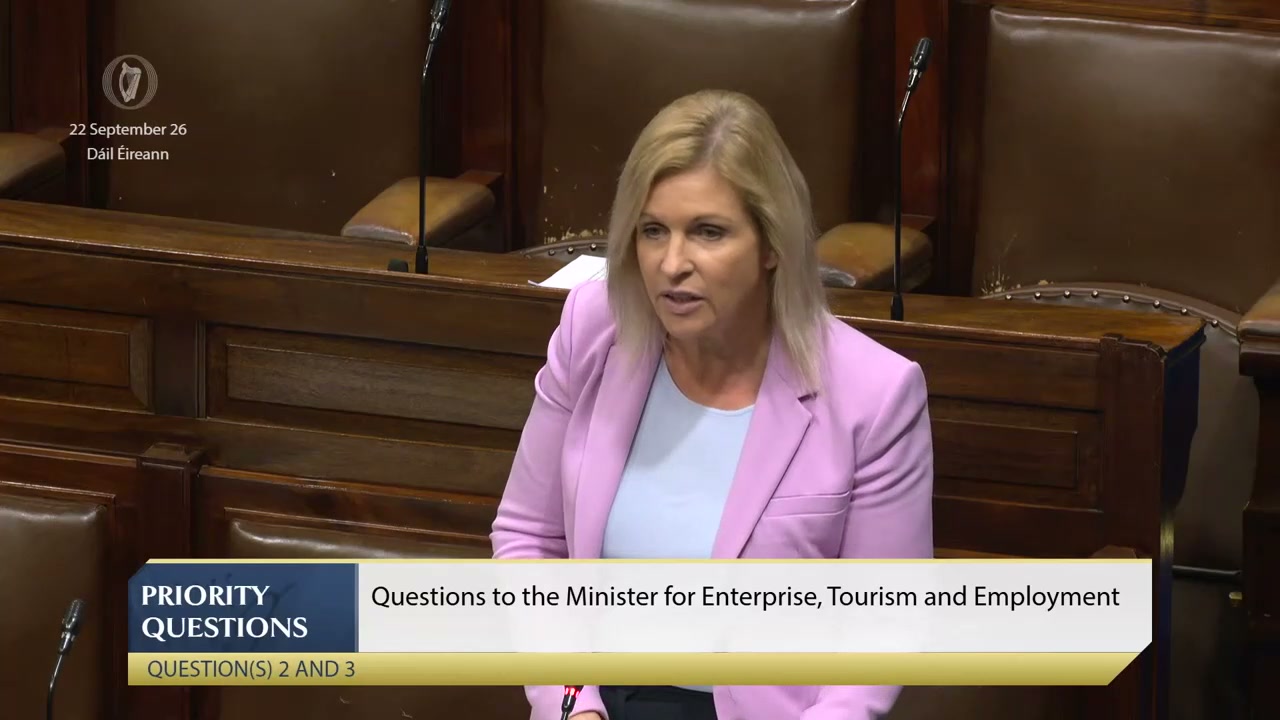
Sinn Féin TD Rose Conway-Walsh questioned the Minister for Enterprise, Tourism and Employment in Dáil Éireann about transparency around a KPMG report on data centres. She called for housing, energy security and public infrastructure to be prioritised amid concerns about the costs and scale of further expansion.
We publish thousands of recordings to make Irish politics transparent and resistant to manipulation. Spotted an error? Report it — together we are building a reliable archive of Irish politics.
Deputy Rose Conroy-Walsh and Deputy Roderick O'Gorman. Deputy Walsh. Minister, over the summer, your department published a report prepared by KPMG that set out the economic case for data centres in Ireland. Freedom of information requests by Lynn Boylan from Sinn Féin, and I want to acknowledge all her work in this area, revealed that officials from your department sought to make amendments to the drafts prepared by KPMG in order to cut concerns about the impact of data centre expansion on housing, on utilities and on farmland. So in the interest of transparency, will you release the full draft report prepared by KPMG where these concerns have not been removed? Minister, please. Thank you. Thank you, Count Corlann. I thank the Deputy for her question. I propose to take PQs 67205 and 67206 together. I propose to take these two priority questions as they concern the recently published report, The Value of Data Centres to Ireland, which was prepared independently by KPMG for my department. Turning to the first issue raised regarding the publication of the draft versions of the report, officials from my department and members of the steering group provided comments and feedback on draft versions in line with standard practice for commissioned research. Draft reports are subject to review and refinement to test assumptions, challenge analysis, seek clarification where required, and ensure that findings are robustly supported by evidence and clearly presented. In line with standard practice, this is the approach that my department takes in delivering independent research studies, including, for example, the sectoral analysis of future hydrogen demand and end-use in Ireland, an evaluation of dead weight in the debt-economic appraisal model, EAM, and an economic assessment of green energy park concepts. Assertions that the KPMG study on data centres was designed to reach a predetermined conclusion are incorrect. Responsibility for methodology, analysis and findings contained in the final report rests with KPMG following its evidence-gathering and stakeholder engagement, expert challenge and quality assurance process. I do not intend to instruct my department to publish draft versions of the report. Drafts are working documents that form part of an iterative research process and do not represent the considered final views of the authors. Publication of drafts without the context of the review and the quality assurance process could create confusion regarding the final conclusions of the study. Turning now to the issue raised regarding the economic impact of data centres, the associated energy costs and the scope of the study, the report was commissioned to address a knowledge gap regarding the economic contribution of data centres to Ireland, including their impact on employment, gross value added, tax revenues and wider economic activity. It found that data centres supported an additional 7,636 operational jobs between 2010 and 2024 and are enabling infrastructure supporting significant economic activity in Ireland. The terms of reference for the study were to determine economic impact and wider societal benefits arising from existing and planned data centres in Ireland up to 2030 and explore options for the evaluation of data centre landscape beyond 2030 with a view to optimising future economic and societal benefits. While the report was required to consider trade-offs and opportunity costs associated with future data centre development, it was not commissioned as a comprehensive cost-benefit analysis comparing the economic benefits of data centres with electricity costs nor was it designed to net economic benefits of data centres against alternative uses of electricity, land, water and infrastructure capacity. And you'll be back now deputies, just to reaffirm, it's a 12 and a half minute, two question slot, so two minutes each for response, starting with Deputy Conrad Watt. Go raibh maith agat. Minister, I do think people need transparency around, because people are really searching with how many data centres are enough, how do we get a sustainable balance? In 2025, data centres consumed 23% of all metered electricity, up from a figure of just 5% ten years ago in 2015. That's more than the total metered electricity used by all urban dwellings in 2025, which accounted for just over 18%, and all rural dwellings accounted for 9%. At this rate, data centres' electricity usage will surpass the whole total used by all homes within a few years, and I don't think that's sustainable, Minister. The pressures that these data centres are placing on grid capacity cannot be understated. And as Minister for Enterprise, Tourism and Employment, I'm sure you can recognise that where grid capacity is unavailable, this jeopardises potential investment and job creation in smaller businesses. Delays in securing electricity or water connections means investment will go elsewhere to competing economies. Businesses need places for their workers to live. If we cannot match this housing demand due to grid constraints, we will lose out there. It's vital that decisions on new data centres' connections take account of the electricity requirements of housing, of businesses, of public services, and future industrial development in that area. That is why last week my colleague, Pa Daly, brought forward a bill that does just that. It prioritises homes and businesses over these energy and water consuming data centres. More data centres mean higher energy bills for households. Earlier this afternoon, Lynne Boyle, an MEP, and Eve Ryan from Trinity College presented the findings of their research on how data centres impact on the cost of electricity. Thank you Deputy. Deputy O'Brien. Thank you very much, Councillor Corlyn. Thank both deputies for their responses. And critically, as I pointed out in my contribution, that our report was not a cost-benefit analysis. It was principally about the added economic value that data centres would bring to the economy or not thereof, because we had a gap in evidence in relation to their economic value. We have a body of evidence from DEC, from the CRU, from AirGrid, from the EPA in relation to grid capacity, electricity demand, emissions, all those other areas. So to get a view on economic analysis, and that's a gap that government should have, should have impartial evidence to make that determination. So it wasn't a cost-benefit analysis. And let's be very clear, as I have outlined in my opening contribution, in other reports that have come forward with the department, you have a steering committee, you have a terms of reference, and you ensure that the report meets the terms of reference as required by the department. And all the methodology, all the assumptions, all the quality assurance have to be stood over by KPMG. That is the key. Just in relation to demand and competing interests, I'm absolutely aware that there are huge challenges with data centres, particularly about grid capacity. That's why I changed the rules. I said very clearly through our large energy user plan that data centres now have to have 80% renewable energy for any new data centre. That's going to drive forward our renewable energy transition. If we're going to breathe life into the five gigawatts of the five projects on the East Coast, you're going to need large energy users. But critically, to finance them, you're going to need that money, that opportunity that's presented, which is key. And secondly, we're also very clear for security with the grid, they have to have 100% of their demand in dispatchable energy generation on site. Again, that builds up resilience in the system. So as I pointed out before, we have an opportunity to book value for our data centres, build resilience in the digital economy. But I absolutely know there are challenges and we are mitigating those challenges by a strong policy response. Go raibh maith agat. Can I ask you, Minister, have you done a real cost-benefit analysis on data centres? Maybe you can just answer that because I think we need a thorough cost-benefit. Now, it may be there that I haven't seen it. Because households are footing the bill for network upgrades to increase capacity for data centres expansion, effectively subsidising the power supply for some of the most profitable companies in the world. Network charges currently represent 30% of the household bills, and they are set to rise by an average 41.25% annually from October. That cannot be fair. The government's laissez-faire approach cannot continue. Housing, energy security and infrastructure serving the public must be prioritised over the endless number of data centres. I mean, how many data centres do we need? How many are we going to have, and where are they going to be? The current arrangement of socialised costs for privatised profits cannot continue. Minister, I really think we need to look at this area, the whole area of data centres, where they are, how many is needed, and what the cost-benefit analysis is. Deputy, that's not an admission, it's a statement of fact. And I'm on the record of saying that, and it's in the programme for government, a comprehensive piece on the economic value of data centres. That's what the research and the report was about. Now, first of all, in relation to increased energy prices, various deputies are quoting reports here that data centres are responsible for increased energy prices. And we saw the Friends of the We've had a huge energy shock, and this report blames data centres. We have to ask ourselves, is that credible? When you look at the contribution to the grid for capital infrastructure that data centres bring, and this is the key thing where people are being misled, when you look at grid capacity, when you look through the temporary emergency generation scheme, when you look at the amount they have to pay. So if you have a household and you're building a new house, you have a charge to pay to put in your connection. Data centres are multiples of that, and so they should be, because their infrastructure costs, their capital costs are huge to put in. But obviously they're buying energy on the wholesale market, which is like comparing apples to oranges, because they're certainly in the amount that they ask, and that can drive forward our offshore renewable. And this is a question that a lot of people that advocate our offshore renewables are not answering. How are you going to finance them? Are we going to for the five gigawatts that we are not going to use that demand here, the nine gigawatts on onshore we're looking to bring in, the eight gigawatts of solar, where are we going to have that energy demand? Are we going to rely on other countries to export it that are increasing their renewables and increasing their own energy independence? Are we going to look at the potential of booking that value for every citizen? And yes, there will be challenges on that road, and yes, we have to be very careful that we don't get into a situation whereby there's a trade-off with housing or industry, but my new policy and the government's policy manages that quite well, because you're driving renewables. We know, as set out in the report, that there's a challenge with emissions, around 4% of emissions right now from data centres, but the opportunity cost in bringing fully renewable energy into the grid is very significant, and no one wants to mention that.
Thank you for downloading 🙏
If you publish this material on social media, we would be very grateful if you tagged VideoParliament. It helps us reach more people and keep building a transparent archive of Irish politics.