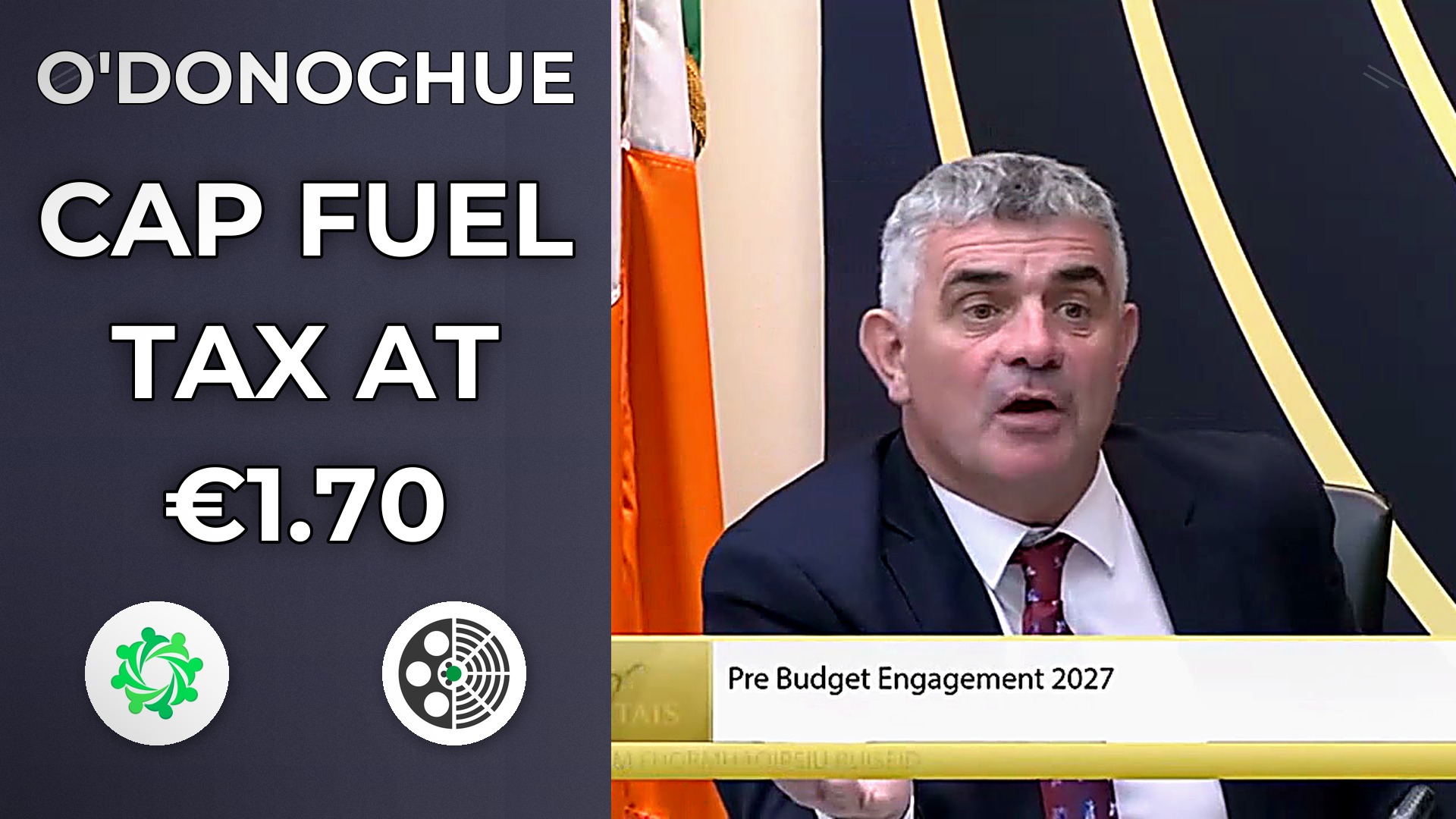
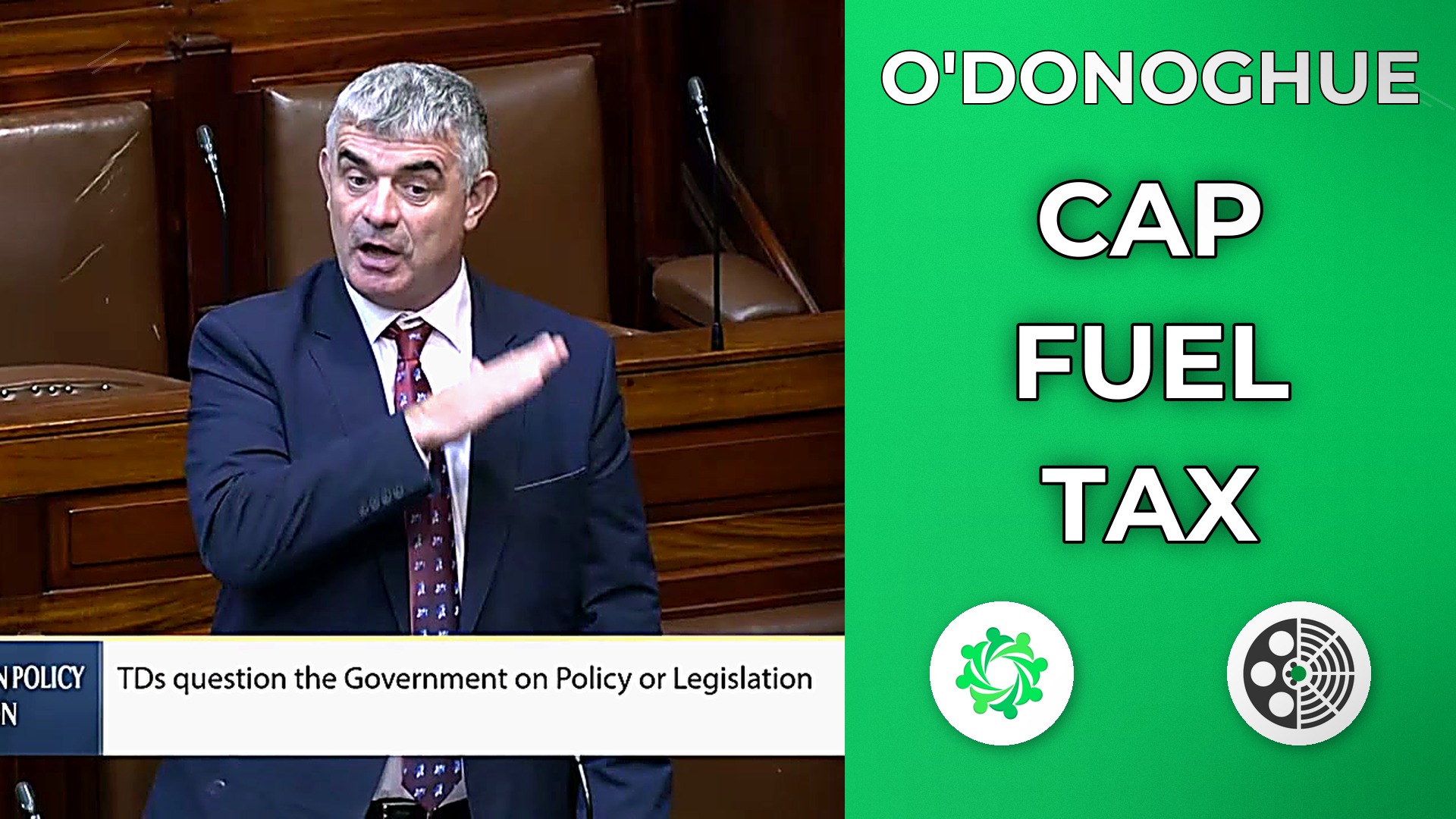
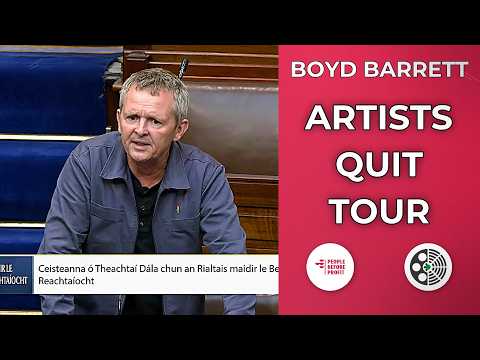
Independent TD Richard O'Donoghue has called for a cap on fuel taxation at €1.70 per litre during a discussion on fuel costs and inflation. He argued that the proposal would give households and businesses greater certainty while allowing consumers to pay any further increase in the underlying fuel price.
We publish thousands of recordings to make Irish politics transparent and resistant to manipulation. Spotted an error? Report it — together we are building a reliable archive of Irish politics.
So, after listening to your evidence that's there, and Seamus I was listening to what you were saying is, when you went back to 2011 and 2013 there was quarterly reviews and reports, which to me is a business model. Which I'm in business myself and I've explained on many occasions I'm in business myself. And I would love to have a business like the government. That you can overspend and have overruns, and we'll start again next year and we can go overspend and overruns. Because in any sector in Ireland, regardless whether you're working, self-employed, whether you're employed, if you have an overrun, you can't go back next year and say, I have an overrun, I need to go back in again. That's logic, it's normality. I've been on about fuel taxes and the cost of fuel and taxes and the inflationary costs, it's costing different people. And everyone in this room is either on 20% tax or 40% tax, it's capped. I have to ask a question to you, and I've put this out there and other economists have looked at this. If there was a cap on taxation on fuel, so the government say, and I've used this before, 170 per litre, up to that it's taxable on the rates that they have. And after that, there is no tax but we pay the increased cost. In the case of the pumps today, ranging at the moment 210 to 215 at the moment. Over 50% of that is taxes. If we had a cap on the tax, it would actually stop inflation on transport, on food products. Across the country, on all sectors, including bus transport, which contracts have locked into for three years. If we had a cap on fuel taxes at 170 on white diesel and petrol, and I just used those two. I could use a business model to forecast a business for 12 months and allowing a percentage rate myself of where it could fluctuate above the 170. Last year, we were on 156 and the government were happy with the fuel that they were taking per litre. It's going to 215 shortly. I've looked at the different rates coming up today. 210, 215. I had one filling station tell me today he paid 212 for yesterday. He's afraid to put on the pumps and he's 3 cents per litre. He said nobody will pull in. In year expertise, if we put a cap on fuel taxes, the same as we have a cap on income tax from 20% or 40%, if we put it in from budget to budget, would that allow business to forecast? Would it curtail some of the inflation that we are fearing at the moment because of the inflation cost on fuel? Corinne, is it? Yes. Please. If I maybe start with the positives from your proposal. If you cap the tax rather than capping the consumer price, you end up with a scenario where you're maintaining the incentive to switch away because there are still price changes going on. The downside is that the tax cut is broad based. It's universal. The person with a big car that consumes a lot of fuel is benefiting more than the person with a small car. That's typically a high income versus a low income household. The tax cut would be regressive. That would make it very costly. A lot of the cost of the measure would be going to high income households who don't really need it as much. We see that savings is very stable or increasing in Ireland. High income households have the capacity to absorb tax increases. They also have the capacity to engage in switching behaviour, to switch away from these things. Can I ask you one question on your theory? The theory for high income families usually have newer cars which are either electric or hybrid, which wouldn't interfere with them whatsoever. The low income families are based on between 2010 and 2018, which are all bigger engines and older cars. Your theory on it would benefit a person that can't afford to change their vehicle because the higher earner can buy a new car. The lower earner can't. The benefits that you're talking about on paper is one thing. Realistically, the amount of cars on the road today are between 2010 and 2018. We have 2.8 million people working today. There's 2.6 million vehicles on the road today. Calculate how many new vehicles on the road today and electric vehicles and then look at the rate of cars between 2010 and 2018, which will take up about 80% of the vehicles that I'm talking about. That means that these are low income people. So 80% of the vehicles are not high earning people on high earning jobs. So saying that it will go back. This was on the Clarebourne show recently and they had an economist on, two economists, and one economist came on exactly what you were saying. The other economist actually said the exact same thing as what I'm saying. If you use the vehicle models that are there today and you look at the truck models and the bus models that are there today, and the other economist actually said the exact same thing as what I'm saying. If you use the vehicle models that are there today and you look at the truck models and the bus models that are there today, they're not in that category. On paper, you're looking at the base of people that are high earning. But practically, and looking at the evidence that's in front of me, it will not benefit. It will benefit everyone. And it mainly will benefit the people on low earning that can't afford to buy a car. At the moment, you have the people that are working on low income salaries and they're going to work. Frontline workers, fire servers, guardees, all working and having to drive to work. All of them would benefit from this. Teachers, people that are employed in the construction industry, all would benefit from this. So you're using a margin of high earners. They're not all there. There are a small minute of people that are there. And if you look at it from the range of housing, 2024, the cost of building a house was $367,000 plus VAT, which was $50,000 VAT. You look at the high earners, 2025, the same house costs $392,000 plus VAT. And in 2026, it's $440,000 plus VAT. All these are increases on people that are trying to get on the ladder. Our age group are fine because we've gone before this and we've got our base done. But I'm looking around the table here, there's a lot of people that are trying to get on the ladder. And they're paying double the cost of what we have to get on the ladder, even for an income of having a house. So the cap I'm looking for is a 170 litre taxable. If it goes below it, it comes back down. If it goes to that, 170 is a taxable that can happen. Rather than we paying on 210 today, we are paying a €1.15 tax on people that are going to work, are caring for the elderly. Whereas if you had put in my model, it would be a 187 today, including the increased cost of fuel. So that would go back to everyone that's working today, not the minute of high earners that you're talking about. Because most of the high earners that you're talking about can afford to change a car. The ones I'm talking about are the ones that aren't driving cars from 2010 to 2018. And that's the majority of the vehicles on the road today. So when we're looking at the process, I want to know can it work and will it benefit everyone, regardless whether you're a high earner or not. So my answer would remain the same. The available evidence shows us that fuel tax cuts are aggressive. They benefit high income households more than low income households. And more could be achieved to protect those vulnerable households with the same money if it was used elsewhere, rather than fuel tax cuts. So you will be okay if your tax rate, from the point of view it was used in a percentage model, which the 40% is the maximum tax. So if the same rate was used on your income today, and as things go up, that you're okay with a percentage rate on fuel of all the different percentages. So the higher it goes, the more tax the government gets, and the more it costs people that are working in this country. You will be okay with that, rather than having a cap that we can actually find a level playing field for businesses across the world, for transport, getting food to your table, getting your bus transport for kids going to school, that we would have a playing level field that I can forecast. Last Monday, I ordered stuff on the building site. Last Monday. I was told on Friday, if I didn't collect this stuff by Friday, that it was going up 10%. How can I forecast a business if I'm building a house for you, or an extension, or whatever we're doing? How can I forecast something on the side of capital? Transport costs I have to take into every single job. I can only price jobs a month at a time. I can't forecast. So if you come to me and you want to get a mortgage tomorrow morning, for a house, I can give you a price for one month. For one month. And in the costing, I'll be putting down, if the materials cost change within that time that you signed the contract, you pay the additional cost on the materials on the job. If I was able to forecast this, that I could lock in with transport costs for my company, to transport three or four vans on the road, forecast the labour content, I can forecast the auto enrolment, all that goes on to you if you're paying for me to do a job for you. It all goes on top. And now you want to put a fuel tax on top of that. We need to try and find a level playing field. The older trucks on the road, the older buses on the road, are paid for. Those older companies can sustain a lot more than the people that want to do better for the environment. They buy new vehicles. They have repayments. They now have a fuel increase cost. They have an ad blue cost. Everything is going this way. So the people that are in trouble at the moment are actually in the newer vehicles, because they have repayments on vehicles that are overpriced at the moment, the cost of buying them. They have to put an ad blue system into their vehicles, which is nearly heavier than ad blue now than it is on fuel going into them. And they have to pay all the different wage increase costs as well, down top of it. And the circle coming back around, it's shown to me now that the older vehicles that are in companies are able to sustain better than the newer companies that are trying to do better for the environment. So how do we find something to help people across the board, regardless whose benefits, up and down, do we find a plain level fit? So I think we're in favour of help. But if you go back 12 months, like I said, the price was close to 160 under the taxes that were in place at the time. And there was no issue or giving out about the tax on fuel. That might have been, oh, the government is putting this tax and that tax on diesel, but people were paying it. And there was no disquiet, shall we say, in relation to those taxes. The price has shot up in recent years, or in recent months, and pretty much none of that is due to the government. There have been some modest changes in tax, the carbon tax would have increased. But as a share of the increase we've seen, none of it is the responsibility of the government. Yet your proposal would put the full burden of covering that increase on the state. And as my colleague Karina has said, some of that benefit would go to people that don't necessarily need it. There are companies that can pass that price on. Yes, there are some price takers that couldn't look at it, and you could look at sector-specific packages for those that are price takers. But some sectors can pass the additional costs on. And when it comes to households, we're clearly in a position where universal benefits go to households that don't need it. Data from the Central Bank shows that, on average, every month, the amount that households have on deposit in this country with the banks increases by 7 or 800 million. Every month. If we introduce universal measures, the benefits go to those households, and they don't even notice it. So why are we using scarce resources to give benefits to households that don't even see it? And these benefits are huge. The cost of the excise reductions we've seen since the middle of this year is now going to exceed €1 billion. We had figures earlier of the scale and sizings. A billion is a huge amount of money. But I'm asking you something here. You just answered my question. €1.60 last year, nobody had a problem with it. And I'm allowing for inflation. I'm saying €1.70. But the additional cost over €1.70, we pay the cost. The state doesn't. So the state loses nothing by capping it at €1.70. They have 10 cents more than they had last year on taxes. But the consumer will pay the extra increased cost, so there's no subsidy. So you're saying it isn't part of the government's problem because fuels have risen. It is the government's thing. It's taking excessive taxes because the percentage rate now that you're paying on the €1.60 that you talked about with €0.50 more at the pumps, €0.26 of that is actually an extra tax. €0.20, €0.06 extra could be in the person that actually doesn't have to pay for it and will allow the increased cost in the fuel. So I'll pay the increased cost on the fuel, but over €1.70. So I understand that we all need taxes. We all need to make sure that people benefit for people that are unable to work and all the different benefits we have to do. But that was okay at €1.60 last year. I've allowed 10 cents more at €1.70 this year. And cap it at that to allow people to breathe and go to work. But if they're going to the pumps today and it's at €2.10, and if it goes to €3, €1.53 per litre will be taxation. So it's going into the government purse, but the person that's going to work is not getting anything extra. So they're paying an extra cost. So I agree with taxing on the fuel. I'm agreeing with it. But what I'm not agreeing with is when the price of fuel goes, because something happens in the Strait of Mews, that fuel goes mad. If we cap it, we'll pay the increased cost. But we can cap the price of energy. We import it. The price has gone up in international markets. There's more money leaving the country to pay for fuel because the price of it has shot up. But we're paying the increased cost. That cost has to go somewhere. If you cap the cost that consumers and businesses pay for fuel, you're saying to the government, you are covering all that cost. And that doesn't make sense. I've said that we are paying the increased cost of the fuel. The taxation system is done on NORA taxes and all the different VATs and all the things that's brought up to €1.70. We're paying the increased cost above €1.70. We'll pay it. So the more fuel money that you're paying for the fuel that's coming into this country, I'm asking you to hold the taxing of all the different energy cost taxing that's on fuel and capital of €1.70 and let us forecast within our businesses that we can actually forecast for something on a transport network. You look at any bus transport, how many even pulled out of bus transport that weren't in a 3-year contract this year? How many pulled out? I don't know the answer to that question. But I was going to come in with a broader point here that I think we need to not lose sight of. So I would agree completely with Carina in that any broad-based measures will not end up targeted. We'd be much better off targeting the households, targeting the businesses. But the reality is one other thing we have to consider is two things. One, some of what's driving the increase is demand. The reality is if price goes up, demand will lower. So if we're going to manage our way through this shock, we import this energy, we cannot be taking steps to increase the usage of fuel in demand, right? We do need to protect households, but those that can absorb the shock and firms that can absorb the shock, unfortunately, because it's external, will have to absorb the shock. We did not create it. That is the reality of this. The other dimension I think we can't lose sight of is if we are too short-termist in this and we provide a lot of current expenditure support, it ebbs away at how much we can build resilience. Ultimately, what we want to do, we want this to matter less five years from now. The new shock is lower dependency on energy, lower the sensitivity of Ireland. That is not achieved through capping the use of energy. That's achieved through incentivising switching of energy usage to households, firms, and we have got to do that. We're not going to be able to spend away out of an energy shock that's imported externally. We just can't do that. Or if you don't like spending, we reduce the revenue-raising measures. We're narrowing the tax base further. It is imperative here we take a very cautious approach to this and ensure the target households, yes, there are vulnerable people who need to be protected in firms, but if it goes broad, it gets very expensive and it has additional costs in terms of how we manage that resilience as well. So you're saying go to more green energy. So you go to an electric vehicle, 200,000 kilometres, which will take me three and a quarter years, three and a half years to do. I replace a battery for 20,000 euros on 200,000 vehicles. On a fossil fuel vehicle, right, you can do up to half a million miles and you'll still have the same engine and the same vehicle. And you look at the cobalt when you come into different countries and you look at all the resources, you're talking about going to green energy. Is it actually green energy when you look at it, when you have to replace it after 200,000 kilometres? So I'm not an expert in terms of car technology. How many buses in this country are parked in depots, electric buses are parked in depots because they're no longer viable? I'm talking about from budget to budget. I'm not saying long-term. I'm saying look at it from budget to budget. Try something different and give people a breather. Go back to what James was saying, quarterly results, and just go into a quarterly and see can it actually help people to stay afloat. Do it from quarterly. Bring back the same system that you did beforehand. As I said, there's an awful lot of people in this country who can't afford to change their vehicles. They can't afford to put food on the table. They have energy costs coming in from their electrical and ESBs. But because somebody said, oh well, these people will benefit more because they're higher income earners. You can't budget for everyone. You have to put a line for everyone that there's a line. The same line that you put in for people that are on 20% tax and 40% tax. There's two different lines because you're low for it. On the likes of fuel for people going to work, which is 2.8 million people going to work on 2.6 million vehicles. If you look at the stats, those people need to have something. They can't afford to spend an extra 50 euros a week on going to work, on going to moggy training, hurling training, different other things that they may be doing, soccer training, gymnastics, whatever. All costs that they've got to do with their children. I'm looking for something where we haven't got a transport network in this country, outside of Dublin, that people have to drive. And people that live in Dublin are telling me the same thing. That if they're going to work and they have a young dependent on them, they can't go to work on a bus because if that child gets sick, I can't get a bus to go to the school to pick a sick child up and take him. Common sense has to be approached here that people need vehicles in this country. And anyone that can afford an electric vehicle or a new vehicle, I applaud them. Well done, you can do it. But the majority of the people can't. And just because a minority of people will benefit out of it, I think we need to come into something on a quarterly approach, half yearly approach, to see can we change something, not long term. It can't be sustained long term. But if we can do something on a quarterly or a half yearly term, just to see can we budget to give people a breeding space, it can actually help. That's what I'm trying to do for everyone. So what I want to see is across the borders, and I want your experience and everything that's here myself. And I look at age groups. And I say to people and myself, my age group, I'll be okay. My children will have some benefits. If I'm okay, they'll benefit. My grandchildren are in big trouble. And they're the generations I'm looking at that if something isn't done for the person that's trying to get on the ladder, as I said, there's people here today I'm looking at, they'll pay 500,000 euros for a house and if it was five years ago, it would have been 250. There's no way a wage increase and all the rest of it are going to come up and help them pay for that money, no matter what earnings they get over their lifetime. And that's what I'm trying to... Everyone has a different opinion on different age groups from where we are. But when you go down the generations, when you go down the years, they're in big trouble if we don't put in something to try and steady it even for three months or six months of the year. And that's what I'm going to do. Marla, did you want to come in on something?
Thank you for downloading 🙏
If you publish this material on social media, we would be very grateful if you tagged VideoParliament. It helps us reach more people and keep building a transparent archive of Irish politics.