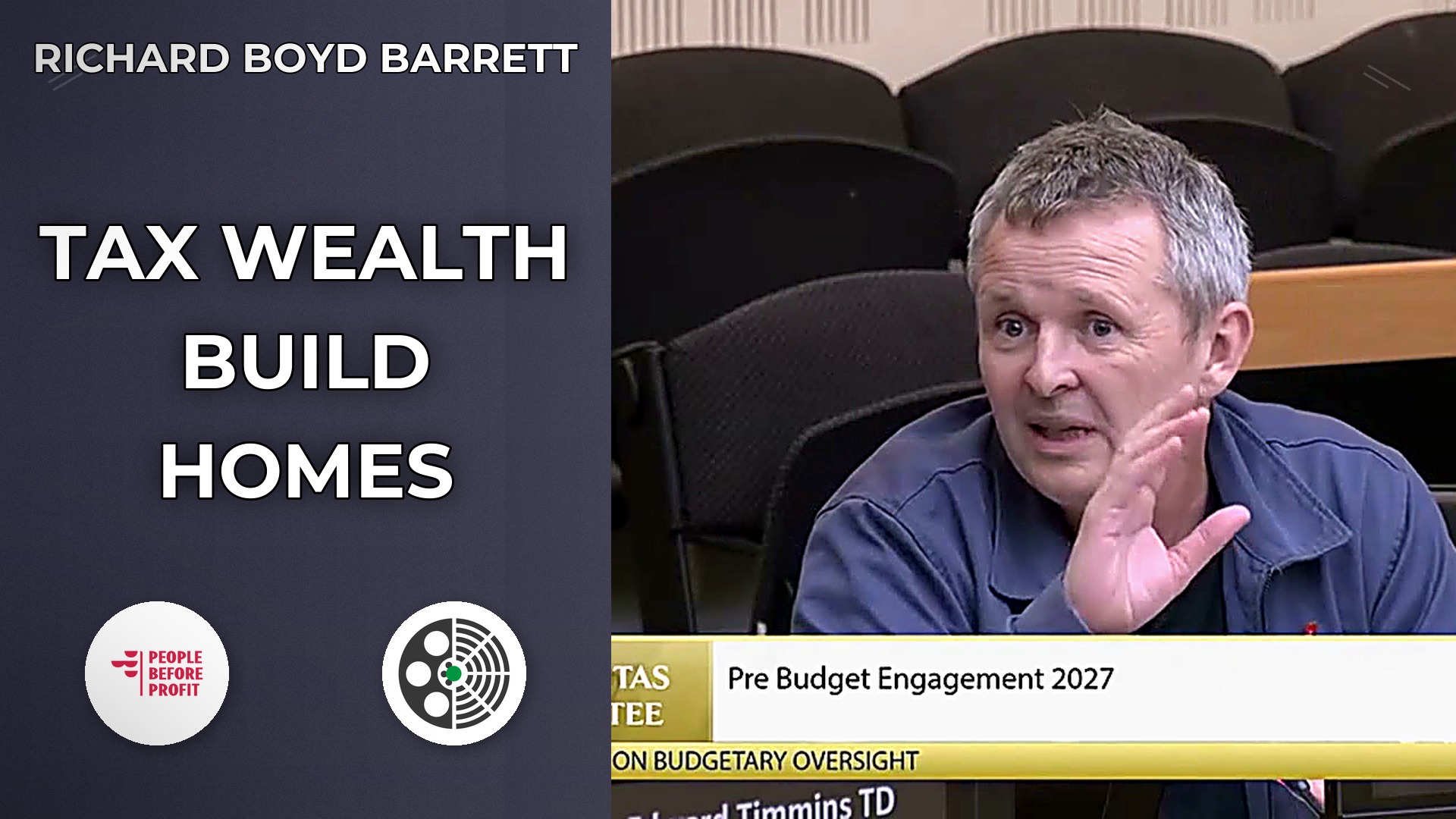
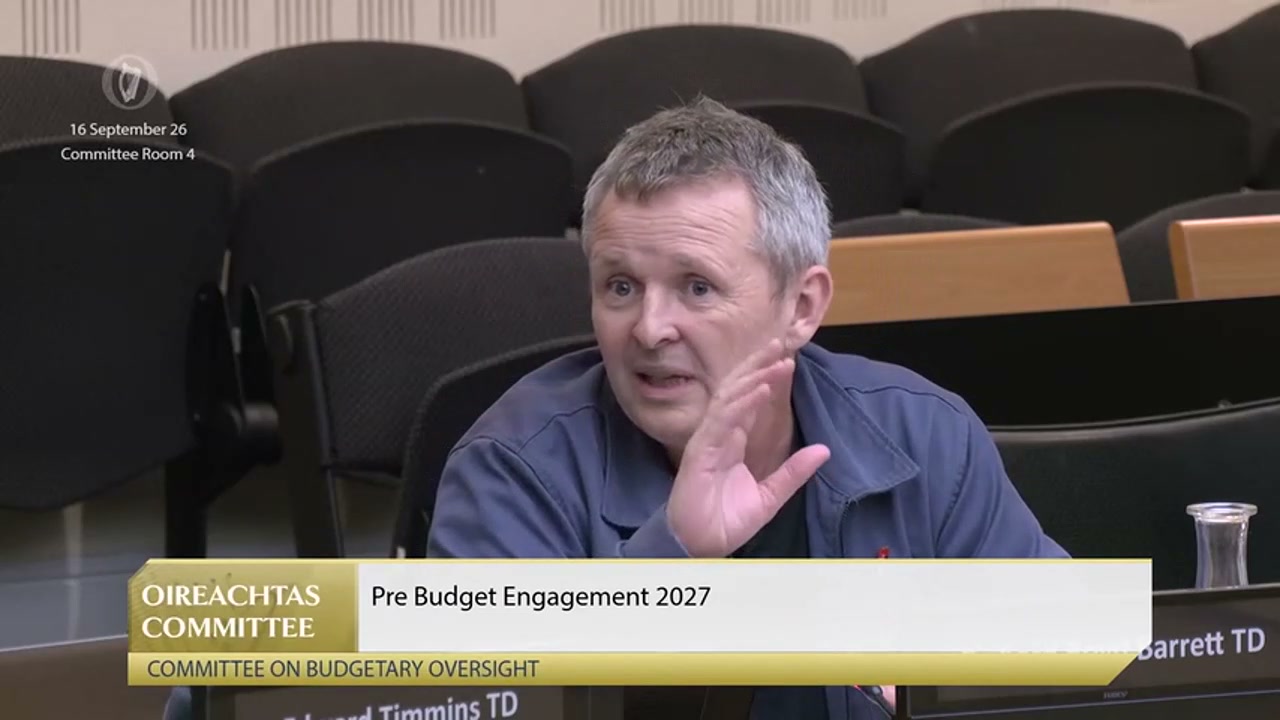
Richard Boyd Barrett Challenges Reliance on Corporation Tax
Richard Boyd Barrett questioned the Irish Fiscal Advisory Council and Central Bank on Ireland’s reliance on corporation tax and the sustainability of current spending plans. During the discussion, he argued that investment in housing, tackling poverty and cost-of-living pressures should be balanced by raising revenue, particularly through wealth taxation and increased State housing provision.
We publish thousands of recordings to make Irish politics transparent and resistant to manipulation. Spotted an error? Report it — together we are building a reliable archive of Irish politics.
Thanks again to my favourite economists in the Irish Fiscal Advisory Council and to the Central Bank for their submissions and papers. So once again, you're warning us and the government that the spending commitments and plans are outstripping the sustainable revenues, as you would see it, because of the over-reliance on corporate tax revenue concentrated primarily among a small number of multinational companies, most probably significantly the ones in the tech area, I think. And by the way, just on that point, would you say that the pharmaceutical sector, which is another big of the kind of taxpayers, is less vulnerable, just as a matter of interest? Because the big concern now, and I don't know how, would you say the risk is heightened now because of the possibility that we have an enormous AI bubble? I think it was the Financial Times said recently that the American economy is one big gamble on AI, possibly the reason that all the tech bros are now even themselves warning about the dangers. When they say AI might destroy humanity, they might more actually be talking about themselves and their companies, because they do think the two things are the same thing. But that vulnerability is heightened, that danger is heightened. But, you know, if, like, I don't know, maybe you don't pass an opinion on this, but the alternative to reigning in spending, because it is difficult to see where you reign in the spending when you look at cost of living pressures, poverty, the housing needs, the central bank have been recently saying we have to deliver more housing, that we're way short of what we need, so you look at all these demands, it's difficult to see how you and that the other option you propose is about raising extra revenue. And I just want to ask about that, because, obviously, our view has always been, yes, we need to balance, but balance the increased spending required in areas like dealing with poverty, housing and so on by raising revenues, particularly on wealth. So the central bank is, you know, getting ever more detailed in its reports on the wealth in this country, net household wealth. Have you any comments on the paper that has been produced by Nevin on wealth tax and what they say it could raise? They produced a paper quite recently saying that I think 3% wealth tax on just the top 1% could raise more than 3 billion euro a year, which would go a fair distance in bridging the gap that you're looking to bridge. And also, would you think it would be fair comment to say that, you know, if you look at the 1 billion euro a year that's going out in HAP payments to landlords, that if the state dramatically ramped up its housing stock so that they weren't so reliant on having to give out that much money in current expenditure every year because they had their own housing stock was filling that gap, that that could be another major contributor to bridging the Because instead of having a billion going out in current expenditure, that we could actually potentially have revenue coming in because the state's own housing stock was filling the gap now currently being filled by massive amounts of HAP payments going out each year. Yeah. So just on the first one on the corporation tax and, like, is there vulnerabilities? Absolutely. And I think they're across all sectors. I think traditionally we'd have viewed the ICT, the technology sector as potentially being more footloose and that the restructuring that could see the tax payments occurring and possibly more likely in that sector, but equally there are those risks in the manufacturing sector where some of the payments go beyond just the value of the manufacturing that takes place in Ireland. There's no doubt, like, that some of these are frontier products being manufactured in Ireland, the active ingredient, right at the top of the scale, but the value on the exports would suggest that it's not just the manufacturing value that's being linked to Ireland, but also the IP value, patents, et cetera, seem likely linked in some cases, so there's risks of the success of these products and then there's risks of the companies themselves restructuring and maybe changing the location. When it comes to the manufacturing, the pharmaceuticals, you would see the jobs as being more stable. These companies have invested billions in these plants and they are going to at least go to the end of this life cycle and these plants can be adapted and moved on to the next round of drugs, so you would see the employment being more stable, but I would see the risks to the corporation tax payments being as prevalent in that sector, just because of the scale of them. We have to understand that these are staggering numbers. To be collecting north of 30 billion of corporation tax is huge. Yes, manufacturing is contributing to a large part of that, but it goes beyond just the value of the high-end manufacturing that takes place here. It clearly is linked to intellectual property unions, because we've seen these changes in the last five, six, seven years. Something has to change. The factories are still here, but the corporation tax has surged, so we are making the products, but the value being located in Ireland is clearly linked to the IP, so there's a risk there. I'd see the concerns being spread across all the high-paying CT sectors. Greenie, do you want to take any of those taxes? On the... So, I mean, you referenced this accounting exercise. If we can't seem to rein in expenditure, if all of that expenditure and that expenditure growth is deemed to be necessary, then we do need to raise income elsewhere. The Commission on Taxation and Welfare have a very comprehensive report on this. I don't want to point to any types of taxes in particular, but the things that they mention are we should be looking at zero-rated or reduced rates of VATs. Are those still appropriate, if they were ever appropriate? Wealth tax should certainly be on the table. All of these things should be looked at. How can we broaden our tax base and make sure that we are able to pay for the expenditure that we deem is needed for capital and current? The Central Bank might want to comment on another slide there. Yeah, I certainly can. So I would agree with a lot of what was just there. Sorry? Around the vulnerabilities of corporation tax receipts, completely agree. There is elements here which are deeply embedded in terms of the volume of exports, but certainly how the likes of intellectual property is valued and where it's valued. This is where the vulnerabilities lie, right? So they are things which can be taken. The second element is we tend to focus quite a bit on the corporation tax, and it is the big one, but if we think there is potentially more structural vulnerability where some of these companies were to leave, they also pay a lot of VAT and income tax. So it's not just the corporation tax element. On your point around raising revenue versus the spending bit, we've always framed this in the net spending world, which is exactly to your point. So that is really the contrast between you can have greater spending like that as a government choice if you want to do more spending and feel it's needed. We'd ask for that it will be balanced in terms of revenue raising. And some of that's about creating space for capital, right? Projects, if you think you want to do a larger capital plan, one of the ways in which you can create the space in terms of capacity in the sectors is to take some of the demand out through taxation. And you can target that across how you think about you want to do that. In terms of you broadening the tax base, all of that.
Thank you for downloading 🙏
If you publish this material on social media, we would be very grateful if you tagged VideoParliament. It helps us reach more people and keep building a transparent archive of Irish politics.