

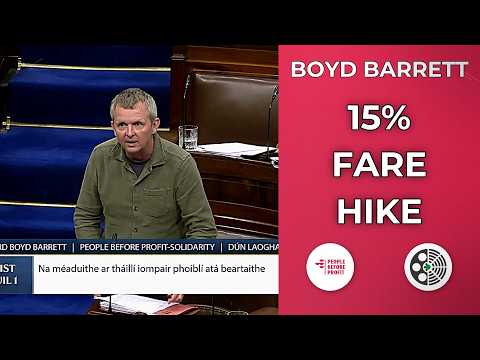


Richard Boyd Barrett: Slams 15% Public Transport Fare Hike
Richard Boyd Barrett challenges the National Transport Authority's decision to raise public transport fares by 15%, arguing it will worsen the cost-of-living crisis and deter people from using buses and trains. He says the NTA itself admits the increase will reduce ridership, undermining climate goals and increasing congestion.
Richard Boyd Barrett addresses the Dail on the proposed fare adjustment, highlighting that a 15% hike is a significant burden on working people who commute daily. He points to the National Transport Authority's acknowledgement that the change will reduce passenger numbers at a time when government policy stresses increasing public transport use for climate and congestion reasons.
The video outlines the NTA's statutory role in regulating fares and its publication of a new fares determination in September, with changes due to take effect in January. The NTA frames the move as part of standardising the national fare structure and following the national fare strategy of 2023.
Speakers in the debate reference almost 21% inflation since 2022, recent affordability measures such as the young adult card and child travel concessions, and the gap between rising operating costs and fare revenue. The NTA and Department of Transport stress the need to balance affordability with financial sustainability to fund network enhancements, including BusConnects and DART+.
Boyd Barrett argues the fare rise will push people into cars, damage climate efforts and penalise those struggling with living costs. The government's response reiterates increased Exchequer support and plans for service expansion, while defending the adjustment as necessary to sustain and improve public transport over the coming years.
Summary of the debate
Richard Boyd Barrett addresses the Dail on the proposed fare adjustment, highlighting that a 15% hike is a significant burden on working people who commute daily. He points to the National Transport Authority's acknowledgement that the change will reduce passenger numbers at a time when government policy stresses increasing public transport use for climate and congestion reasons.
NTA decision and statutory role
The video outlines the NTA's statutory role in regulating fares and its publication of a new fares determination in September, with changes due to take effect in January. The NTA frames the move as part of standardising the national fare structure and following the national fare strategy of 2023.
Costs, funding and affordability measures
Speakers in the debate reference almost 21% inflation since 2022, recent affordability measures such as the young adult card and child travel concessions, and the gap between rising operating costs and fare revenue. The NTA and Department of Transport stress the need to balance affordability with financial sustainability to fund network enhancements, including BusConnects and DART+.
Consequences and political response
Boyd Barrett argues the fare rise will push people into cars, damage climate efforts and penalise those struggling with living costs. The government's response reiterates increased Exchequer support and plans for service expansion, while defending the adjustment as necessary to sustain and improve public transport over the coming years.
We publish thousands of recordings to make Irish politics transparent and resistant to manipulation. Spotted an error? Report it — together we are building a reliable archive of Irish politics.
Other speeches




Tego samego dnia All speeches from this day →
James Geoghegan
James Geoghegan probes €500K ICT failure at FISRU
Danny Healy-Rae
Danny Healy-Rae demands diesel support for construction firms
Paul Murphy
Paul Murphy: Fare hike pushes commuters into cars
Darragh O'Brien
Darragh O'Brien: Cost-of-Living Budget to Shield Households
Brian Stanley
Brian Stanley: Data Centres Are Driving Up Bills
Pádraig O'Sullivan
Pádraig O'Sullivan demands clarity on CUH stem-cell funding
Transcript
people are struggling with the cost of living including the cost of getting in and out of work and of transport generally and we need to increase the number of people in public transport for climate reasons and the government's response to that situation is will increase fares to make the cost of living situation worse for people and reduce the number of people using public transport. The first point is self-evident that a 15% increase is a significant hit for people that use public transport particularly working people who go in and out using public transport day in day out but we now have confirmed by the NTA absolutely extraordinary that they know that they took this decision knowing that it would reduce the number of people using the public transport system when everybody is supposed to be committed to increasing the use of public transport in order to reduce congestion and to assist with climate action. I mean how can you justify that? How can you possibly justify that? It's beyond belief Minister and it must be because you don't actually want people to use public transport. Thank you and thank you to Deputy O'Reilly, Boyd Barrett and Murphy for submitting this topical this afternoon which I'm taking on behalf of Minister Dara O'Brien. From the outset I would like to clarify that the Minister for Transport has responsibility for policy and overall funding in relation to public transport but neither the Minister nor his officials are involved in the day-to-day operation of public transport services. The National Transport Authority or the NTA has statutory responsibility for securing the provision of public passenger transport services nationally, working with the public transport operators who deliver the services and have responsibility for day-to-day operational matters. The NTA also has a statutory responsibility for the regulation of fares charged to passengers in respect of public transport services provided under the public service obligation contracts. In their capacity as fare regulator the NTA under its responsibilities within the Dublin Transport Authority Act of 2008 made the decision to publish a new fares determination on the 3rd of September of this year with the revised fares taking effect from January coming. This is a critical step in standardisation of the national fare structure and in line with the national fare strategy published in 2023 with the key objective of the strategy providing more equitable and consistent structure for all PSO services. Since 2022 we've seen inflation of almost 21% which has driven up the cost of operating subsidised public transport services with fuel vehicle maintenance and staff costs. In the same period public transport fares have decreased through various measures such as the 20% cost of living discount, the young adult card discount of 50% and the extension of free travel to children under the age of nine. This has widened the gap between what it costs to run services and the revenue that fares bring in. All the while the National Transport Authority is also seeking to continue with a significant expansion and enhancement of services. There is a requirement to strike the right balance in public transport fares to enable further enhancements to the public transport network in the coming years. Offer the most competitive fares to younger and student passengers and ensure value for money for the PSO subsidy to society. Fare revenue covers approximately 38% of the cost of operating PSO services nationally compared to a 44% European average with the remaining costs funded by the Exchequer. While 2026 saw a substantial increase in Exchequer funding, continued inflationary pressures have increased the cost of operating public transport services which has limited the NTA's ability to introduce improvements to existing services or new services in the TFI network as part of wider capital investment under the National Development Plan. Ireland has maintained an effective eight-year fare freeze alongside targeted affordability measures including the young adult card, free travel for children up to nine and the 90-minute fare. These measures compare favourably with international practice and will continue to provide substantial support to passengers in 2027. The adjustment to fares are required to help offset the cost increases in recent years, improve fare revenue recovery and ensure the sustainability of the PSO funding. It is important to note that every euro raised through fares goes directly back into the network supporting better reliability, frequency and capacity and continued rollout of bus connects connecting Ireland and DART+. I've no doubt the deputies will understand that maintaining affordable fares must be balanced with ensuring a financially sustainable transport system capable of funding service improvements, network expansion and fleet investment. Of course we need to dramatically increase the investment in public transport. We're more than in favour of that and indeed the absence or inadequacy of public transport in many parts of the country particularly in rural Ireland is an absolute disgrace. But the idea that that should be paid for by hiking up fares for people struggling with a cost-of-living crisis in a way that the NTA themselves is going to actually deter people from using public transport is just unbelievable. They've admitted that for every 10%, 3% less people are going to use public transport. You're driving them out of public transport and into cars. How could you possibly justify it? Thank you Deputy Deputy Murphy. Thanks again to the three deputies for their contributions to this and bringing this topic forward here this evening but I wish to assure them that the government is strongly committed to providing all citizens with reliable and realistic sustainable mobility options and public transport plays a key role in the delivery of this goal. To support this objective and budget 2026 the Department of Transport secured 940 million euro funding for public service obligation and TFI local link services. A significant 43% uplift which is an increase from the 658 million euro in 2025. Ireland's package of fare measures as I said at the outset compare very favourably with many international peers. The challenge is of course to balance affordability for passengers with the long-term financial sustainability needed to expand and improve public transport services. The NTA has identified approximately 140 new service initiatives and capacity enhancements as part of its 2027 budget submission to the Department of Transport. Subject to the outcome of the annual estimates process this represents the biggest in-year and year-on-year enhancement of services for many many years. The changes also represent an important step towards standardizing fares nationwide in line with the national fare strategy published in 2023. The government and the Department of Transport in partnership with the NTA and operators remain fully committed to delivering a public transport system that is reliable, accessible, affordable and capable of meeting the needs and the growing needs of communities across the country and it's therefore essential that the public transport system remains well-funded and responsive to passenger needs and adequate fare revenue is critical in supporting this. So thank you again to the three deputies for raising it.