



Paul Nicholas Gogarty: Data centres are hiking Irish bills
Paul Nicholas Gogarty speaks in the Dail in support of a motion on energy relief, arguing that data centres and the current market rules are driving up electricity prices for households. He outlines legal barriers to an outright ban, and proposes policy workarounds, investment in storage and long-term renewable strategies to end fossil gas dependence.
Paul Nicholas Gogarty says rising household energy costs require urgent attention while Ireland moves toward sustainability. He links high bills to the marginal pricing system and fossil gas dependence, which today set the price for the entire market.
Gogarty highlights the growth of data centres and their inflexible, 24/7 demand, arguing this sector now consumes a disproportionate share of measured electricity. He explains how that demand forces gas generators to set market prices and increases costs for ordinary families across constituencies.
He warns that some proposed measures, like a legislative ban or an electricity levy ring-fenced for households, could collide with EU and constitutional rules, including Article 49 of the EU Treaty and Regulation 2019-943. That legal reality, he says, means government must seek workable policy alternatives rather than be stalled by technical objections.
Gogarty proposes a series of practical steps: tighten the CRU large energy users policy, require off-grid battery storage and renewable guarantees for new data centres, and consider corporation tax measures to return value to households. He also urges EU-level reform of marginal pricing and fixed-price contracts for renewables.
For the medium and long term he calls for strategic borrowing to invest in mass battery storage, interconnectors, overbuilding wind, tidal and wave capacity, and eventual green hydrogen infrastructure. If Ireland pursues that scale of renewable investment, Gogarty argues, it could become a major renewable energy exporter by the 2040s.
Key argument
Paul Nicholas Gogarty says rising household energy costs require urgent attention while Ireland moves toward sustainability. He links high bills to the marginal pricing system and fossil gas dependence, which today set the price for the entire market.
Data centres and pricing
Gogarty highlights the growth of data centres and their inflexible, 24/7 demand, arguing this sector now consumes a disproportionate share of measured electricity. He explains how that demand forces gas generators to set market prices and increases costs for ordinary families across constituencies.
Legal constraints
He warns that some proposed measures, like a legislative ban or an electricity levy ring-fenced for households, could collide with EU and constitutional rules, including Article 49 of the EU Treaty and Regulation 2019-943. That legal reality, he says, means government must seek workable policy alternatives rather than be stalled by technical objections.
Policy solutions and consequences
Gogarty proposes a series of practical steps: tighten the CRU large energy users policy, require off-grid battery storage and renewable guarantees for new data centres, and consider corporation tax measures to return value to households. He also urges EU-level reform of marginal pricing and fixed-price contracts for renewables.
Long-term vision
For the medium and long term he calls for strategic borrowing to invest in mass battery storage, interconnectors, overbuilding wind, tidal and wave capacity, and eventual green hydrogen infrastructure. If Ireland pursues that scale of renewable investment, Gogarty argues, it could become a major renewable energy exporter by the 2040s.
We publish thousands of recordings to make Irish politics transparent and resistant to manipulation. Spotted an error? Report it — together we are building a reliable archive of Irish politics.
Other speeches


Tego samego dnia All speeches from this day →
Richard Boyd Barrett
Richard Boyd Barrett: Make Data Centres Pay for Energy Crisis

Pádraig O'Sullivan
Pádraig O'Sullivan demands clarity on CUH stem-cell funding
Brian Stanley
Brian Stanley: Data centres are putting huge pressure on the grid

Gerard P. Craughwell
Gerard P. Craughwell Questions Defence Forces Retention Crisis
Danny Healy-Rae
Danny Healy-Rae demands diesel support for construction firms
Paul Murphy
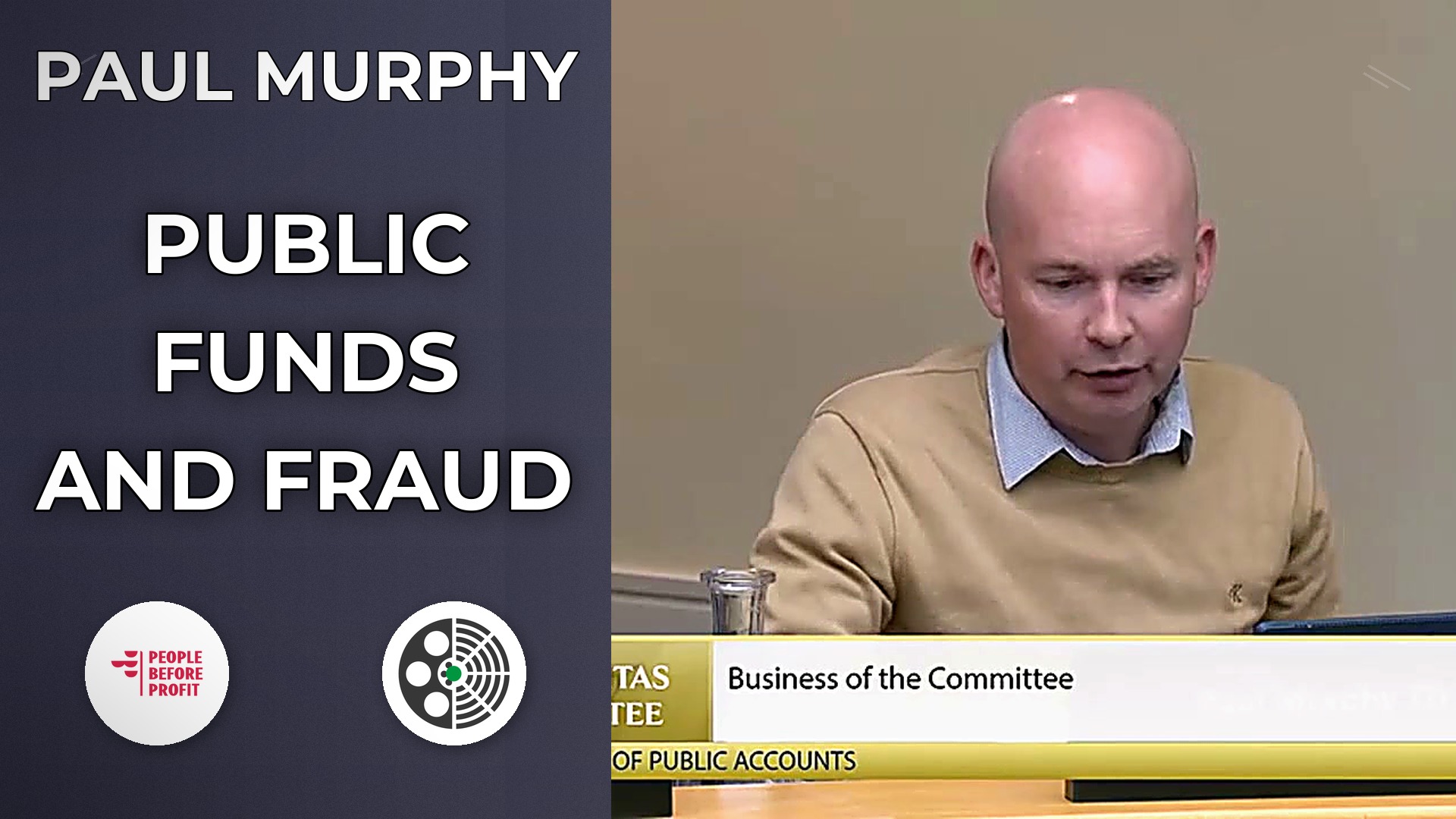
Paul Murphy Raises Questions Over Public Funds and GRI
Transcript
Go raibh maith agat, Cathaoirleach. I'd like to support this motion in principle. I do have a couple of queries about what is implementable and what is not, but I definitely think that the hard-pressed people of Ireland, faced with rising costs, need a little bit more help in terms of energy prices at the moment, while also trying to move towards a more sustainable future. Because for many years, people in Ireland have been told that our electricity bills, which are now, I think, around the third highest in the European Union, that these are simply the result of the international factors beyond our control. And in some ways that's true, because if you look at gas, which I'm about to get onto, global gas prices have risen internationally and conflict has contributed to that. But the reason we're dependent on gas is because the electricity market operates on the system of marginal pricing, which means that the most expensive form of power needed to meet demand at any given time sets the price for 100% of the market. And right now, we're dependent on fossil gas for that. In the future, it could be different. If I have time, I'll outline a couple of suggestions, which may already be in the government mindset, but it's the pace I'm really worried about. So why are we burning so much gas anyway when we have all this existing wind potential? And I've mentioned wave and tidal before. And the answer right now lies in the uninhibited growth of data centres, which are now consuming nearly a quarter of our measured electricity in this state, which matches the usage of every single residential home in Ireland. So these data centres are operating 365, basically. The demand's completely inflexible. So when the wind stops blowing, that base load doesn't end up dropping. Instead, we're forced to fire up the gas generators, and diesel's been referenced as well, which is also a fossil fuel and also has cost implications, to keep the data centre servers cool. So under the market rules, the gas doesn't just price electricity for the tech giants, it prices electricity for the family trying to heat their home in Clondalkin and Saggart, Raccoon and Luke and in Adamstown in British, in Parmistown and elsewhere throughout the country. And data centre demands and inflation holds electricity prices by up to 8.5%, maybe more, which puts the average household with hundreds of euros in extra costs in recent years as part of a rising price on energy and household prices in any event. So we can't look at data centre policy on its own and energy policy separately. They're together. And the current trajectory is placing an unfair tax, for want of a better term in Irish families, to subsidise what is still an unsustainable demand in our grid. Because obviously if the data centres weren't there in the first place, a lot more of our supply would be provided by renewables, and we wouldn't have the same dependence on the gas. So we need to review the data centre grid connections. There's already another application in my constituency. There's already an application for a licence to the EPA. So I think the message hasn't gone out to these companies yet, and I don't think it's government policy to say that it's an unwelcome place for data centres. I've mentioned before the brave new future where we could be using so much excess capacity that we can afford to operate data centres and be the data centre hub of Europe as one of the major energy producers. And there's huge revenue potential irrespective of the fairly minuscule job creation element associated with them. So as of now we're going to have to work within Europe to reform the marginal pricing system that's penalising consumers for the corporate energy demands of multinationals and also it's penalising the producers of renewable energy basically. The figures are staggering. When a single sector consumes nearly a quarter of our national electricity and ordinary families face a crushing cost of living crisis, it just beggars belief. I am kind of lost for words in terms of how to put it, but if you ask an ordinary constituent do they feel they've been fleeced by data centres, they would say absolutely. They feel they're not getting the support. The government supports for electricity pricing over the last couple of years were very welcome. The fuel allowances right now are very welcome. One half of me says I do not like subsidising the fossil fuels to keep cars and buses going. And another part of me acknowledges that some of the electricity produces from fossil fuel as well and we need to reduce our dependence on these supplies and reduce our carbon emissions. But when you look at what's actually impacting on people in their bottom pocket, you have to take a two-pronged approach. And even if we need to borrow strategically to create that energy self-sufficiency, it will actually benefit us in the medium term. Now I do have a couple of queries about the specific mechanisms in this motion in terms of legal hurdles, which I think does give the government an excuse to do nothing because from the research I was doing, a legislative ban would violate Article 49 of the EU Treaty on the Freedom of Establishment and that would get the state kind of being vulnerable to court action and multi-billion damages claims. And this electricity levy to raise the 500 euro would also violate EU Regulation 2019-943 on non-discriminatory grid access and also in terms of ring-fencing money directly for household credit, that would clash with our own constitutional Article 11 in terms of where taxes are collected and how they're distributed. But that doesn't mean that the sentiments of this motion aren't absolutely 100% right. That we have to find a workaround so that we don't have the legalese blocking government action. So to achieve the goals to legally enforceable pathways, there might be a couple of other things, like legally codifying the strictest possible version of the CRU's large energy users policy and mandating that no data centre can connect to the grid unless it has its own off-grid supply of battery storage and that it's relying 100% on renewables. Personally I don't think any new data centre should be built for the next 10 years until we get to a point where we are more comfortable in terms of energy generation. So basically we could still levy some corporation tax off these companies as it stands to make sure that Irish families get some sort of a subsidy. But as it stands, we are at a critical juncture in terms of our energy self-sufficiency and our potential. So what would get rid of our dependence on gas as the baseline? Obviously if we did put the investment in, mass battery storage would be one element to store all the daytime wind, solar and as I said before, tidal and wave, which we are not even properly investing in to replace the gas plants during evening peaks. Creating new interconnectors, further links to France and the UK and if we have to import cheap nuclear or solar power from Spain when the domestic wind is low, so be it. Until we get to the point where we are producing three or four times our actual needs and it will be a quid pro quo and we will benefit from that. That means we have to overbuild our own capacity for wind, overbuild our tidal, overbuild our waves so that the grid is always renewable no matter what, even on low wind days when we are taking in the solar from Spain then the pricing will be fixed in such a way that it is not dependent on fossils to set it. We could look at fixed price contracts to have steady lower rates of renewable developers for decades. That could be done in the EU level, bypassing the market price on a day to day basis for fossil fuels. While it would be more expensive to implement right now, green hydrogen is also a solution because once you get to the point where you have built your hydrogen infrastructure and it is produced from excess renewables, then hydrogen can also replace gas to make sure we don't have any type of winter blackouts. But I am foreseeing that would be a 2030s type of solution and then as you move into the 2040s if we put the investment in and as Deputy Henehan has so eloquently said so many times we have to get the grid right. We have to allow the private generators, the home generators to access and share the energy and have a more sustainable individual local grid as well as having one big national one that is upscaled for renewable generation off the west coast which it isn't really right now. If we put in all that work and it is going to cost tens of billions to be fair, but that tens of billions will reap the rewards. We will be the energy Arabs of Europe in the 2040s at a time when other countries will need access to that energy, maybe not just for heating or for transport but also for cooling depending on the way the climate change situation is going. But it will be all renewable, it will all have lowered our carbon emissions to virtually nothing. We have the potential if we have the vision Minister. Thank you.