

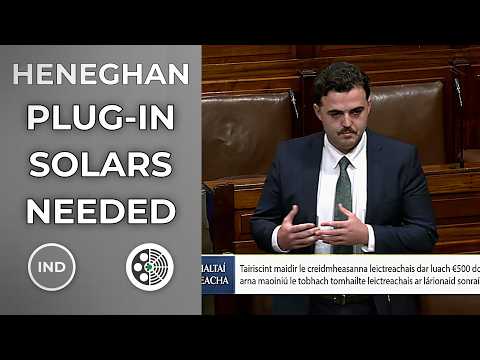


Barry Heneghan: Plug-in Solar, Batteries and Data Centres Debate
Barry Heneghan addresses the Dáil on electricity affordability, data centres and long-term solutions for households and businesses. He sets out why he opposes a blanket ban on new data centres and argues for targeted investments in plug-in solar, batteries and grid reforms.
Barry Heneghan thanks People Before Profit for bringing the issue to the Dáil and explains his background in engineering and data-centre research. He supports immediate protections for disabled people and those with medical electricity needs, but rejects a one-off 500-year credit and a blanket ban on data centres.
Heneghan outlines practical measures: a roll-out of plug-in solar systems paired with batteries, a 400 euro electrical readiness credit for necessary wiring changes, priority for low-income and vulnerable households, and protection for renters to access rooftop solar. He argues these measures provide lasting reductions in household bills rather than temporary relief.
He calls for smarter grid investment, decentralisation with multiple DSOs, clearer solar export payment policy, faster connections for renewables, and greater use of waste heat from data centres in district heating. He stresses the need to examine tariffs and CREU processes so households and local businesses can benefit from export and import options.
Heneghan highlights Ireland's offshore renewable energy potential and cautions that any levy or restrictions on data centres must consider jobs, investment and tax revenue. He references his electricity regulation bill aimed at facilitating local energy sharing and better linking renewable supply to nearby demand.
Key points and position
Barry Heneghan thanks People Before Profit for bringing the issue to the Dáil and explains his background in engineering and data-centre research. He supports immediate protections for disabled people and those with medical electricity needs, but rejects a one-off 500-year credit and a blanket ban on data centres.
Policy proposals
Heneghan outlines practical measures: a roll-out of plug-in solar systems paired with batteries, a 400 euro electrical readiness credit for necessary wiring changes, priority for low-income and vulnerable households, and protection for renters to access rooftop solar. He argues these measures provide lasting reductions in household bills rather than temporary relief.
Energy system and market reform
He calls for smarter grid investment, decentralisation with multiple DSOs, clearer solar export payment policy, faster connections for renewables, and greater use of waste heat from data centres in district heating. He stresses the need to examine tariffs and CREU processes so households and local businesses can benefit from export and import options.
Economic and strategic context
Heneghan highlights Ireland's offshore renewable energy potential and cautions that any levy or restrictions on data centres must consider jobs, investment and tax revenue. He references his electricity regulation bill aimed at facilitating local energy sharing and better linking renewable supply to nearby demand.
We publish thousands of recordings to make Irish politics transparent and resistant to manipulation. Spotted an error? Report it — together we are building a reliable archive of Irish politics.
Other speeches
Tego samego dnia All speeches from this day →
Richard Boyd Barrett
Richard Boyd Barrett: Make Data Centres Pay for Energy Crisis
Seán Kelly
Seán Kelly Calls for Sustained Global Health Funding
Rory Hearne
Rory Hearne: Data centres driving up bills and crises
Billy Kelleher
Billy Kelleher backs EU plan to tackle health workforce crisis
Pádraig O'Sullivan
Pádraig O'Sullivan demands clarity on CUH stem-cell funding
Richard Boyd Barrett
Richard Boyd Barrett: Slams 15% Public Transport Fare Hike
Transcript
I do agree, Minister, and I welcome, and I thank People Before Profit for bringing this issue before the Dáil. Electricity and electricity affordability is probably my favourite topic to discuss. I studied DCU for five years, engineering, with my thesis on waste to utilisation of data centres. Sometimes I hear people in this house speaking about data centres and the water they use and they're not looking at the statistics. I'm not defending that they do use a lot of water, but Iska Airman's recent report saying 0.3%, a lot of that water is in-house. With my politics, I'm always talking, Minister, about the current problem we face and what solutions we can bring, and I think with data centres we could, and we already are, in Tala using waste heat from data centres in a district heating system with a central pump to supply heat at a reduced cost to nearby buildings. I would love to see this at a faster rate, and I commend all the people at District Heating Ireland for the work they're doing. I think that the electricity affordability and the parts of the motion where you speak about, particularly for disabled people, people with long-term illnesses and carers, 100%, that's something I support. I also think that, in regards to protecting jobs, I think the next Budget, Minister, and it's something that I will continuously push for, we need to support businesses in retrofitting, support businesses in transitioning, support businesses in installing their renewables into their, particularly SMEs and local businesses, as the rise in energy costs has affected a lot of businesses, Minister, and I will continue to push for that. For households, the electricity power is essential for some medical equipment, and those costs cannot simply be switched off, Minister, they can be life-saving. However, I won't be supporting this motion, and it's not that I don't share the concerns about households, but I do not support its call for a blanket ban on new data centres. I'm not persuaded that the proposed levy provides a sound basis for reoccurring household support. It is the old saying, bring a horse to water, feed him for a day, but if you teach, I say bring a horse to water, give a man a fish, feed him for a day, teach him how to fish, feed him for life. If we provided people, rather than a one-stop, 500-year electricity credit, for 500-year, you could provide nearly every household a plug-in solar system, Minister, in conjunction with a battery, that would have a 10-year lifespan and constantly reduce their energy bill. It would be an in-circuit, built-in. Minister, I agree that hardship does not require us to agree on this, but I think that the motion and the 500-year credit would provide immediate relief. What we should be doing is investing in reducing on all relief, and what will come in the future. We need both immediate protection, but also lasting change, Minister, and that's what a plug-in solar system, battery investment, grid investment, decentralising our grid, Deputy Goldie just said about green hydrogen. Ireland is in a unique position, Minister, with our seabed, with the potential of ORE that we have, and if another country like Germany, which was mentioned multiple times in this House, had the potential that we have, they would be seizing it. I understand from looking at records that we did have a lot of plans for our ORE. Sadly, the crash occurred and a lot of them fell through, and we did have the only successful sale of an ORE system in the EU last year off the coast. What I'm trying to say is, I don't agree with a current one-off payment. What I would like to see is multiple payments for plug-in solar, for batteries, for smarter grids. Maybe give a 400 electrical readiness credit towards assessments, and I don't want that to be used as a presumptive method by electricians, like we have seen with the BER ratings, with the solar installations. A 400 electrical readiness credit by an electrical contractor, where they could then include changes to protective devices in the fuse box for a plug-in solar system. Maybe changing one breaker to make every house compatible, making apartment buildings compatible. Maybe changing the laws to compel that every single apartment dwelling must allow people to use plug-in solar or have solar systems on the rooftops. Because if we're not allowing people who are in renting to have access to renewable energy, Minister, that's not a fair society, and we see what Germany has done very successfully with the plug-in solar systems. We had them in the Climate and Energy Committee just before the break. I think if we're going to do a pilot scheme of these systems, priority should go to low-income households, to elderly people, to people with disabilities, with a workable arrangement for renters like I've just discussed. Battery storage, as well, needs and deserves considerable discussion in this House. Before the recess, Minister, I invited Energy Storage Ireland into the AB room. We had a great discussion on the potentials of batteries across Ireland to act as storage systems for the curtailment and dispatch down that we are seeing constantly that needs to be addressed, Minister. Minister, a panel can generate electricity when the sun shines, a wind turbine when the wind blows, but a battery, Minister, can help a household use that electricity when it's needed. Also, if used smartly, batteries can be used when the cost is higher, if used when they are needed to reduce as smartly as possible. With new systems that are being used with these batteries, it can really help people who are struggling. Minister, the one thing that I saw recently with the headline warnings that I'd like to bring as well regarding electricity is that solar export payments need and underline a clearer policy. Minister, if people have invested thousands of euro in solar systems with the belief that they will be able to sell at a certain cost back to the grid, and in other EU countries there's now warnings that that cost being sold back to the grid will be reduced, that needs to be looked at now by our government. Those reports have been already brought to the Climate and Energy Committee and I'm looking forward to discussing them with my colleagues. Minister, I've brought forward a bill to this House already in relation to data centres and what I would like to see being done at a faster rate. I think that if data centres had an easier route, or any LEU across the country that could use solar, renewables, HVO to supply onsite generation at an easier rate, it would be very beneficial to these data centres, which would then in turn be beneficial to the Irish public. For someone and anyone who is struggling at the moment, it doesn't make sense when you hear about solar farms, wind farms, waiting months for connection. I think the CREU needs to examine this. I think the CREU also previously needs to examine the tariffs that reflect when exported electricity is valuable and when customers could benefit from choosing their import and export providers separately. Like in any market, Minister, and speaking to professors during the week, in DCU, in UCD, this is something that needs to be done. I think with data centres as well, the government commissioned a study, obviously with the job that you have referenced associated with the construction, having some of my friends working in that industry, including the supply chain of development, construction and the wider spending effects, obviously some of them aren't permanent jobs inside data centres, but they do represent a significant economic activity. Ireland's wider multinational economy does and has supported this, but it doesn't justify every single project, Minister. I think if you look at the programme for government, which one of the things that I was very happy to help negotiate was that if a data centre, it should be encouraged for renewable energy. I favour, and I will continue to favour, renewable energy being used, and I don't think that a blanket ban can distinguish between projects on that basis. So likewise, the 20% levy, I think that the levy should be examined, but I don't think that this one should immediately be examined without a discussion that ultimately speaks on investment and ultimately the tax revenue that this country gets. My bill, Minister, for the last minute, for the electricity regulation bill, I do believe that it will help connect additional renewable energy to the nearby demand, not only for data centres, but also for energy sharing for a school that has solar panels and in the summer needs to share that energy that it's not using to a nearby nursing home, to a nearby gard club. Minister, we have one DSO. We need to have multiple DSOs, like other countries, as an energy monopoly is not good. I welcome the government's emphasis on permanent supports. Now I want delivery, Minister, and I think that those proposals need to eventually face immeasurable results. I favour the immediate help, and I do hope that in the coming months we see plug-in solar rolled out, like the UK government did on the 27th of August, Minister. Also I'd like clarity from the Department on if someone is to order a plug-in solar system and plug it in now, does it make them a criminal for wanting to reduce their electricity bills? I think that if the motion today, and I do commend the discussion on it, and I welcome that discussion, I'd always love to debate energy in this House. Go raibh maith agat.