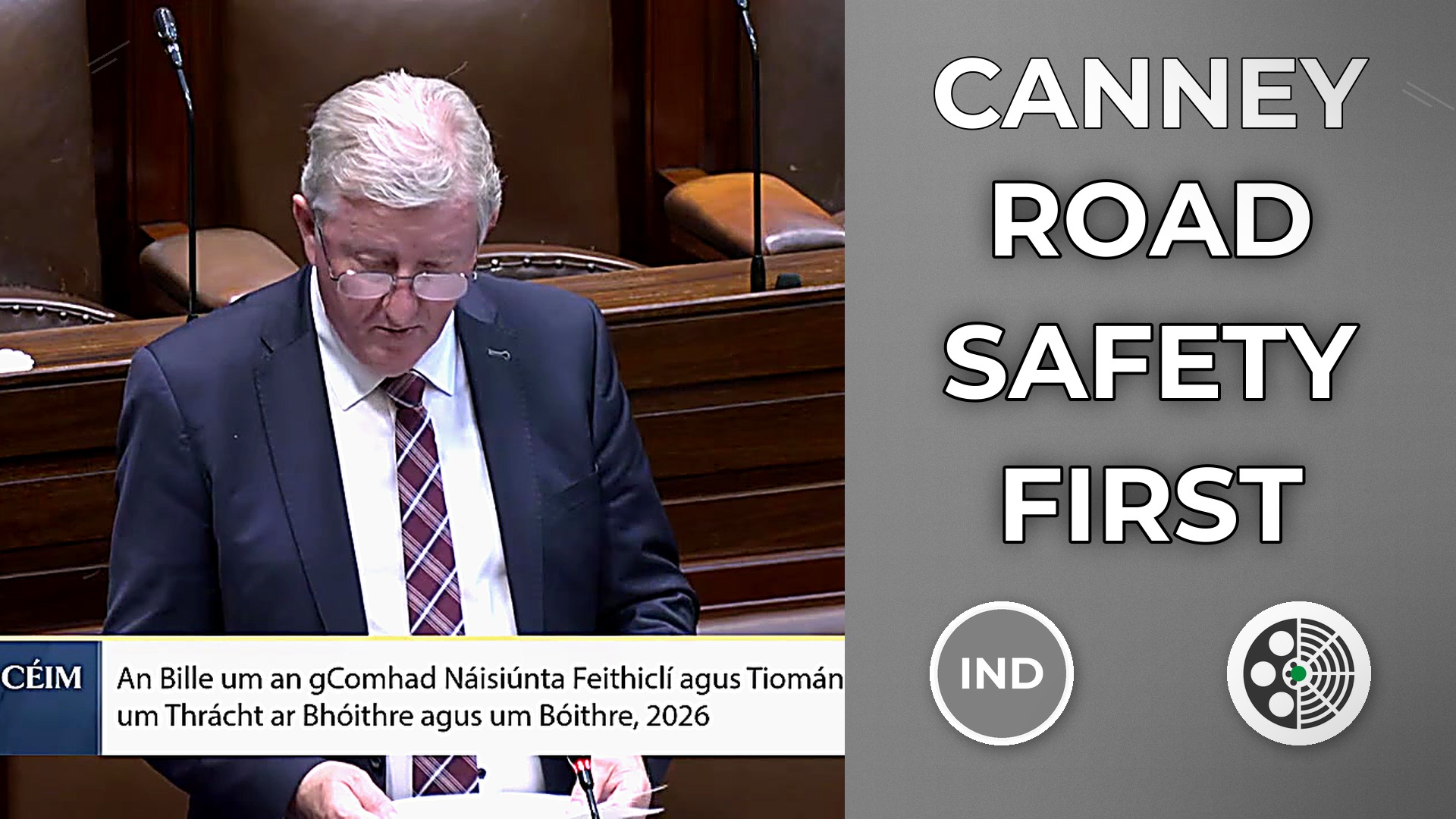
Seán Canney presents the National Vehicle and Driver File Road Traffic and Roads Bill 2022-26 to the House, outlining reforms to modernise vehicle and driver records, remove paper motor tax discs, and strengthen enforcement and data sharing for road safety. He argues the Bill updates pre-GDPR provisions, underpins the Check My Vehicle service, enables open-ended non-use declarations and clarifies speed-limit and penalty-point rules.
Bill overview
Seán Canney sets out a practical, technical Bill designed to make the law fit for modern road safety and public administration. The Bill aims to ensure vehicle and driver information can be used lawfully and responsibly by the state, and that local authorities and enforcement bodies have the data needed to identify risks and target action.
Digital and administrative reform
Part 2 modernises the National Vehicle and Driver File and establishes the Check My Vehicle service so motor tax and roadworthiness status can be verified without paper discs. Part 3 repeals the requirement to display a motor tax disc; Part 4 introduces open-ended declarations for non-use to simplify administration and avoid unintended arrears.
Speed limits and local flexibility
Part 5 protects local authorities' ability to set a 60 km/h special limit in built-up local roads and allows a 100 km/h special limit on qualifying national secondary roads where appropriate. The changes are framed as targeted adjustments to support sensible, evidence-led speed limit reform.
Enforcement, data sharing and courts
Part 6 introduces measures on penalty points for multi-offence incidents, permits certified evidence from mobile camera operators, authorises local authorities to receive collision data from Gardaí and the Road Safety Authority, and allows juries to consider careless driving where dangerous driving is not proven. These provisions are presented as practical steps to improve detection, compliance and local road safety planning.
Conclusion
Canney frames the Bill as a necessary, evidence-led contribution to the Government's Road Safety Strategy 2021-2030, arguing that better information, enforcement and modernised administration are required to reduce deaths and serious injuries and to support Vision Zero goals in the longer term.
We publish thousands of recordings to make Irish politics transparent and resistant to manipulation. Spotted an error? Report it — together we are building a reliable archive of Irish politics.
Minister. I move that the bill be read a second time. Thank you Minister, 20 minutes. Thank you very much and thank you Ciann Comhairle and before I start I just want to wish Deputy Michael Healy-Rae a quick recovery from the horrible attack yesterday evening here in Dublin. I spoke with him last night, he was in good form, he was on his way back home. I wish him and his family, I suppose they need time and they need for him to recover but also it's been such a harrowing experience. I think it's important and I'm delighted to see that an arrest has been made and we leave that with the Gardaí but very, very concerning for everybody that something like that could happen in broad daylight in our capital city. Now to move on, I'm pleased to bring the National Vehicle and Driver File Road Traffic and Roads Bill 2022-26 before the House. This is a practical bill but its purpose is significant. It is about making sure that the law which supports road safety, vehicle compliance, enforcement and public administration is modern, clear and fit for purpose. The policy rationale is straightforward. The state must be able to use accurate vehicle and driver information lawfully and responsibly. Local authorities must have the collision data, the need to identify risks and target action. Enforcement systems must work efficiently. The bill also advances the government's digital agenda and improves the efficiency of public service delivery and the law on motor tax, vehicle records and speed limits must reflect how services are now delivered and how road safety decisions are now made. There is also a practical necessity. Much of the legislation being amended was designed for a paper-based system. It assumed display and surrender of discs. It contains data provision that predates the general data protection regulation and it does not fully reflect current systems for vehicle licensing, compliance checking or the use of road safety information. The bill updates that framework. It gives public bodies legal certainty. It also gives the public confidence that the system is operating properly. Above all, there is a road safety imperative. Better information supports better decisions. Better enforcement supports better behaviour. Easier verification supports better compliance. Road safety is not secured by one measure alone. It depends on safer behaviour, safer infrastructure, effective enforcement, reliable data and clear responsibilities. In practical terms, the bill does a number of things. It modernises the national vehicle and driver file. It underpins the Check My Vehicle service. It removes the need to display a paper motor tax disc. It allows open-ended declarations for non-use. It supports more flexible and evidence-based speed limit management. It provides a statutory basis for sharing collision data with local authorities. It clarifies the operation of penalty points in multi-offence incidents and it makes targeted improvements to court and enforcement procedures. I will now deal briefly with each part of the bill. Part 1 contains the preliminary and general provisions. It provides for the short title, commencement, collective citation, construction, definitions and repeals. These are technical provisions but they matter. They give the bill its legal structure. They also remove provisions that are obsolete, superseded or no longer consistent with the policy changes being made. In particular, Part 1 repeals older provisions on the display of vehicle licences, non-annual payment of motor tax, obsolete notification arrangements and the offence of failing to display a motor tax disc. It also amends the provision of the Road Traffic Act 2024 so that the approach to special speed limits can be adjusted later in the bill. I now turn to Part 2 which deals with the national vehicle and driver file and Check My Vehicle service. The NVDF is a state's central database for vehicle and driver information. It supports vehicle registration, driver licensing, motor tax, enforcement and road safety. The current statutory framework is pre-GDPR and general in nature. Part 2 of the bill modernises that framework. It sets out more clearly the records and data held in the file. It also includes appropriate data protection provisions for personal data. Part 2 also places access to the NVDF data on a clearer footing where bodies need information to carry out their functions. Access can be provided for in secondary legislation. The legal basis and purpose can then be set out clearly. This includes bodies such as An Gorda Síochána and the Revenue Commissioners. The objective is simple. Access must be lawful, transparent, proportionate and linked to the function of being performed. This part also depends on the Check My Vehicle website. A person will be able to enter a vehicle registration number and check certain information held on the NVDF. That includes the status of motor tax and roadworthiness tests. It will not disclose the owner's name or address. As paper discs are removed, this service will provide a clear way to verify compliance. That will be useful for car buyers, driver testers, driver instructors and others who have a practical need to check relevant information. I move next to Part 3 which removes the requirement to display a paper motor tax disc. It also makes the related changes needed across older legislation. This measure forms part of the wider paperless disc project under which physical insurance and roadworthiness discs will also be abolished. The requirement to display a disc belongs to a paper-based system. Compliance can now be verified through electronic records. The law should reflect that. The Bill therefore repeals the offence of failing to display a motor tax disc. It does not remove the obligation to have motor tax. The offence of not having motor tax would be capable of being dealt with as a fixed charge offence. Part 3 also removes outdated references to surrendering, taking back or displaying paper discs. This includes references relating to refunds, bouncing checks and driver tests. A vehicle licence will be deemed to be issued when the owner receives a receipt for payment, either in a local authority motor tax office or through the online motor tax service. Part 4 deals with the declarations of non-use of a motor vehicle. At present, a motor vehicle can be declared off the road for a period of between three and 12 months. This can create unnecessary administration where a vehicle could remain off the road for longer or where the period is uncertain. Under this Bill, a declaration may be made in the last month of motor tax. It may then continue indefinitely until the vehicle is brought back into use. This will simplify the process for vehicle owners. It will reduce available renewals. It will also prevent arrears arising simply because there is a gap between the end date of declaration and the next date of tax in the vehicle. The Bill makes clear that arrears will not apply to the first application for motor tax following an open-ended declaration for non-use. The integrity of the system is also protected. It will be an offence to use a vehicle while a declaration for non-use is in effect. The Bill also provides transitional arrangements. Declarations already in force will end on the date specified in the declaration. If the vehicle remains off the road after that date, a new open-ended declaration will be required. I now turn to Part 5, which concerns speed limits. This part makes targeted amendments to the Road Traffic Act 2004. The purpose is to make sure that road authorities retain the flexibility they need within the national speed limit framework. First, it allows local authorities to set a special speed limit of 60km per hour on local roads in built-up areas where this is appropriate. This is unnecessary because the Road Traffic Act of 2024 changes the default speed limit position. Without this amendment, local authorities could lose the legal power to apply a 60km per hour special speed limit in certain local roads in built-up areas, even where road circumstances and traffic planning justify it. This was never the policy intention. Part 5 also allows for a special speed limit of 100km per hour on national secondary roads, including national secondary managed roads. This supports the next phase of the speed limit reform. Under that phase, the default speed limit on national secondary roads is to reduce from 100km per hour to 80km per hour. Where a road authority considers that a particular national secondary road meets the criteria in the speed limit guidelines, it should be able to retain the 100km per hour limit to special speed limit by-laws. Speed limits are one of the most visible parts of the road safety policy. They do influence behaviour. They affect stopping distances and they affect the severity of collisions. These amendments do not weaken speed limit reform. They help ensure that reform can be implemented sensibly, lawfully and consistently by the authorities best placed to understand the local road conditions. Finally, I turn to Part 6, which contains a number of important road traffic and road amendments. The first allows a jury to consider the lesser charge of careless driving where a defendant is acquitted of dangerous driving. This amendment arises from the Judge Houghton's report on the death of Seán O'Farrell in 2011. Where the evidence may not establish dangerous driving to the required standard, but may establish careless driving, the court process should be able to reflect that. Part 6 also provides a legal basis for local authorities to receive and process road traffic collision data from a Garda Síochána or the Road Safety Authority. The data may be used for specific road safety purposes. These include identifying and assessing safety risks on public roads, targeting maintenance or construction and supporting the proper allocation of resources. This part also provides for nominating local authorities where two or more local authorities agree that one authority should perform a specified executive function on their behalf. This is central to road safety provision. Local authorities require robust information to identify collision-prone locations, assess emerging risks and target engineering interventions. Collisions data help move from reacting after incidents occur to identifying patterns and intervening earlier. Part 6 also clarifies the application of pintly pines in multi-offence incidents where a driver is disqualified. Recent legislation introduces the concept of a multi-offence incident. That means that where several penalty point offences arise from the same incident, more than one set of pints may be endorsed. A practical difficulty can arise where fixed charge notices from the same incident are paid at different times and a driver has already been disqualified before a later, higher set of pints is notified. The Bill makes clear that the swapping in of penalty pints will not apply where the driver has already been disqualified. This avoids having to dismantle and reconstruct an existing disqualification. There is no appropriate legal basis for doing that. It could also unfairly advantage or disadvantage the driver depending on the sequence of the notifications. Part 6 also provides for operators of mobile safety camera vans to give certified evidence, certificate evidence in court where a fixed charge notice is not paid. This means that they do not have to attend in person to give testimony in every case. It is a practical enforcement measure. It supports the efficient presentation of evidence and helps ensure that road traffic enforcement can operate effectively. Taken together, the parts of the Bill form a coherent package. Part 1 clears away obsolete provisions. Part 2 modernises the NVDF and supports public access to defined vehicle information. Part 3 removes the paper motor tax disrequirement while maintaining the obligation to have motor tax. Part 4 simplifies declaration of non-use. Part 6 strengthens court enforcement and evidence-led road safety functions. The Bill is technical in places, but its public purpose is clear. It makes dangerous behaviour easier to detect. It makes lawful compliance easier to verify. It gives local authorities better information for road safety work and it ensures that the legal framework keeps pace with modern systems and modern expectations. It also supports the Government's Road Safety Strategy 2021-2030. That strategy aims to reduce deaths and serious injuries by 50% by 2030 and to move Ireland towards a Vision Zero by 2050. Strategies must be matched by practical action. This Bill is one such action. In conclusion, this Bill asks the House to support measures that are reasonable, targeted and necessary. It allows data to be used lawfully and responsibly where it can improve road safety. It modernises a modern tax system that should reflect the digital age. It gives local authorities the information they need to make roads safer. It supports speed limit reform and it strengthens the practical operation of enforcement. Above all, it asks us to recognise that road safety is a shared responsibility. Every death on our road is a life ended. It is a family changed forever. It is a community left to ask whether they could have done more. We cannot normalise poor road user behaviour and we cannot allow outdated systems or avoidable legal uncertainty to stand in the way of road safety. This Bill is a necessary step in reversing current trends, strengthening accountability and building a more modern, evidence-led and future-focused road safety system. I commend the Bill to the House. Before I finish, I want to acknowledge the work of my officials in the Department who have worked tirelessly on this. I also want to acknowledge the work of previous Ministers, James Lawless, Hildegard Nocton and Jack Chambers, who were in this position and helped formulate this Bill in their time there.
Thank you for downloading 🙏
If you publish this material on social media, we would be very grateful if you tagged VideoParliament. It helps us reach more people and keep building a transparent archive of Irish politics.