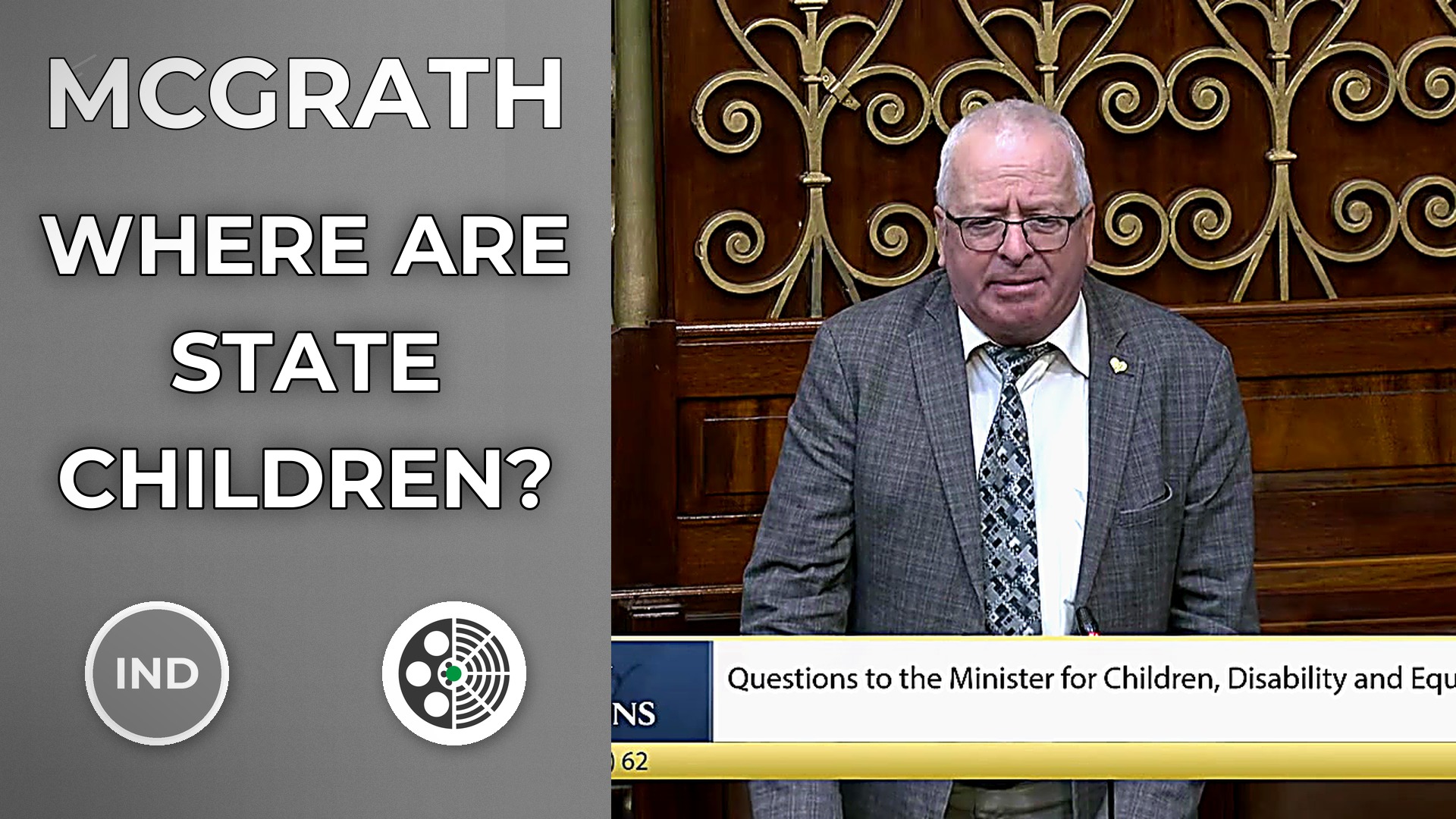
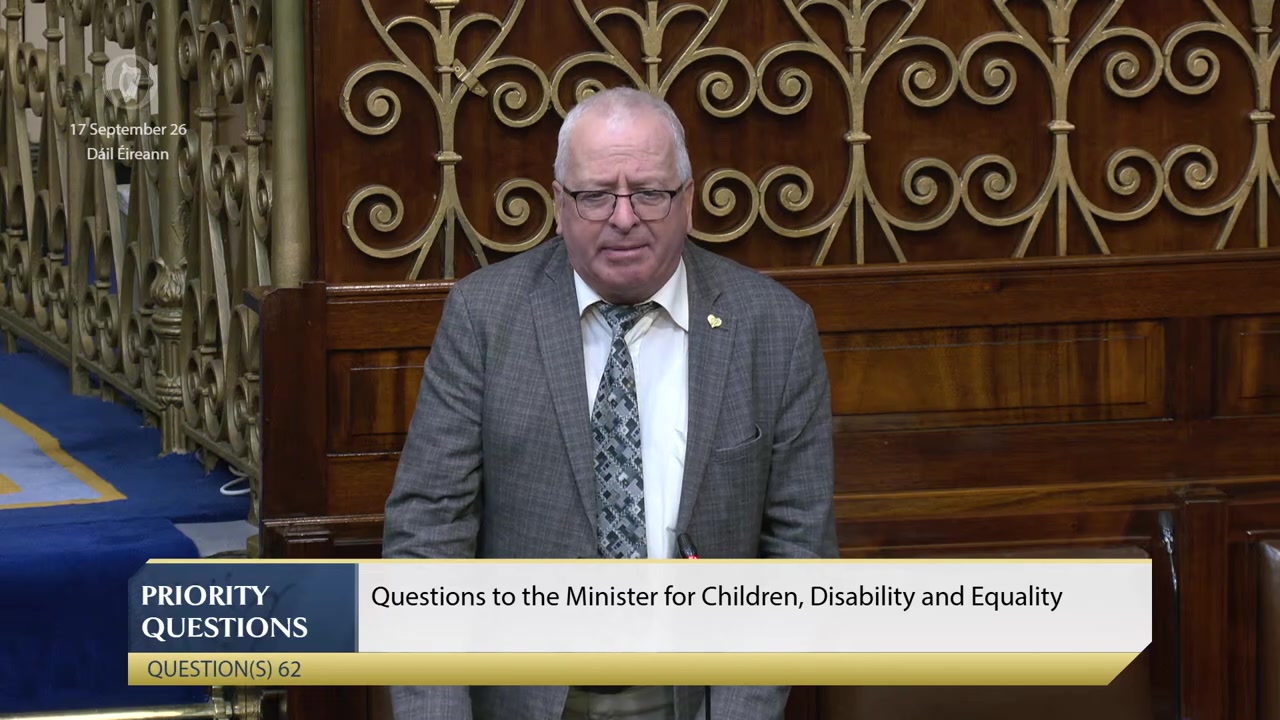
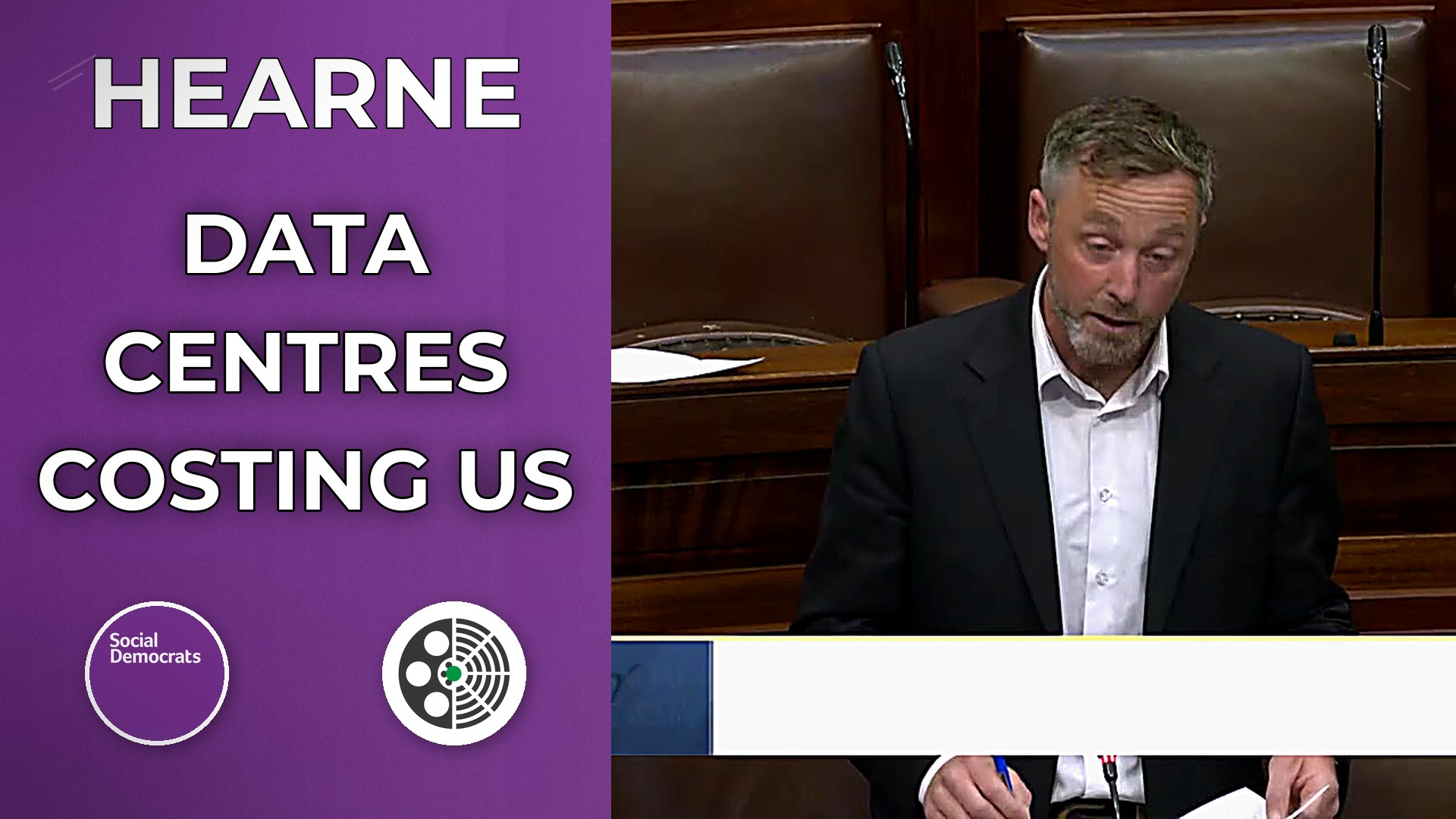
Mattie McGrath: Alarm over missing children in state care
Mattie McGrath questions ministers about rising antisocial behaviour among young people and concerns over children missing from state care. He presses for accountability, better outcome data and clarity about the roles of TUSLA, the Department of Justice, and youth diversion services.
Summary
Mattie McGrath sought a statement on the number of young people displaying disruptive behaviour and the small minority who may enter the criminal justice system. He highlighted the Government youth justice strategy, the role of family support, and the distinction between TUSLA's child protection remit and the Department of Justice's crime prevention responsibilities.
Policy and governance
The Minister outlined the youth justice strategy 2021-27, emphasising family support, early intervention and community-based diversion projects, and noted that detention remains a last resort under the Children Act 2001. Officials from the relevant departments engage through youth justice oversight and governance groups to implement policy.
Data and accountability
Mattie McGrath drew attention to gaps in robust Irish outcome data on the impact of family support on re-offending and raised concerns about accountability in state care. He referenced reported cases and asked whether state agencies, youth services, have sufficient resources and oversight to keep children safe and accounted for.
Services and supports
The Minister noted a range of family supports: parenting programmes overseen, targeted outreach, counselling and therapeutic services, an expansion to 136 family resource centres, 12 area-based childhood (ABC) programmes, 121,000 Child and Family Support Networks, and 27 Children and Youth People’s Service Committees. These measures were presented as the government’s response to prevention and reintegration efforts.
We publish thousands of recordings to make Irish politics transparent and resistant to manipulation. Spotted an error? Report it — together we are building a reliable archive of Irish politics.
There are growing concerns among many parents, guardians, teachers, youth workers, GADD, and indeed many many people across society about the number of young people involved in displaying challenging and disruptive behaviour and some of them going on even to commit crimes and I wonder if you would make a statement on the matter please. Thank you very much Deputy. The Government's youth justice strategy identifies family support, early intervention, and community-based diversion programmes as key components in preventing offending and promoting desistance. Enhanced family engagement through GADD youth diversion projects, TUSLA services and reintegrated planning is regarded as an essential element of effective youth justice practice in Ireland. It's important to note that TUSLA's remit is primarily focused on child protection rather than on the prevention of crime and I think that's important Deputy. The prevention of crime is a matter for the Department of Justice. However, child protection being a matter for TUSLA. TUSLA works hand-in-hand however with Angorda Síochána as both state organisations work together to help children and families who need their combined assistance. Officials from the Department are in regular contact with officials from the Department of Justice, in particular by way of engagement through the youth justice oversight and youth justice governance and strategy groups. These help to implement the youth justice strategy 21-27 which is led by the Minister for Justice, Home Affairs and Migration. Under this strategy the Government committed to strengthening family support interventions including through the Department of Justice youth diversion projects. At the core of the Children Act 2001 is the premise of detention as a last resort. This is a critical factor to understanding the youth justice system. The GADD, the National Youth Diversion Bureau's role is to keep young people who offend out of the formal criminal justice system where appropriate and indeed to reduce the risk of re-offending. Although family support is a central pillar of Irish justice policy, I am advised by my colleague the Minister for Justice, Home Affairs and Migration that there remains a need for more robust Irish outcome data specifically measuring the extent to which family support interventions reduce re-offending among young people. Current policy is informed largely by international evidence and by broader assessments of youth diversion and early intervention programmes. It is important to recognise that the overwhelming majority of children in the care system will never come into contact with an Garda Síochána, let alone be in conflict with the law. I think it is really important to say that. The vast majority of children in care never, ever come to the attention of an Garda Síochána and it would be remiss of us to suggest otherwise. Minister, Deputy Maguire. That is your answer and of course we all want to see that and that is the optimal result. We do not want any children to be involved in antisocial and disruptive behaviour but unfortunately there is. Are you satisfied Minister, you gave a nice flowery answer there about that you are responsible for the welfare of children, not if they are offending. So they are both intrinsically linked. I want to ask you Minister, do you have concerns about the increasing number of young people engaging in persistent antisocial and offending behaviour and what do you intend to do about the situation and the causation of that trend? And also, are you satisfied that two schools, youth services and other state agencies have the resources and supports necessary to intervene effectively and at risk children. We also know that children are missing in state care Minister. A lot of children in the last couple of years are under the care of Toothland Estate and that is an appalling vista. So your answer here is not really that helpful because we need to get to the bottom of this. It is a growing trend and it is worrying. While the vast majority don't and we are delighted that is just great, we need to have accountability here. Thank you very much Deputy. I absolutely appreciate your concern and I think we all share the concern. However, I must also speak to the fact and the fact is that the vast vast majority of children who are under the care of the state never ever come into contact with An Gorda Síochána. In fact, I would say thrive very positively with positive intervention and it is not appropriate to suggest otherwise. I would also say that there is a close working relationship between An Gorda Síochána or between the Department of Justice and indeed my own department looking at it from a child welfare point of view and obviously justice looking at it from a crime prevention point of view. I do want to say also that there are more than 5,000 children in the care of the state. Often some of those children, very very small number of them, come from particularly complex and challenged backgrounds and it is for that reason they are in the care of the state. But that is a very small percentage and in that respect I want to acknowledge the work that is done by Cúisle in terms of family support and I can list to you some of the family supports that are there. So for example there are parenting supports overseen by Cúisle and its partner community and voluntary organisations. So you have parenting supports to help parents feel confident and capable in their parenting role. You have targeted outreach programmes designed to reach specific groups of families who may be at risk of social exclusion and I will continue. Minister, the vast majority, thankfully I agree with you there, but it is the minority that are involved in this behaviour and it is a sad minority that have gone missing in state care under the watch of Cúisle. Your previous minister said he didn't lose a wink of sleep and Pat Roberts, the former chairman of the board of Cúisle, I think Cúisle is wholly unfit for purpose. My goodness gracious accountability is not there. The children could go missing. We saw from the UCD report some time ago where children were being trafficked in hotels in Cork from state care, under state care. This is a shocking vista and you can't just wish it away by saying that the vast majority of children are not involved in anti-social behaviour. No they're not, thankfully. So we all have responsibilities as parents and jurors as well. The ones that fall through the cracks and that do end up in state care, they deserve to be minded, nurtured and indeed rehabilitated and also to be taken care of and above all to have a state knowing where they are. If they are not with their family and they're in state care, where they are, are they accounted for or are they missing or have they been trafficked as other horrible activities like that. It's a shocking situation. Again just to reiterate, I think we are all concerned with any young people who find themselves in difficult situations and I am mindful that they are a percentage of children, not just children in state care. Children who are not in state care, who find themselves involved or find themselves involved in issues of crime or whatever. And that's not just exclusive to the children, and that's not just exclusive to the very small minority who are in state care who find themselves in similar circumstances. Other children outside of state care find themselves in similar situations. And for that reason, there are significant supports being made available from a family point of view to support families, to support young people so that they can readjust their lives. So for example, whether that's counselling and therapeutic supports, whether it's a strengthening of the family resource centres, and indeed you would be aware Deputy that that service has increased by 15 in the last year and a half to 136 family resource centres. There's also services provided through the 12 area based childhood programmes, the ABC programmes, so that parents as the first and most important carers and educators in their children's lives can be supported. There's 121 Thousand Child and Family Support Networks. There's 27 Children and Youth People's Service Committees. There's a number of support agencies working to ensure that children get the best possible opportunities and supports in life.
Thank you for downloading 🙏
If you publish this material on social media, we would be very grateful if you tagged VideoParliament. It helps us reach more people and keep building a transparent archive of Irish politics.