Brian Stanley: Backyard Dwelling Rules Lock Out Rural Homes
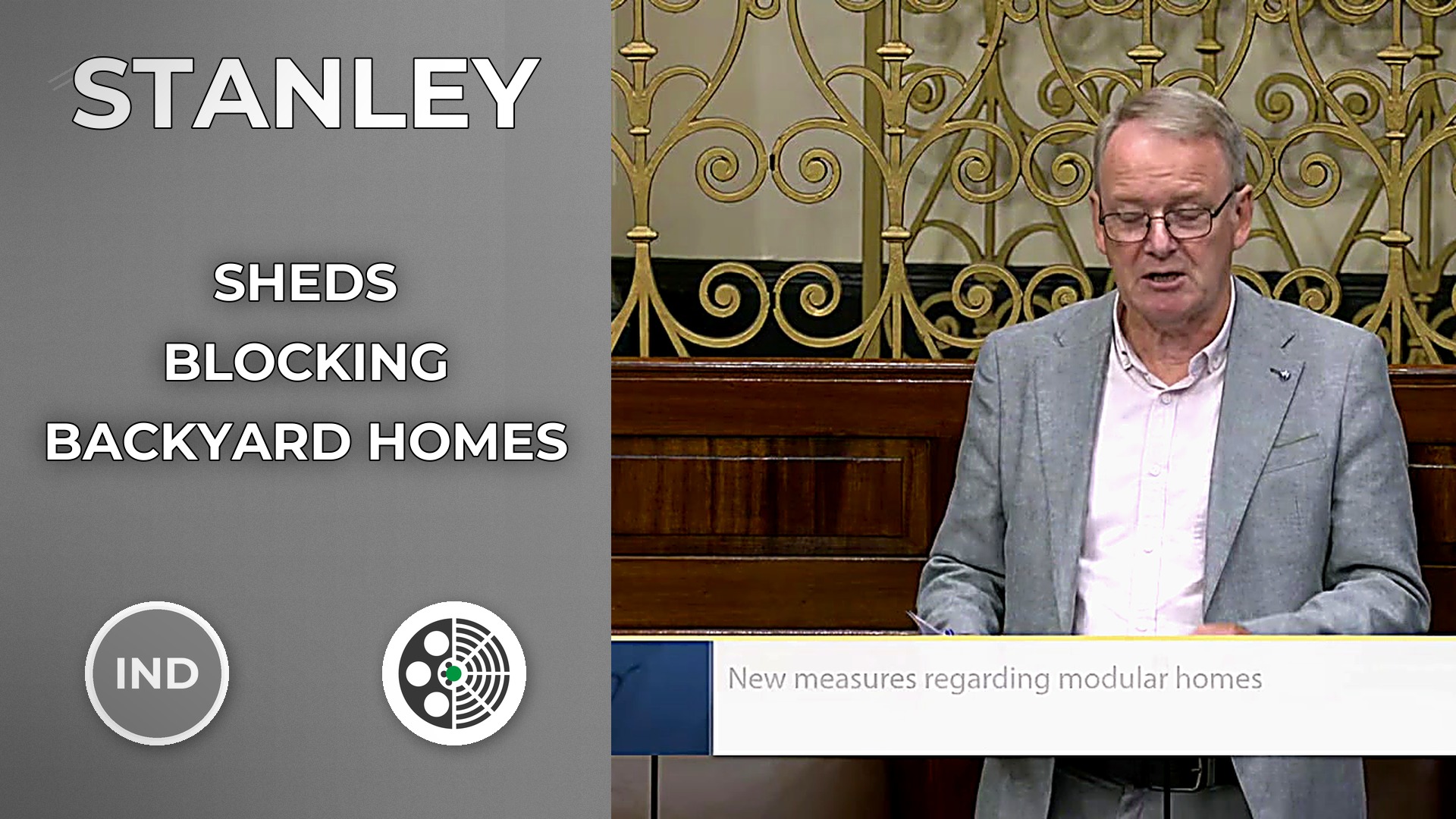
Brian Stanley raised urgent concerns in the Dail about the new Class 3A backyard dwelling regulations signed into law in July 2026. He warned that counting existing sheds and garages against the 45 square metre allowance effectively prevents many rural homeowners from adding an auxiliary dwelling, and he questioned inspection and enforcement arrangements.
What Brian Stanley said
Brian Stanley outlined practical cases from his constituency where a small 14-15 square metre shed or single-car garage uses up the permitted floor area under Class 3A, leaving homeowners unable to meet the 32 square metre minimum for a separate dwelling. He argued that in much of rural Ireland the rules will block uptake rather than enable it.
Shed accounting and site size problems
Deputy Stanley highlighted that the new Statutory Instrument No. 340 of 2026 and the Class 3A exemption allow up to 45 square metres but require a minimum dwelling size of about 32 square metres. Where an existing store, greenhouse or fuel shed is present, that existing floor area is bundled into the limit and can make the new dwelling unworkable even on large sites of 0.6 or 1.4 acres.
Inspection, roads and neighbouring impact
He also raised related concerns about access where previous entrances meet regional or national roads, roof water run-off between properties, and very tight distances in estate gardens. A further issue flagged was that the measure requires only a 14-day notification to planning authorities, with no mandatory local authority site inspection outlined in the guidance.
Ministerial response and next steps
The Ministerial representative confirmed the regulations came into effect on 27 July 2026 and that building regulations and certification requirements apply, and noted guidance and a planning circular were published in late July. The representative said planning authorities will report notifications to the Minister and offered to raise specific technical questions with Minister James Brown. Stanley asked for those specific operational problems to be reconsidered and for clear answers on how existing sheds will be treated.
We publish thousands of recordings to make Irish politics transparent and resistant to manipulation. Spotted an error? Report it — together we are building a reliable archive of Irish politics.
Minister, the issue I'm raising with you regarding backyard dwellings and backyard dwellings, the new regulations that's been announced over the summer period, what I would say at the outset is that look, backyard, the regulations and backyard dwellings may work in a certain number of limited cases, so I'm not going to come in here and knock them, but only in a certain limited number, because there's already issues arising regarding the size of a dwelling, and the main one being is that they're counted as Class 3A buildings, but the size of the, you're allowed to build 45 square metres, but if you have an existing garden shed, small garden shed or garage or greenhouse or such and such or a small store, they're all counted within the 45 square metres, but the dwelling can't be below 32 square metres, 45 square metres gives you enough for one or two people, 32 square metres would be very small, but just say you can even build one at 38, the fact that you have a small shed already is ruling that out, so if there's a small shed on the site, for example 14 square metres, which is a very small garden shed, like you'd have in Leitrim or Saigo or in County Leash or wherever, you can't meet the minimum size of 32 square metres, so it's the shed, greenhouse, store or the dwelling, the way the regulations are, you won't get both, and I'd say there's none going through in your county and there's certainly none going through in Leash at the moment, and this is regardless of the size of the garden or yard or site. I have a case where the owner has 1.4 acres of a site, in fact it's nearly a field, a huge site, but there's already a 15 square metre small fuel shed on it, and the fact that there's a 15 square metre small shed on it means that they can't build, they can't put in a modular dwelling for an elderly relative on that site, so you get what I'm saying to you, you take the 15 metres from the 45, that leaves you with 30, so you can't put anything into it. I have another case where they have 0.6 of an acre, almost two thirds of an acre, but there's a garage on the site, a garage just for a single car, which is common in every rural dwelling around the country, almost every rural dwelling, that can't be done there. So I estimate for 80% of homes and premises in the likes of Leash, or most Leash counties where you have towns and rural areas, it will not work, it will be the shed or the dwelling. A number of other issues are arising, Minister, where you have existing entrances onto regional and national secondary roads, what happens there? Where a house has been given planning permission in previous years, there's an entrance there onto, we say, a national secondary route or a regional road. The issue of water runoff off roofs, this is going to be an issue, where you have neighbouring dwellings. The distance from the next door neighbour, and this will become an issue in more urban areas. I'm living in a housing estate, for example, and if there was a modular building put in the garden each side of me, 0.6 of a metre from the house, that's two foot from my house. That will become an issue. And that needs to be revisited again. And this is the key issue. There's no inspection by the local authority, there's simply a requirement, and it says it here, to notify the minimum of 14 days notice of the local authority. And this is from the memo from the department to the local councils, and I'm quoting this directly. It says, this will provide the basis for each planning authority to report to the Minister for Housing on a regular basis about the uptake of the measure. That's what it's for. It's only to report to the Minister if money is being done. But there's no site assessment, there's nothing being done with these. And there's a number of issues there that need to be sorted out. As I say, I can work for a limited number of dwellings, but there are problems there, and I raise these I'm appealing to you, and to the Senior Minister, to resolve this. Thank you Deputy. Minister. Again, I want to thank you Deputy for raising this matter, and giving me the opportunity to update members of the House on this important measure that was signed into law during the summer recess following the approval of the House of the Oireachtas at the end of the last term. I'm taking this topic issue on behalf of James Brown, TD, Minister of Housing, Local Government, Heritage. You've asked some very technical questions, and I don't have the answers, but I will certainly endeavour to get those answers for you. On the 27th of July 2026, a suite of exempted development regulations came into effect to expand the exemptions available to homeowners to maintain and improve existing residential dwellings. And a central purpose across all the changes that have been introduced is to facilitate the efficient use of residential space through enhancements, expansion or adaption over the different stages of the life cycle, while also lifting a regulatory burden on both the citizen and the planning authorities. The revised exempted development regulations include a new Class 3A, which allows for the construction, erection or placing of the attached house in the rear garden of a principal house, subject to certain conditions and limitations, as set out in Statutory Instrument No. 340 of 2026. It should be noted that planning does not specify the method of construction, and therefore Class 3A is referred to as a detached house in the rear garden of a principal house and not specified as a modular home. I can confirm that all relevant building control legislation shall apply to structures such as building regulations, including fire safety and building control regulations. On 28 July, the Department published guidance on the application of building regulations and building control regulations, highlighting the principal matters, including fire safety, that need to be considered when building an auxiliary dwelling in the rear garden of an existing dwelling house. This material highlighted that the performance requirement of the building regulations for a new dwelling will apply to such structures and confirmed that the key building control procedures that apply include the requirement for certification by appropriate qualified professionals. A planning circular was also issued to the planning authorities at the end of July, with guidance on the expected operation of the measures. Those who wish to utilise the planning exemption must notify the relevant planning authorities at least 14 days before they commence the work on the development, as set out in Condition No. 16 of Class 3A. These regulations also require that the planning authorities will report to the Minister on the notification received regarding the use of Class 3A. This will provide a basis to review the uptake and operation of this measure over time, as it is appropriate for a new measure. You did raise some interesting issues regarding garden sheds. Would they be taken in or not taken into consideration when looking for a new modular development in the back garden? These are areas that I do not have the answers to, but I would certainly be glad to raise them with the Minister on your behalf. Thank you very much. Deputy Stanley. Key issues. To summarise it, it is fairly straightforward. If you take any county outside of De Pale, 80% of houses will have some structure already, such as a garage, a greenhouse, a store or whatever. That is the problem. It is going to be a shed or a cabin or modular development. I know they do not have to be modular. They can be a different type of self-contained structure. As I said, they will work in certain cases and I welcome that, but they are not moving at the moment and there is no-one moving on them because of these problems. The big message I want you to take back to the senior ministers and the senior officials in the department, because this has not been thought through properly, is that the accounting in bundling existing sheds and greenhouses in class 3 structures in with the new 3A1, in other words, what you are doing is you are taking up so much of the 45 square metres that you cannot have the cabin. That is the problem. You cannot have the backyard dwelling. That is one thing that needs to be sorted out. The second thing that needs to be sorted out is the size of the site. You get it. You are from a rural area, so you understand what 1.4 acres is. It is massive. It is a small field. Despite the fact that this dwelling, the existing dwelling on this site that is there a long time, is serviced by town water and town sewerage, they cannot move on it. They cannot put the small modular or backyard cabin on this site for the elderly relative because there is an existing fuel shed, 15 square metres. The 15 square metres leaves them with 30 square metres and the minimum they can be is 32. It is game over for them. That needs to be taken. It is not practical the way it is constructed at the moment. The other issue is that you are saying that will require certification and subject to building regulations, but who is going to inspect it? All they have to do is notify the local authority 14 or 15 days before they are going to put it in there. That is it. That is a problem. Just in housing estates as well, the proximity to existing dwellings in tight housing estates and small backyards, they are the three things. Minister, if you can bring him back to me. Minister. Thank you Deputy for raising the topic on which I am taking behalf of James Brown, Minister for Housing, Local Government and Heritage. With all new legislation, time must be given to allow for the operational implementation of new measures across the 31 planning authorities where any individual has concerns about the use of any exemption, they can engage with the relevant planning authority prior to submitting their notification to use the Class 3A exemption. It is a matter for the planning authorities to investigate any concerns raised on a case-by-case basis and determine if enforcement procedures are required or not, as the case may be. Under section 30 of the Planning and Development Act 2000, the Minister for Housing, Local Government and Heritage shall not exercise any power of control in relation to any particular case with which a planning authority or a commission plan mala is or may be concerned. The Minister specifically prevents from interfering in individual cases, which is the most important to maintain the independence of the planning authority and commission. I know you are not talking about any in particular, but you have come up with some interesting views regarding the existing sheds and the greenhouses that they may be not taking into consideration in the development of these modular homes. Also, the fact is the size of the sites, 1.4 acres, the existing food, and you have also said in housing estates that there may not be enough place. Look, again, it is new legislation. I would say that a lot of the issues you have raised have been teased out, but again I am happy to bring them back to the Minister and discuss them with him. Again, I want to thank you, Deputy, for raising these important issues.
Thank you for downloading 🙏
If you publish this material on social media, we would be very grateful if you tagged VideoParliament. It helps us reach more people and keep building a transparent archive of Irish politics.