




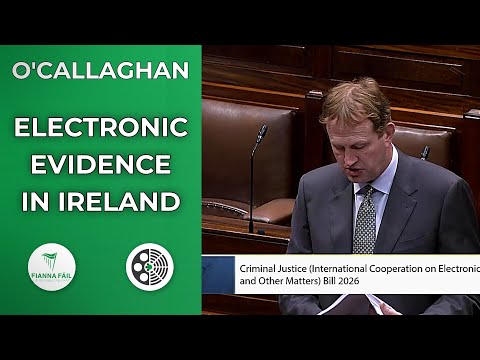
Jim O'Callaghan: Garda Powers Bill - Digital Evidence & Safeguards
Jim O'Callaghan introduces the Garda Powers Bill following its passage through Seanad Éireann, explaining why the legislation is needed now to provide legal certainty for search, stop-and-search, access to electronic devices and custody safeguards. He sets out how the Bill responds to recent Supreme Court and EU judgments and how it balances effective investigation with fundamental rights.
Jim O'Callaghan outlines a targeted Bill to codify Garda powers within a modern statutory framework. The Bill focuses on stop-and-search, search warrants for electronic devices, and strengthened custody safeguards, aiming to place existing powers on a constitutionally secure footing while introducing new procedural protections.
The Minister highlights that electronic devices now feature in almost every serious criminal investigation and explains why clarity is required for seizure, preservation, screening for privilege and forensic examination. Part 3 addresses the Supreme Court's Corcoran finding and establishes a structured, judicially supervised process for privileged material, including strengthened protections for journalistic and other non-legal privileges.
Part 5 modernises the statutory rights of persons in Garda custody, including the right to consult a solicitor, mandatory electronic recording for serious offences, and clear rules on when interviews may proceed in exceptional circumstances. The Bill puts cautions and custody records on a firmer statutory basis to improve transparency and compliance with EU and domestic law.
The Bill is structured in six parts and 41 sections, redefining terms such as electronic device and digital forensic examination, consolidating stop-and-search powers, and setting out new procedures for court authorisation of digital searches. Jim O'Callaghan flags minor technical amendments he will bring at committee stage to ensure coherence and to align existing enactments with the new framework.
Overview
Jim O'Callaghan outlines a targeted Bill to codify Garda powers within a modern statutory framework. The Bill focuses on stop-and-search, search warrants for electronic devices, and strengthened custody safeguards, aiming to place existing powers on a constitutionally secure footing while introducing new procedural protections.
Digital evidence and privilege
The Minister highlights that electronic devices now feature in almost every serious criminal investigation and explains why clarity is required for seizure, preservation, screening for privilege and forensic examination. Part 3 addresses the Supreme Court's Corcoran finding and establishes a structured, judicially supervised process for privileged material, including strengthened protections for journalistic and other non-legal privileges.
Custody and procedural reforms
Part 5 modernises the statutory rights of persons in Garda custody, including the right to consult a solicitor, mandatory electronic recording for serious offences, and clear rules on when interviews may proceed in exceptional circumstances. The Bill puts cautions and custody records on a firmer statutory basis to improve transparency and compliance with EU and domestic law.
Key provisions and next steps
The Bill is structured in six parts and 41 sections, redefining terms such as electronic device and digital forensic examination, consolidating stop-and-search powers, and setting out new procedures for court authorisation of digital searches. Jim O'Callaghan flags minor technical amendments he will bring at committee stage to ensure coherence and to align existing enactments with the new framework.
We publish thousands of recordings to make Irish politics transparent and resistant to manipulation. Spotted an error? Report it — together we are building a reliable archive of Irish politics.
Other speeches





Tego samego dnia All speeches from this day →

Brian Stanley
Brian Stanley: Backyard Dwelling Rules Lock Out Rural Homes

Richard Boyd Barrett
Richard Boyd Barrett: Artists' Boycott a Lesson for Government
Cathy Bennett
Cathy Bennett: Government Must Explain Gutting the Triple Lock

Timmy Dooley
Timmy Dooley: Triple Lock Reform Doesn't Abandon Neutrality

Carol Nolan
Carol Nolan: Defending the Three-Day Safeguard

Richard Boyd Barrett
Richard Boyd Barrett Challenges Reliance on Corporation Tax
Transcript
I'm very pleased to introduce this Bill to the House following its passage through Seanad Éireann. In fact we had five days of debate in Seanad Éireann and I thought during that debate the Bill was very carefully considered and debated there and as a result of the debates a number of amendments were proposed in Seanad that I agreed to and which I'll be bringing forward at committee stage here and I'll discuss them presently. I look forward to hearing the contributions of colleagues as we continue our consideration of this Bill. This is an important and necessary piece of legislation, Cathaoirleach. It responds directly to developments in constitutional, European and human rights law and reflects this Government's commitment to ensuring that Garda powers are exercised within a clear, modern and legally robust statutory framework. Much of the commentary surrounding this Bill has focused on journalistic privilege which the legislation addresses carefully. However the Bill serves a much broader purpose. Electronic devices now feature in almost every serious criminal investigation and the number seized by An Garda Síochána reflects their growing importance. These devices can contain vital evidence and that evidence must not be placed beyond reach because of uncertainty over Garda's lawful access under judicially approved search warrants. In organised crime investigations Garda increasingly encounters sophisticated technology. Recent cases have involved satellite phones, GPS devices, radios and other digital equipment, all of which can be of central importance to coordinating criminal enterprises. Criminals use such technology to conceal and facilitate serious offences and Garda must be able to seize and access the information it contains lawfully, subject of course to appropriate safeguards. Technology is also becoming an increasingly important tool for the Garda itself. Body worn cameras, drones, biometric analysis and other digital technologies can support Garda in preventing and investigating crime. This Bill, Gaeaireach, strengthens the statutory framework governing Garda's digital powers, providing greater clarity around how information and evidence encountered in the course of investigations can be accessed and used. The Bill is not simply about phone messages. It also covers laptops and other digital storage devices that may contain evidence critical to criminal prosecutions, including in cases involving child sexual abuse material. So ensuring lawful and timely access to such evidence is essential to effective criminal investigations. Ultimately, this Bill promotes clarity, fairness and the proper administration of justice. It provides a modern statutory framework for Garda powers and helps ensure that evidence obtained lawfully, under appropriate judicial oversight, can be relied upon in court. It reflects this Government and my commitment to equipping and guarding Gaeaireach to protect the public while fully respecting fundamental rights. The general scheme of the Bill was published in June 2021, Gaeaireach, with the aim of codifying Garda powers, including powers of arrest and detention. Since then, there have been a number of significant Supreme Court decisions, most notably the decisions in Corcoran and indeed Quirk. They have identified deficiencies in the existing law governing search warrants, particularly in relation to electronic devices and privileged material. These judgements highlighted gaps in statutory safeguards and judicial oversight, as well as legal uncertainty for Garda and for individuals whose rights may be affected by the exercise of these powers. With the advice of the Attorney General, the Government decided to expedite those elements of the wider codification project where there was an urgent need for greater legal certainty. This Bill therefore focuses in particular on stop-and-search, access to electronic devices and custody safeguards. At its core, the Bill places Garda powers on a clear statutory footing, with an appropriate judicial oversight and safeguards reflecting the modern reality that evidence is increasingly digital. It does not expand powers without appropriate limits. Instead, it places existing powers on a more constitutionally secure basis and introduces safeguards where none previously existed. This balance is particularly important for digital evidence. Much of the existing law was developed when evidence was physical and relatively easy to identify and separate. Today, a single device may contain vast quantities of highly sensitive information. The Bill recognises this reality by distinguishing between the seizure of a device, the preservation or capture of data, the screening of material for privilege and the forensic examination of digital content. By ensuring that each of these steps is subject to appropriate authorisation and judicial oversight, the Bill introduces clarity where the law was previously uncertain, while maintaining the necessary balance between criminal investigations and the protection of fundamental rights. The Bill must also be understood in the context of wider legal developments. The Supreme Court decisions in Corcoran and Cork, as I said, together with the judgments of the Court of Justice of the European Union, including in Landeck, underscore the need for a transparent, rights-compliant regime for access to digital data, information systems and access codes. It is precisely at the intersection of digital evidence and privileged material that urgent legislative reform is required. The Bill has been drafted with these judgments to the fore, ensuring compliance with both constitutional and EU law, while safeguarding fundamental rights. In that regard, it is instructive to note that in the Supreme Court decision of Corcoran, the Supreme Court stated that the deficiencies identified in section 10 of the Criminal Justice Miscellaneous Provisions Act 1997 required urgent legislative intervention. I want to briefly address concerns raised by journalists and representative bodies regarding Part 3, which implements the Supreme Court's findings in Corcoran. A free press and the protection of journalistic sources are fundamental pillars of our democracy, and these protections have been carefully considered in the drafting of the Bill. Part 3 responds directly to the Supreme Court's finding that the existing framework was deficient in its call for urgent legislative action. It replaces that framework with a clear, structured process centred on independent judicial oversight, where material may be subject to privilege. The Court must be made aware of this, and any determination as to the examination of privileged material is now subject to judicial approval. The Bill therefore strengthens the protection of journalistic privilege, while ensuring that any interference with that privilege is necessary, proportionate, and subject to appropriate safeguards. Protections for journalists sit within a broader framework of safeguards that apply to all search and seizure powers under the Bill. Guard actions are subject to judicial oversight, ensuring that searches, including those involving electronic devices, are lawful, proportionate, and consistent with fundamental rights. Search warrant applications must be grounded in information presented to a district court judge, and the seizure or examination of electronic devices requires appropriate court authorisation. For the first time, the Bill also provides a comprehensive statutory framework for the treatment of privileged material. Legal professional privilege is absolute. Other forms of privilege, including journalistic, public interest, and any sacerdotal privilege, are subject to clear procedures for identification and resolution, either by agreement or judicial determination. The Bill recognises the importance of privacy, due process, and data protection in a democratic society. At the same time, these rights must be balanced with the public interest in the effective investigation and prosecution of serious crime. This Bill strikes that balance by ensuring that GuardE can investigate serious offences effectively, while intrusive powers are exercised only where necessary and proportionate, and subject to independent oversight. I will now turn to the structure of the Bill, which comprises six parts and 41 sections. I will highlight its principal provisions, focusing on parts introducing new or significantly reformed statutory frameworks. Part 1 contains standard preliminary and general provisions, including the short title, commencement and interpretation. It introduces definitions of electronic device and information system to ensure that legislation remains adaptable to technological developments. It also defines terms such as seize, capture, and digital forensic examination, covering processes for examining seized digital data. It also provides for the repeal of existing search warrant powers, replaced by the new standardised framework set out in the Bill. Part 2 provides a consolidated statutory basis for GuardE's stop-and-search powers. Section 9 allows a member to stop and search a person or vehicle where there are reasonable grounds to suspect possession of a relevant article, a term defined in Section 7 to cover unlawfully obtained items, prohibited substances, weapons, and other restricted articles. Section 10 allows vehicle searches where serious offences, including specified terrorist offences, are suspected, and for gathering evidence of those offences. The part sets out clear procedural safeguards. Section 12 requires that persons be informed in accessible language of the reason for the search on a statutory basis, while Section 13 requires a written record of searches and provides a right to a copy of that record. Section 14 confines the use of force to what is reasonably necessary in line with the established legal standards, and Section 15 creates offences relating to obstruction, failure to comply with lawful requirements, or providing false identifying details. Part 3 is a central element of the Bill and establishes a comprehensive and consolidated framework for the application for and execution of search warrants by GuardE. While other statutory bodies will amend their powers separately, this part provides the core template for modern search warrant law. Section 17 provides for applications to a district court judge where there are reasonable grounds to suspect evidence of an indictable offence or a specified summary offence, as listed in Schedule 2, may be found at a place. Where privileged material is suspected, all known information concerning its nature and relevance must be disclosed to the court. Section 18 sets out the powers under a search warrant, including entry, search, seizure, and use of reasonable force. Section 19 regulates the search and examination of electronic devices and information systems. It allows the court to determine the scope of authorisation granted for a device. This may include capturing data for preservation, screening where privileged material is suspected, or a digital forensic examination for investigative purposes. Section 20 provides for the limited and exceptional circumstances in which the court may authorise the forensic examination of material subject to privilege other than legal professional privilege, where this is strictly necessary and proportionate in critical cases. Section 21 strengthens the rights of occupiers of searched premises by requiring that they be informed of the search, shown a copy of the warrant, and provided with a written notice in accessible language. It also establishes a mechanism to ensure this information is provided where the occupier is not present during the search. Sections 22 and 23 allow Gardaí to seize material containing both items they may lawfully take and items they may not if on-site separation is impractical, and establish procedures for its handling, storage, recording and return. Sections 24 and 25 establish a clear process for the determination of privileged material by the High Court, requiring parties to apply within a defined 14-day time frame, while also encouraging consultation and agreement between the parties where possible. Section 26 allows for applications to extend the validity of a warrant where necessary, while Section 27 provides for tightly circumscribed powers to conduct a search without prior judicial authorisation in urgent circumstances. Section 28 creates offences for providing false information, obstruction or non-compliance with lawful requirements. Part 4 provides a statutory framework for accessing electronic devices and information systems lawfully seized under Parts 2 or 3. It ensures that any examination of digital data is subject to judicial authorisation and confined to what is necessary and proportionate, whether following a stop-and-search or a search warrant. This part enables a member of An Gardaí Síochána to apply to a district court judge where there are reasonable grounds to suspect that evidence of an indictable or specified summary offence may be on a device or system. Court authorisations may specify the form of access, including privileged screening or digital forensic examination. The part also contains provisions governing the scope, operation and legal effect of such authorisations, together with related offences. Part 5 introduces a modernised and strengthened framework governing the treatment of persons in Gardaí custody. It gives effect to Directive 2013-48 EU and addresses key recommendations of the Advisory Committee on the Interviewing of Suspects in Gardaí custody. Sections 30 to 33 clarify and consolidate the rights of persons in custody to consult a solicitor and to have a solicitor present during interview. They provide clear statutory definitions, establish the requirement for private consultation, whether in person or by telephone, and place duties on custody officers to explain these rights and the implications of waiver. Section 34 sets out the limited and exceptional circumstances in which a Garda inspector may authorise an interview to proceed before a detained person has exercised their right to consult a solicitor or have one present, for example to prevent harm or the destruction of evidence. Any such authorisation must be documented and formally notified to the person concerned. Section 35 sets out how a person in custody other than a child may waive entitlement or consent to interview without a legal representative and how such decisions are recorded. Solicitors I know play a vital role in making these rights meaningful in practice and I want to see solicitors available to provide timely and independent advice and representation to their clients both in Garda stations and indeed in our courts. Sections 36 and 37 extend these protections with appropriate modifications to all persons in custody and provide for custody records to be maintained electronically. Section 38 introduces mandatory electronic recording of interviews for serious offences listed in Schedule 3 with optional recording for other interviews. This represents a significant modernisation reducing reliance on handwritten notes and enhancing transparency, accuracy and efficiency. Part 6 contains miscellaneous but important provisions. Section 39 places the obligation to administer a caution on a clear statutory footing, setting out when a caution must be given, including on arrest, prior to interview or on charging a person. It requires that the caution be administered strictly in its prescribed form, while clarifying that statements made before caution can be given, remain admissible, provided the caution is administered as soon as possible thereafter. Section 40 amends Section 9 of the Criminal Justice Act 1976 to apply explicitly that provision to misconduct by members of an Garda sheer Connacht, thereby supporting accountability and ensuring legislative clarity. Section 41 amends Section 50 of the Criminal Justice Act 2007 by revising its wording and expanding the list of offences to which it applies. I want to briefly flag a couple of matters I intend to bring forward at committee stage. To ensure coherence and avoid duplication, amendments will be required to repeal existing search warrant provisions across various enactments, fully aligning them with the new framework of this Bill. Arising from the debate and the shenanigan contributions from Senators, I am proposing an amendment to Section 8 to ensure that the power to require provision of information can only be exercised in a public place or where a member is lawfully present. Two further technical amendments are proposed to Section 11 subsection 4 to remove possible duplication with Section 15 covering offences and the addition of place to the details to be recorded in a record of a search under Section 13. Additional amendments may be required to the custody provisions in Part 5, including but not limited to notification to consular activity, and depending on the outcome of the pending Davis appeal on the statutory interpretation of the term accompanied by when executing a search warrant. Additional technical amendments may follow, including finalising the schedules of offences and clarifying the recording and management of materials seized under search warrants. These measures will ensure the legislation operates effectively in practice. All amendments are subject to further drafting consideration. This Bill represents a targeted and expedited phase of the broader Garda Powers reform project, focusing on areas where urgent constitutional and legal clarity is required, particularly search, stop and search, access to electronic devices and custody safeguards. Other elements of the project, including reforms relating to arrest and detention, will be progressed separately in due course. I also want to emphasise the practical importance of this legislation. Gardaí now routinely handle investigations involving multiple electronic devices, vast quantities of digital data and complex issues of privilege and access. Without a clear statutory framework this creates uncertainty for Gardaí, for the courts and for individuals whose rights are engaged. This Bill provides clarity, it provides certainty, it provides safeguards and it ensures that evidence scattered in good faith under judicial supervision can withstand constitutional scrutiny. I am friendly of the view that the powers provided for in this Bill are proportionate to the challenges faced by an Gardaí síochána and that the safeguards contained within it reflect the values of our constitutional order. Therefore, I commend the Bill to the House and I look forward to hearing what colleagues have to say in respect of the proposed legislation.