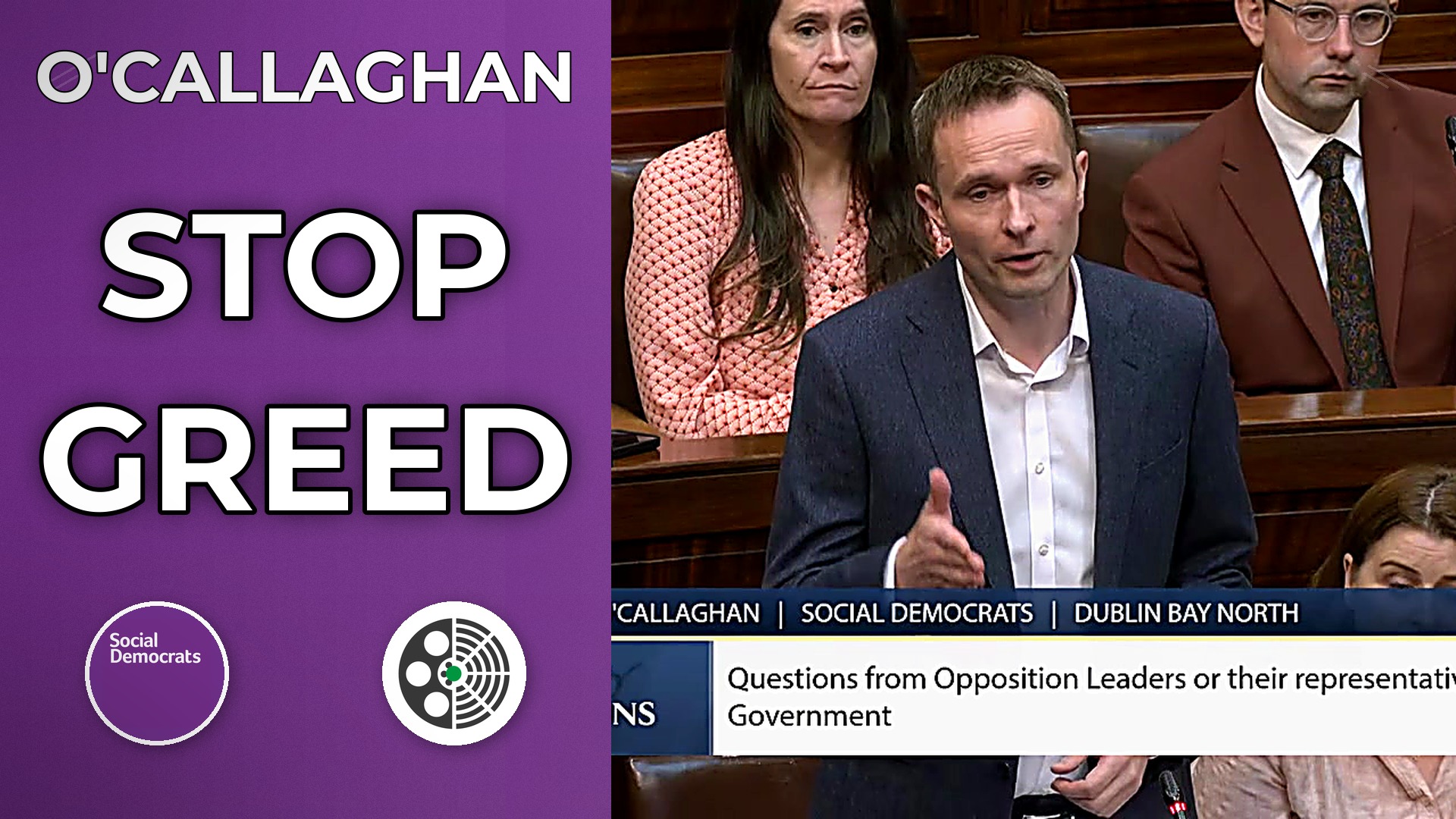
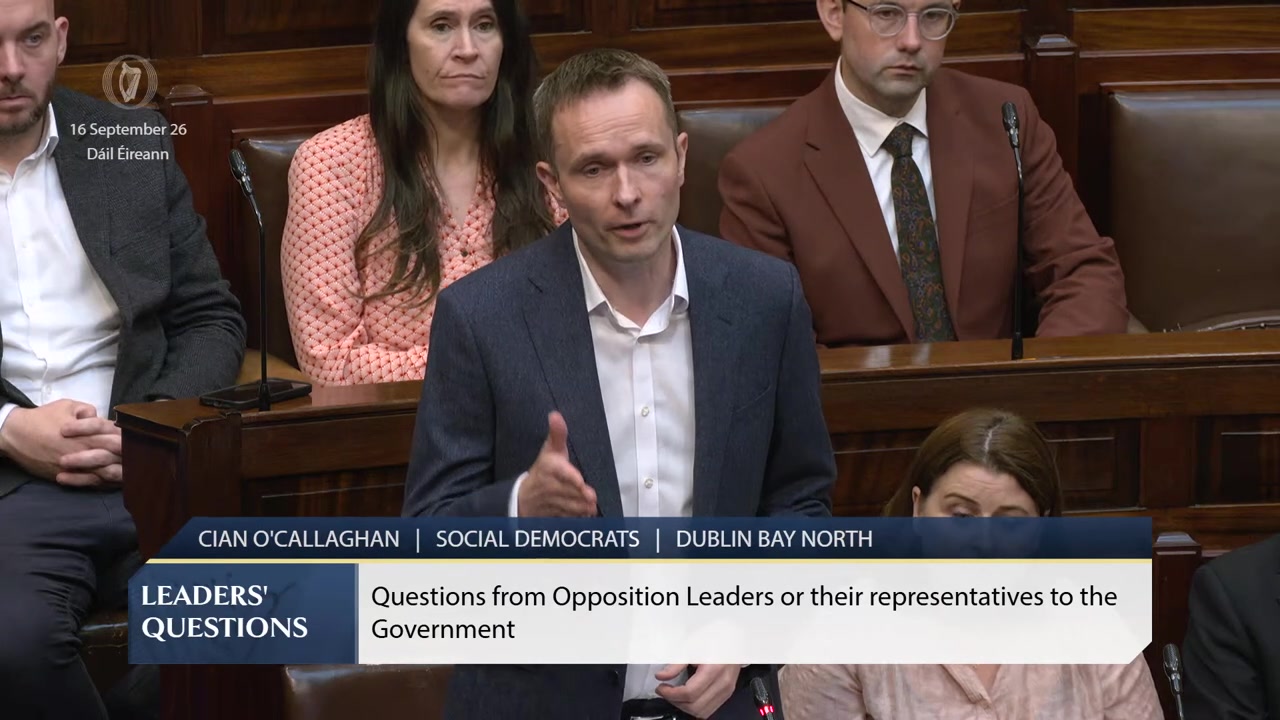
Cian O'Callaghan demands windfall tax as bills soar
Cian O'Callaghan questioned the Taoiseach today about surging energy bills and pressed for a windfall tax on energy companies to relieve households. He pointed to recent price hikes and large profits at ESB as evidence that ordinary families are shouldering an unfair burden.
Key exchange: In parliament O'Callaghan confronted the Taoiseach with direct questions about the morality of record profits in the sector and whether the government will introduce a windfall tax. He argued that eight energy companies increased prices recently and that those rises will add hundreds of euro to household bills already among the highest in Europe.
Profit figures and executive pay: O'Callaghan cited ESB's half-year results, noting profits were up nearly 100 million euro and that the CEO faces a potential 51% salary increase. He contrasted corporate gains with pensioners left cold and urged a tax on excess profits to force price reductions.
Government response: The Taoiseach replied that the energy crisis is driven by international conflict and global market pressures, outlined around 1.4 billion euro of government measures so far, and said a previous windfall tax raised roughly 200 million euro but did not reduce prices. He said taxation measures remain under review and emphasized targeted supports in the coming budget.
Implications and next steps: O'Callaghan pressed for an immediate answer on whether the government will act now to introduce a windfall tax to lower bills directly. The exchange frames the debate ahead of the budget on how to balance revenue, supply-side risks and urgent support for struggling households.
We publish thousands of recordings to make Irish politics transparent and resistant to manipulation. Spotted an error? Report it — together we are building a reliable archive of Irish politics.
Hello, I would like to make a few comments about the current situation. As you know, there are a lot of people all over Ireland who are struggling with the current situation in this country. It is difficult to say whether Éireann should be removed or the solution should be found. Taoiseach, eight energy companies have put up their prices in recent weeks. These increases will add hundreds of euro to people's energy bills. Bills that are already the highest in Europe. We all know that Donald Trump and his disastrous war are to blame for rising prices. But Taoiseach, there are things that you can do. Why is it that Irish households are expected to shoulder the entire burden of these skyrocketing costs? Especially when the profits of energy companies are booming. They have never been healthier. Just yesterday, the ESB announced its profits for the first six months of the year. They are up nearly 100 million euro. Today we learned that their CEO is in line for a salary boost of a staggering 161,000 euro. An increase of 51%. Energy companies are making enormous profits while pensioners go cold. Taoiseach, instead of allowing this blatant and scandalous profiteering, you could introduce a windfall tax on their excess profits. You could take a stand. Tell energy companies that the burden of paying for these costs will not be borne by Irish households. That the people of this country who are already paying the highest electricity prices in Europe will not be bled dry. A windfall tax would push energy companies into reducing prices by threatening to take their entire excess profits. This would directly help households that are really struggling. Taoiseach, my questions today are very straightforward. I would appreciate a straightforward answer. Do you agree that it is immoral for these companies to be making such eye-watering profits? And will you introduce a windfall tax on their excess profits? First of all, in terms of the energy crisis, fundamentally it is a global, external situation in terms of war in the Middle East, and particularly the war in Iran, and now the situation in Yemen with the Houthis gaining control of key ports and potentially a key waterway. And it's compounding what happened in respect of the Ukraine crisis and the massive increase in inflation and energy prices that arose from that. And in the first instance, the scale of the government's response has been very, very significant. About 1.4 billion to date. No windfall tax will come near that. So let's be very clear and straight about that. I think our last windfall tax that was introduced during the Ukrainian crisis might have brought in about 200-plus million. I can get the precise figure for you. And that's not without implications as well across the sector. And there are a number of factors that we have to take on board in respect of that. The budget and the measures we've taken are targeted, have been targeted, particularly at low-income groups. And even the measures taken in respect of diesel and petrol, if the Parliamentary Budget Office in its review will say that they were proportionally better for lower-income groups in our society. And you add to that, of course, the changes we made in the fuel allowance, the child support payments, which were record increases in the last budget. And furthermore, in terms of the expansion of the free fuel allowance itself in terms of the numbers of people who have benefited from it. Now in the forthcoming budget, and of course we have energy supports through the Minister O'Brien, which have hit about 640,000 families now in terms of getting their prices down long-term because of installation of solar or various other retrofitting that has been quite impactful. And there'll be more on that front. In the forthcoming budget, cost of living will be the central focus of government, particularly in terms of both the income tax system, in terms of reducing the tax burden on people, in terms of the home heating situation. In terms of, again, further supports for energy efficiency measures and retrofitting and so on like that. We'll keep all taxation measures under review. And I do accept that in times of crisis, the supply chain, be it wholesale, retail, can inflate or there can be supply or price increases that are more the responsibility of the supply chain than the actual crisis itself. And there's been some work done on that in the UK. So our focus now, coming into the budget, is to have a range of supports to try and protect people. We'll also look at childcare. We'll also look at disability sector in terms of easing the burden. But I do think it has to be targeted and it has to be focused on those who are enduring the most in respect of what undoubtedly is a very significant hike in energy prices more generally. Thank you Taoiseach. Excuse me, I was distracted. Deputy O'Callaghan, excuse me. Taoiseach, firstly, the vast majority of what this government has done has not been targeted. You're kidding yourself if you think that. Secondly, I asked you two very straightforward questions. I asked you to give your view. Do you think it's immoral for energy companies to be booking record profits, windfall profits, off the backs of people who are struggling with the energy crisis? Do you think that's immoral? Do you have any view on it? Do you have anything to say about that Taoiseach? It's a straightforward question. And then secondly, keeping things under review is no good. Households are struggling now. We've put forward a proposal here for a windfall tax. The aim of the tax is actually to reduce energy bills because companies could no longer pocket and keep excess profits under this proposal. That would create an incentive for them to actually reduce energy prices and bring down people's bills directly. It's a very straightforward proposal. It can be done. It should be done. It's been done before. Will you do that? Will you take action as quickly as possible to reduce people's energy bills by introducing a windfall tax? Two very straightforward questions Taoiseach. Of course, it's immoral to exploit any emergency such as we're experiencing right now. Absolutely immoral for any part of the supply chain, be it wholesaler, retailers, anybody that would exploit the crisis internationally to extract more from people. In respect to – sorry, please, would you take it handy? There's no evidence in terms of putting on a windfall tax that it would reduce any prices. We did it in the last crisis. It didn't reduce. However, its merit is in bringing some revenue back into the government in terms of any windfall gains that were made. There are some specific, but it doesn't have wide prevalence in terms of who you could hit in this country. We're not blessed with massive oil energy companies as such, but also we have issues around refining and so on, which we have to be careful about, frankly, in terms of the supply side. It's easy to come up with simplistic sort of things, and I accept we did a windfall tax last time. I think it was 200-plus revenue came in. That didn't bring down prices, but at least it gave the government some revenue back. We're keeping it out under review, and it's not something that's ruled in our favour.
Thank you for downloading 🙏
If you publish this material on social media, we would be very grateful if you tagged VideoParliament. It helps us reach more people and keep building a transparent archive of Irish politics.