

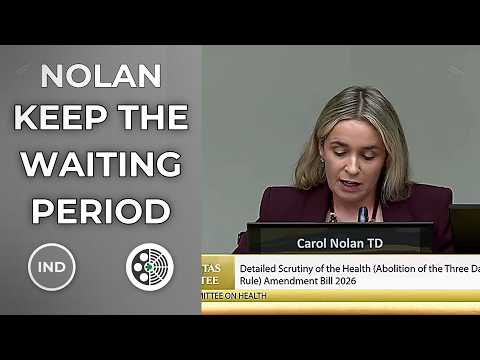


Carol Nolan: Defending the Three-Day Safeguard
Carol Nolan challenges proposals to remove the statutory three-day waiting period for abortion pills in a Dail address this morning, arguing it is a minimal safeguard for unborn life and for women who later change their minds. She cites parliamentary figures showing 10,534 women between 2019 and 2024 who did not return for a second appointment and questions the evidence being relied on to justify removing the mandated reflection period.
Carol Nolan sets out her central claim: a three-day reflection period is a minimal but vital safeguard for unborn life and for women who may be traumatised or confused when they first learn they are pregnant. She describes proposals to discard that safeguard as shocking and unacceptable.
Nolan references her parliamentary question response showing 10,534 women did not return for a second appointment between 2019 and 2024, which she says indicates many women changed their minds and benefited from time to reflect.
She questions the ICGP's comparison of abortion to other general practice procedures, asking whether any GP procedure intentionally ends a human life and whether mandatory waiting periods are applied elsewhere in general practice.
Nolan disputes relying solely on WHO and UNPAC publications without speaking to the Irish women who say they are glad they did not proceed. She argues the international evidence does not capture those voices and calls that omission flawed and biased.
Nolan urges that the reflection period must be maintained if amendments proceed, or at minimum individualised so each woman can make a considered decision after reflection and access to non-directed counselling.
Core argument
Carol Nolan sets out her central claim: a three-day reflection period is a minimal but vital safeguard for unborn life and for women who may be traumatised or confused when they first learn they are pregnant. She describes proposals to discard that safeguard as shocking and unacceptable.
Statistical evidence
Nolan references her parliamentary question response showing 10,534 women did not return for a second appointment between 2019 and 2024, which she says indicates many women changed their minds and benefited from time to reflect.
Questions for the ICGP
She questions the ICGP's comparison of abortion to other general practice procedures, asking whether any GP procedure intentionally ends a human life and whether mandatory waiting periods are applied elsewhere in general practice.
Assessment of published studies
Nolan disputes relying solely on WHO and UNPAC publications without speaking to the Irish women who say they are glad they did not proceed. She argues the international evidence does not capture those voices and calls that omission flawed and biased.
Policy implications
Nolan urges that the reflection period must be maintained if amendments proceed, or at minimum individualised so each woman can make a considered decision after reflection and access to non-directed counselling.
We publish thousands of recordings to make Irish politics transparent and resistant to manipulation. Spotted an error? Report it — together we are building a reliable archive of Irish politics.
Other speeches
Tego samego dnia All speeches from this day →
Charles Ward
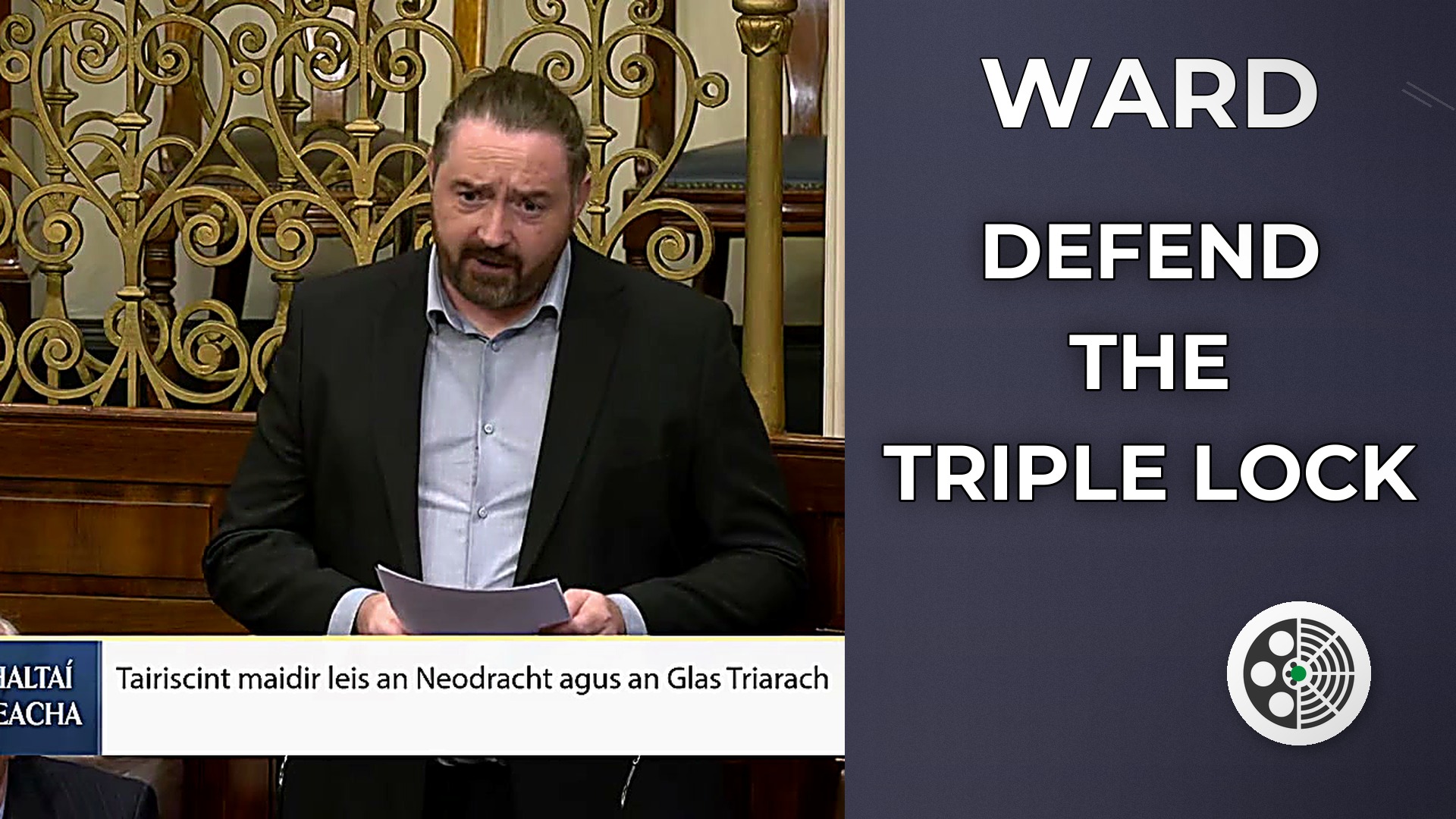
Charles Ward: Defend Irish Neutrality, Save the Triple Lock
Verona Murphy
Verona Murphy: Call for Respect and Safety in Leinster House
Luke Ming Flanagan
Luke Ming Flanagan criticises government over ACRES scheme

Richard Boyd Barrett
Richard Boyd Barrett Challenges Reliance on Corporation Tax
Sinéad Gibney
Sinéad Gibney: Government is 'muddying the waters' on neutrality

Richard Boyd Barrett
Richard Boyd Barrett: Demands Raise to Social Housing Thresholds
Transcript
I'm delighted to get the opportunity to speak here this morning. As a pro-life politician, I'm particularly appalled by attempts to take away a minimal safeguard for the protection of life, and obviously destruction of life, but destroying another woman's life also possibly in the process. I mean, the majority of people wanted this minimal safeguard kept when it came to the referendum, and now that seems to be discarded and we're going on a different path. So it is quite shocking and unbelievable that we're at this point, and you know, even the majority of people in Amoric research that was carried out, they clearly expressed their opinion for the retention of this minimal safeguard for unborn life. I mean, unborn life is precious, and to think that an unborn baby, a vulnerable life, hangs in the balance, and that we're even discussing this this morning is particularly sickening, I feel. I just want to ask a few questions, if I may. The ICGP is on record as saying it does not know of any other procedure in general practice that is subject to the mandatory waiting period. Without getting into the broader debate about abortion itself, could that be because there are no comparable procedures in general practice in which human life is directly and intentionally ended? Can you identify another procedure carried out in general practice where the intention of the procedure is to end a human life? My second question then is as follows. I know from both women and those who have contacted me about the number, you know, that don't attend their second abortion appointment, and I got the figures in my parliamentary question response that between 2019 and 2024 there were 10,534 women who did not return for a second appointment, and you know, that clearly shows that they subsequently changed their minds, and you know, I believe the majority of them do, and that they are very grateful that they had time to reconsider the decision, and that really supports the rationale for keeping this minimal, minimal safeguard in place. Does the ICGP not see particular value, therefore, in ensuring that every woman has a period of time between her first consultation and the taking of the first abortion pill to reflect on such a significant and irreversible decision? Without the three-day waiting period, a woman who has just discovered that she is pregnant could potentially access abortion pills within minutes, and that is completely, you know, I think completely wrong, particularly in a case where a woman is confused and probably, you know, most likely traumatised, and those three days waiting, I mean, it's only three days. Surely the experiences of women we encounter and the women who tell us how important and how vital and how precious it is to retain this, including those who change their mind, as I say, during the waiting period, surely they raise very significant and legitimate concerns that removing this opportunity for reflection does not serve women's best interests in the long term. So I'd just like to say that, as we said in our opening statement, and it was, I suppose, our first point in consideration of the implications of the proposed amendment is that the importance of a reflection period should not be diminished by and must be maintained if the proposed amendment is passed, but what the amendment would allow for, if passed, is for that period of time to not be mandated in law, but to be individualised according to a woman's needs and her stage of decision making so that she can make a considered decision after a period of reflection and after possibly accessing non-directed counselling. Can I just come in there? The majority of people who voted in the referendum didn't look for this. That's what it should come back to. They did not seek any amendment here to current legislation. We voted the way we did in the 2018 referendum and nobody looked for that. In fact, there were assurances given that there would be no change to legislation. So why are we even discussing this here today? It's just not acceptable. We were just asked to bring the evidence about what change that would make and the practical considerations for general practice if the law changed. So that was what our proposal, our evidence was to support today, just that our finding is that the international evidence doesn't support a mandatory three-day wait or a mandatory waiting period for termination and just some of the practical considerations for healthcare delivery in the community if the law were to change. But your evidence doesn't also capture the women who are glad that it didn't go ahead with the abortion. As Deputy Tobin and Senator Sarah O'Reilly pointed out, it does not capture those voices. So it's flawed and it's biased. It should be scrapped. Whatever sample you're using there along with this amendment should be scrapped immediately. It's published evidence by the WHO, which is international, and then the UNPAC study within Ireland captures the evidence within the Irish context. Within the Irish context, you haven't spoken to women. You haven't spoken to those women who decided not to go ahead. We're presenting the published evidence. The women that I speak to, that Deputy Tobin and Deputy O'Reilly speak to, that are glad that it's there, we represent them, those voices. Those are Irish women. So you haven't done that. So how can you just say that everything is correct just because the WHO attached its name to it? It's quite frightening, actually. It's unbelievable.