

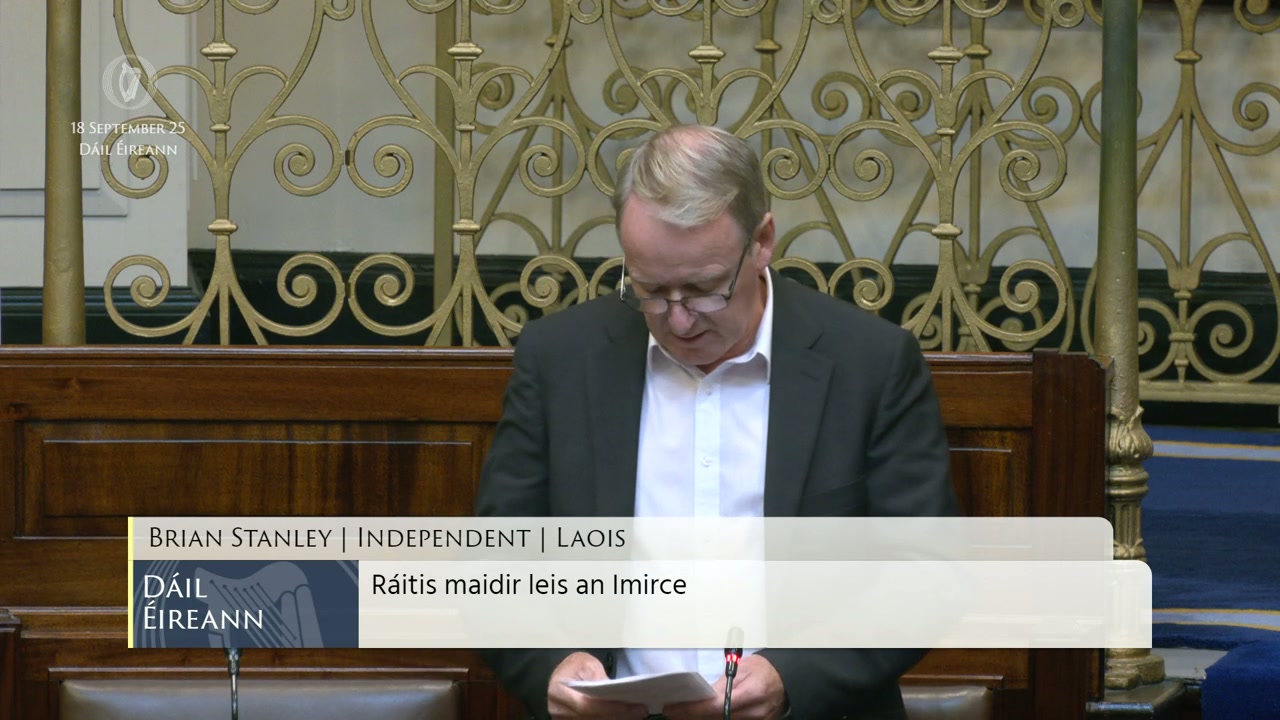


Brian Stanley urges faster asylum decisions and rejects racist attacks
Brian Stanley condemned attacks on the Indian community and called for a fair, rules-based immigration and asylum system. He urged faster asylum assessments, verified departures for failed applicants, better supports for those granted protection, and an end to substandard reception accommodation.
He welcomed the opportunity to speak and rejected racist attacks on the Indian community, noting he has many Indian neighbours in his housing estate who work in the health services. He said those people do great work, are very good people, and that racism directly against them must be countered.
He described the current system as chaotic and inadequate, citing figures that four out of five applicants failed their first assessment in the first part of the year. He warned that the 20 per cent who pass first assessment are not getting needed assistance because resources are lacking, and highlighted that people can languish in direct revision centres for many years, citing a case of 15 years given to him by the Secretary General at the Public Accounts Committee.
He argued assessments should be completed in three or four months rather than three or four years, and that appeals should be concluded in shorter timeframes regardless of outcome. He said that if an application and appeals fail, the person must leave the State and their departure must be verified, criticising the current practice described to him of merely sending a letter to the last known address.
He said those granted international protection must be assisted with training, work and other supports to help integration, and that racism must be countered beginning in schools with parental responsibility noted. He called for implementation of the day report recommendations to create a smaller number of larger reception centres and quicker transitions for applicants.
He criticised the use of old pubs, converted shops and substandard accommodation to house applicants and warned this is becoming big business. He urged the minister to move away from that model and provide better, faster, fairer reception arrangements.
Racist attacks and community
He welcomed the opportunity to speak and rejected racist attacks on the Indian community, noting he has many Indian neighbours in his housing estate who work in the health services. He said those people do great work, are very good people, and that racism directly against them must be countered.
Assessment outcomes and backlog
He described the current system as chaotic and inadequate, citing figures that four out of five applicants failed their first assessment in the first part of the year. He warned that the 20 per cent who pass first assessment are not getting needed assistance because resources are lacking, and highlighted that people can languish in direct revision centres for many years, citing a case of 15 years given to him by the Secretary General at the Public Accounts Committee.
Timing, appeals and departures
He argued assessments should be completed in three or four months rather than three or four years, and that appeals should be concluded in shorter timeframes regardless of outcome. He said that if an application and appeals fail, the person must leave the State and their departure must be verified, criticising the current practice described to him of merely sending a letter to the last known address.
Support and integration for protected persons
He said those granted international protection must be assisted with training, work and other supports to help integration, and that racism must be countered beginning in schools with parental responsibility noted. He called for implementation of the day report recommendations to create a smaller number of larger reception centres and quicker transitions for applicants.
Reception accommodation and commercial provision
He criticised the use of old pubs, converted shops and substandard accommodation to house applicants and warned this is becoming big business. He urged the minister to move away from that model and provide better, faster, fairer reception arrangements.
We publish thousands of recordings to make Irish politics transparent and resistant to manipulation. Spotted an error? Report it — together we are building a reliable archive of Irish politics.
Other speeches

Tego samego dnia All speeches from this day →
George Lawlor
George Lawlor Urges Free Travel for Under-Nine on Commercial Buses
Richard O'Donoghue
Richard O'Donoghue presses for clarity on windfarm health guidelines
George Lawlor
George Lawlor: Calls for tougher action on anti-social behaviour

Michael Fitzmaurice
Michael Fitzmaurice – Private Members Business (18.09.25)
Paul Murphy
Paul Murphy proposes removing UN mandate from deployment law
Transcript
I welcome the opportunity to speak on this important issue and I want to first of all say that the attacks on the Indian community, I have many Indian neighbours living in the housing state where I live, most of them are working in the health services and they are doing great work and they are very good people and we need to counter this racist attacks on them. We need a fair and efficient and rules-based immigration system. The current system is chaotic and inadequate. Those who are genuinely fleeing more persecution or famine must be granted protection. Racism directly against them must be rejected. Those who do not meet the criteria for international protection, as you said yourself, have to leave. According to figures you gave, four out of five applicants in the first part of this year were failing their first assessment. That means that changes are required to the system. It also means that the 20 per cent who passed the first assessment are not getting the assistance they need, because the resources are not there for that. It is clear that the list of so-called safe countries needs to be expanded, and I mean this in a fair way, because there are more than 11 safe countries in the world. Those who are coming from safe countries, as we know it, are more than likely to be granted international protection. Assessments need to be quicker, to be fair to the applicants, they need to be done in three or four months, not three or four years. And appeals in cases that fail need to be done in a shorter timeframe. But in any case, successful or fail, they need to be a shorter timeframe. People should not languish for years in direct revision centres. At the Public Accounts Committee, when I was sharing it, I was told by the Secretary General that one person was in it for 15 years. Now what is that about? If a person's application and appeals fail, they have to leave the State. Their departure must be verified. And that is not happening, Minister. Because the Secretary General told me at the Public Accounts Committee, when I asked him the question, how does that happen? He said to get, and this is what he said to me, to get a letter to their last known address. That is it. He told me that there last year, it is on the record at the Public Accounts Committee. And if that is the system, that is not a system that is working. Those who are granted international protection must be assisted in every way possible. And this, I believe, is key. We have to help these people to integrate and live here, you know, with training, with work, with other supports as well, to make sure that those who are genuinely fleeing war, persecution or famine, you know, are assisted in every way possible. Racism must be countered, and that has to start in the schools. You know, parents have an obligation here as well. The day report recommendations need to be implemented to have a smaller number of large reception centres, and that people are transitioning quick. So what we have instead is we have applicants living in old pubs, converted shops, substandard accommodation and conclude wait. This is becoming big business, and we must move away from this Minister.